
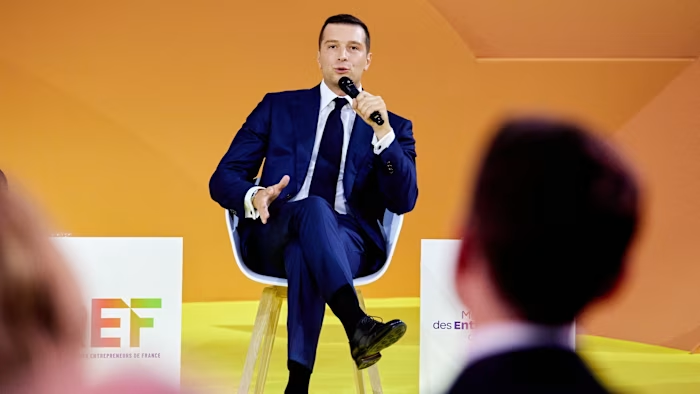
France’s far-right leaders Jordan Bardella and Marine Le Pen are courting business leaders and international investors keen to prepare for the possibility that Rassemblement National may come to power.
Leading figures at Cac 40 companies have stepped up their engagement with RN — a link once considered taboo — with one senior board member describing it as a “duty” to influence a political force that is leading in opinion polls. At business lunches in Paris, the party is now taken far more seriously by a business class keen to steer it towards a more liberal economic platform.
“They are a political force that matters in France,” Guillaume Faury, chief executive of Airbus, told France Inter radio station in December. “It’s not us who chooses the parties that are powerful and have influence.”
The senior board member said the party was “legitimate”, citing its leading role in several parliamentary committees. “Whether you like them or not, it’s worth engaging to ensure they make some sense,” they added, arguing that “the RN is totally inconsistent” on economics.
 Guillaume Faury, chief executive of Airbus: ‘They are a political force that matters in France’ © Matthieu Rondel/Bloomberg
The outreach comes as Bardella has emerged as France’s most popular politician. With his mentor Marine Le Pen currently ruled ineligible to stand in the 2027 presidential election over her conviction for embezzling EU funds — which she is appealing — an Odoxa poll in November showed for the first time that Bardella would defeat any challenger in a second-round vote.
Were snap parliamentary elections to be held again, the RN would obtain the largest vote share, recent polls have shown. France has had a succession of fragile governments since President Emmanuel Macron called an early legislative vote in 2024, in which RN recorded its strongest result to date.
Bardella has also been building his international profile, recently travelling to London for a lunch with Reform party leader Nigel Farage. At home, Bardella is heavily promoting his new book, What the French People Want, with well-attended signings across France — although one recent event was disrupted when an attendee smashed an egg on the far-right politician’s head.
In December, Bardella met a group of UK hedge fund investors and asset managers in Paris, in a meeting not previously reported that included representatives of T Rowe Price, Rokos Capital, Man Group and M&G Investments, according to an attendee list seen by the Financial Times.
Investors discussed the RN’s economic programme in exchanges aimed at reassuring holders of French assets and debt about the party’s stance on the economy, said a person familiar with the meeting, which was part of a broader day of talks with French politicians.
 Bardella visited the UK recently, where he had lunch with Reform party leader Nigel Farage © Jordan Bardella/X
A spokesperson for the RN confirmed the meetings took place but declined to comment further. M&G, Rokos, Man Group and T Rowe Price declined to comment.
The RN’s allies in the business world include François Durvye, chief executive at the Paris investment fund Otium Capital, who has brokered meetings between Le Pen, Bardella and business leaders since 2021.
He told the FT he was motivated by a “conviction that there had been too few exchanges between this political family and the economic world”, adding: “For these two groups to understand each other, they needed to meet.”
Durvye said a recent wave of “realistic” businesspeople were seeking to better understand the party as the likelihood of RN coming to power increases. Many Cac 40 bosses have now met the party’s leadership, he added.
During those meetings, Durvye said, Le Pen and Bardella have sought to understand concerns in business leaders’ sectors and reassure them that the party’s programme is not “anti-liberal”.
But several business leaders said they remained unconvinced. Some of the RN’s proposed policies — including sharply reducing France’s contributions to the EU budget, unravelling Macron’s pension reforms and levying taxes on share buybacks — are seen as at odds with the interests of big business.
The party’s electoral strongholds include poorer areas such as Pas-de-Calais in the north, where Le Pen’s constituency lies — a former left-leaning region whose voters have shifted towards the party’s anti-immigration and law-and-order message.
“They have a real decision to make: what’s the best way to get votes? Seduce business or lose the more traditional voters on the left: that’s their dilemma,” the senior board member said.
Airbus CEO Faury said: “When we have a party that has a level of representation like the National Front has today then yes, we speak to them.”
Although he used the former name of the party founded by Jean-Marie Le Pen, the remark underlined how far his daughter Marine has succeeded in normalising the movement.
In 2015 she expelled her father, who had described the Holocaust gas chambers as a mere “detail” of history and was convicted of hate speech and discrimination.
While business and the larger political world treated Jean-Marie Le Pen and the far-right party as pariahs, his daughter has successfully cleaned up its image since becoming its president in 2011.
Over the course of three failed bids for the French presidency, Marine Le Pen has sought to make it more respectable, including through stricter dress codes for MPs, dubbed the “tie strategy”.
Slick and social media-savvy, the 30-year-old Bardella has become the epitome of this shift and is seen by some business leaders as more malleable than Le Pen.
 RN president Jordan Bardella says he would only run for president if his mentor Marine Le Pen was barred from standing again © Alain Jocard/AFP/Getty Images
He has said he would only run for president if Le Pen were to lose her appeal and be barred from standing again. But business leaders said it was clear she would continue to exert significant influence over the party’s policy and direction.
Growing frustration with Macron and a succession of fragile governments is another reason business leaders are engaging with the RN.
After cutting corporation and wealth taxes in the early years of his presidency, Macron has seen his pro-business agenda unravel since his ill-fated decision to call snap parliamentary elections in 2024. Prime Minister Sébastien Lecornu has been forced to suspend the country’s pension reforms as part of negotiations on the 2026 budget.
Previous governments have also used windfall taxes on big businesses to plug the country’s deficit.
Ongoing budget discussions are “not addressing the key issues of the country — it’s keeping us going in the wrong direction,” said another senior CAC40 board member. While he said the RN’s programme remains “very populist”, business is “waking up” to the party’s importance.
In a recent “counter budget” put forward by Le Pen, the RN proposed reducing France’s contributions to the EU budget by €8.7bn and a costly removal of VAT on energy, as well as unlikely savings from a sweeping immigration crackdown.
Some on the French right favour an alliance with the RN around a tough stance on security and immigration alongside liberal economics. Former president Nicolas Sarkozy has said he would not oppose such an arrangement, but a senior figure in his Les Républicains party said any agreement was unlikely to take shape until much closer to the presidential race.
One LR adviser who supports a deal said progress would remain blocked until the RN made “concessions” on its economic platform.
“We agree on security,” the person said, but “business leaders have not obtained anything clear on the economy”.