
Sign up for the Slatest to get the most insightful analysis, criticism, and advice out there, delivered to your inbox daily.
Of the several things the Japanese novelist Haruki Murakami loves including in his books—cats, spaghetti, Blue Note jazz albums—wood-burning stoves always seemed to me to be a bit of an outlier, the one rustic note in an otherwise urbane assortment of faves. Then I got a wood-burning stove of my own, and now I feel sorry for anyone who doesn’t have one. Fireplaces may be more charming and atmospheric, but the humble cast-iron woodstove (invented, more or less, by Benjamin Franklin) is much more efficient. Instead of sending its heat up a chimney, the wood burner absorbs and radiates it into the room. It exists to keep you warm, and it’s great at that job, something I’ve learned to treasure living in Maine.
Laura Miller
This triumph, however, only whetted my appetite for more ambitious stacking. Firewood stacking can be a folk art, with master stackers using different-colored or -sized pieces to make patterns on the side of a straight stack. There’s even an annual contest in Norway—one of the world capitals of wood stacking—for the most artful woodpiles. I, however, just wanted to get my firewood off the porch, where it was overly sheltered for anything but fully dried wood, and didn’t have a viable spot for a long straight stack, let alone the expertise to make patterns in it. Instead, I dreamed of building a holzhausen.
Nevertheless, a wood-burning stove is a lot more work than just turning up the thermostat. Sometime in the spring—if you’re smart—you have to order at least a cord of unseasoned split firewood, which in these parts arrives on the back of a dump truck and gets deposited in a huge mound in your front yard. Then you’ve got to stack the wood, which will help it dry out enough to become seasoned. (You can pay more for seasoned wood if you procrastinate on this until the fall, but the best suppliers often run out.) There’s an old saying about firewood warming you three times: when you cut it, when you stack it, and when you burn it, but although my house came with a dull old maul, or splitting axe, I would rather let someone else get warmed by mine on that first stage. Stacking, though—nothing prepared me for the addictive nature of this chore, or for my growing obsession with building the picturesque freestanding Scandinavian-style woodpile, the iconic holzhausen.
I had my quest but no clear idea how to proceed, so I did what everyone does when they want to learn a practical skill these days: I turned to YouTube. There, I found some key advice: The bigger the diameter of the ring, the more stable the holzhausen. The smaller the circle, the wider the spaces between the outward-facing ends of the splits, making slippage more likely and more catastrophic. I have a friend who built an adorable but diminutive holzhausen that collapsed within a couple of weeks. Because wood shrinks as it dries, pieces in the upper layers can fall into the expanding spaces between the pieces below.
Laura Miller
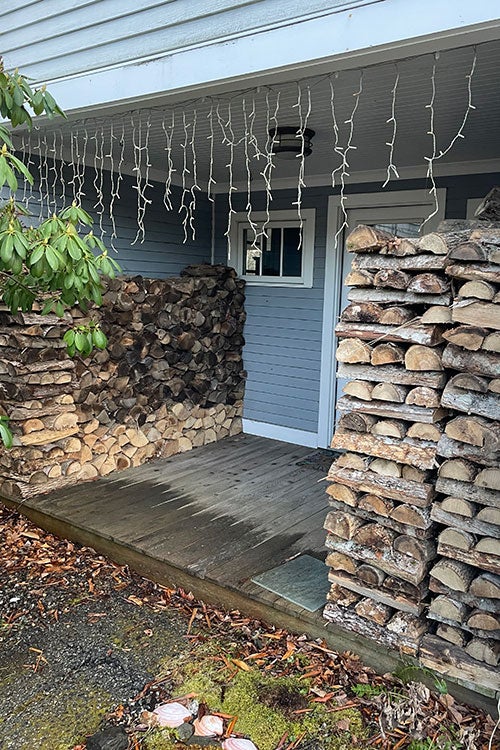
Firewood, for those unaware, should be stacked outdoors, where it will be exposed to sun and wind during the warmer months. You can cover the top of the stack, but the sides need to take plenty of abuse from the elements. The classic, but rather basic, method involves making a long and sometimes tall row of split wood supported at the ends by a rack or a pillarlike end stack made of splits arranged in alternating directions. As a friend who recently moved from Brooklyn to a nearby town noted, even this most elementary form of wood stacking is “strangely satisfying.” And it is not without technique. The pillars can be either quite stable or pretty rickety, depending on how carefully you construct them. Last year, I was absurdly proud of my pillar-stacking game, as exhibited on the porch that I use as a makeshift woodshed.
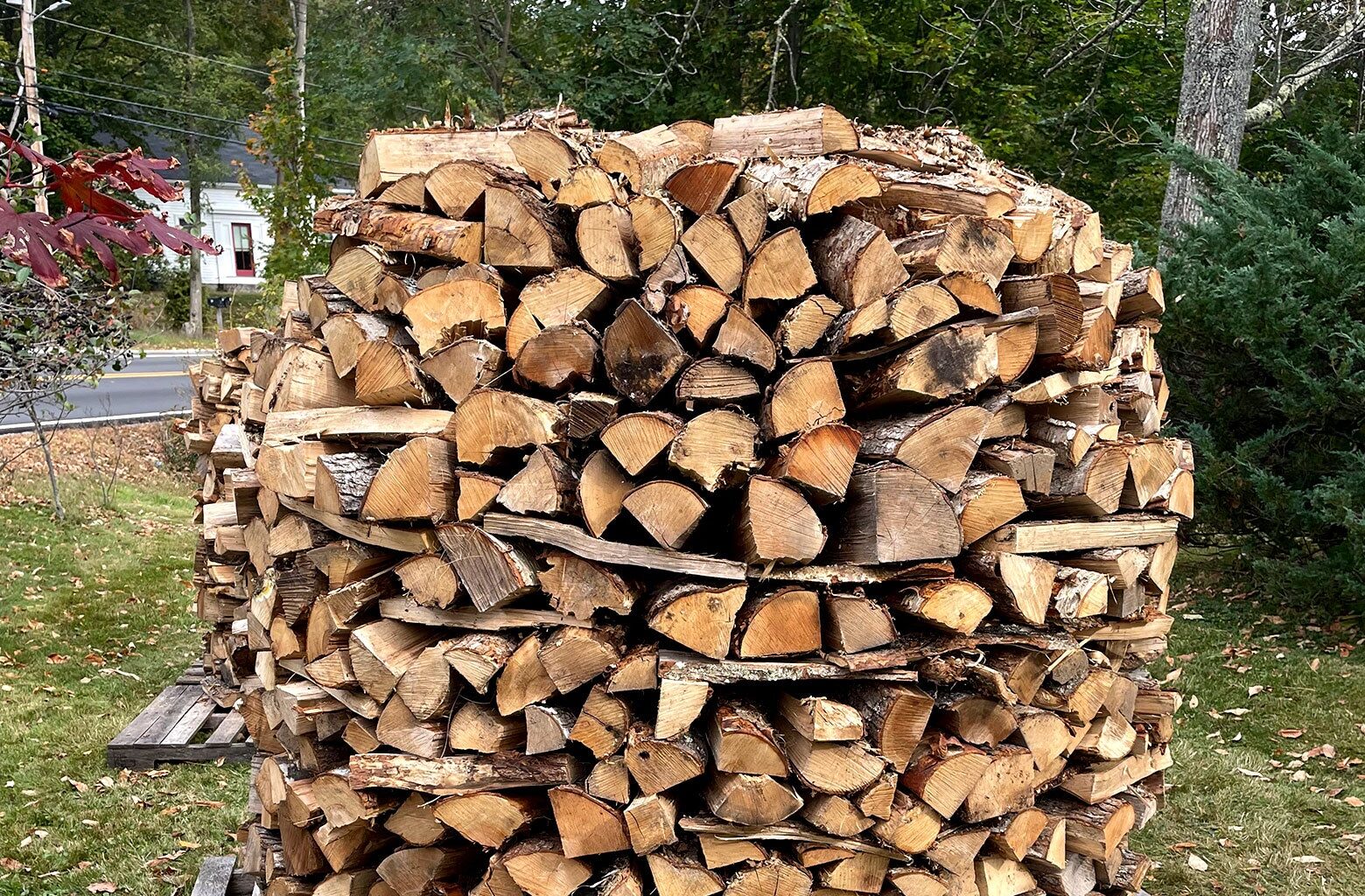
Although holzhausen is German for “wood house,” this wood-stacking method is usually regarded as a Scandinavian specialty. It involves constructing a cylindrical, hollow stack, often with a closed top made of pieces arranged bark-up to look like a roof. Holzhausen range from modest beehive-style piles to truly impressive edifices, like the towering structures built by the nuns in the Pühtitsa Convent, in Estonia. I wanted something big enough to impress anyone driving past my front yard (yes, I admit it), but not so tall that I couldn’t easily fetch splits from it during the winter.
I had two cords of wood to stack, and I knew it would take me forever to finish the job without help, so I invited over some friends—lured by curiosity and the promise of garden tomato sandwiches—to pitch in. The first ring of splits went down, and we were off to the races. A task that would have taken me a week or more was nearly done in less than a day. My friend Dave, who maintains that splitting wood is his favorite exercise, brought his maul and broke down the bigger and more unwieldy pieces. This proved a bit of a disappointment to another friend, Donald, who seemed taken with the notion that some holzhausen builders fill the center of the cylinder with the twisted and odd-sized pieces of wood that don’t stack well.
Laura Miller
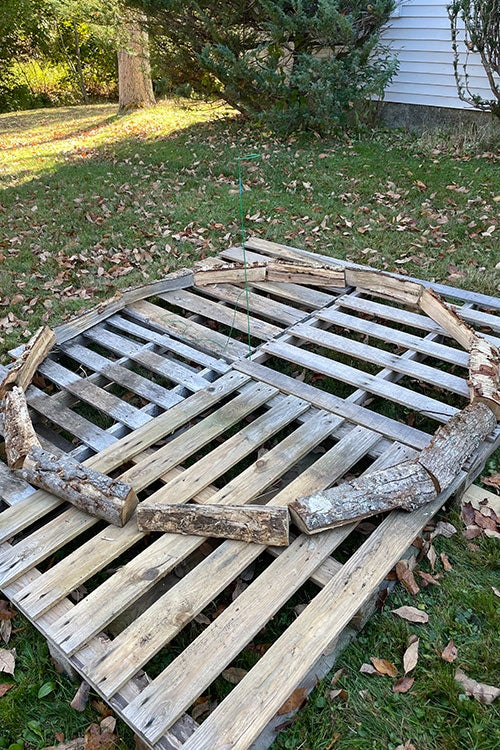
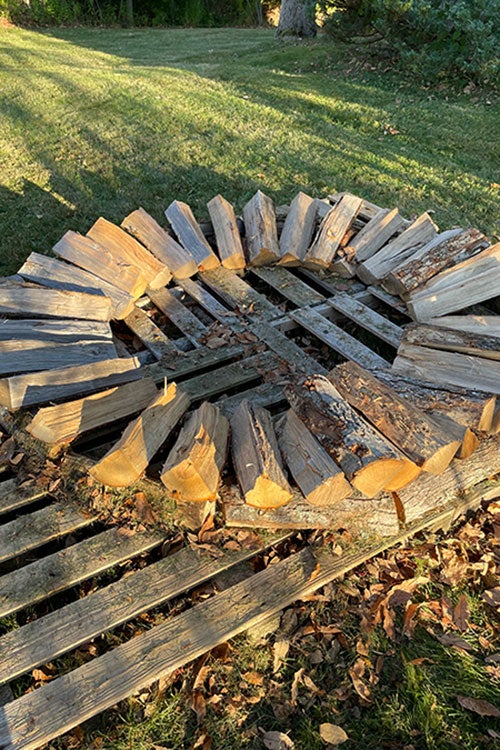
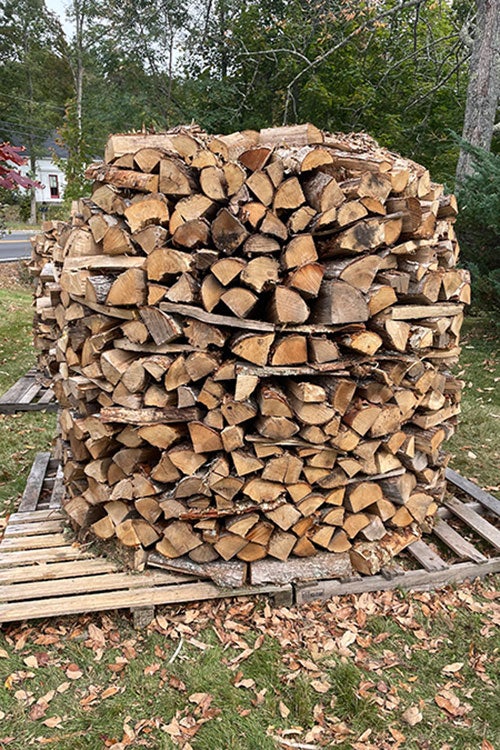
I had originally planned to make a small holzhausen as a starter experiment, but I soon realized that a 6-foot diameter was the minimum practical size. I got four old pallets from Facebook Marketplace to use as the base and drove a garden stake through the middle, tying a 3-foot length of string to it. I used the string as a guide for laying down an outer ring of sideways splits. These assure that the splits stacked on top tilt inward, essential in keeping the holzhausen standing.
We ended up with very few stray pieces in the middle, and later, when I noticed how the wind whistled through the stack on a blustery day, I could see why many stackers claim that the holzhausen is one of the best structures for drying wood, since a maximum of surface area is exposed to the air. That’s provided you don’t fill the center. Some would claim that filling it makes the holzhausen more stable, but mine is still standing without fill. I’d long wondered how much wood it takes to build a holzhausen. It turns out that a stack 6 feet in diameter and 6 feet tall uses just a cord of wood, so we ended up making two.
We soon discovered that the wider gaps between the outward-facing ends of the splits caused a relentless outward-tilting tendency that had to be corrected by inserting slivers of wood—the kind typically used for kindling—sideways at intervals. We called these “shims”; some accomplished stackers will assemble their holzhausen so that the shims form a spiral pattern along the sides of the cylinder. Ours were not so artful (next year!), but the end result was nevertheless a pair of holzhausen that we were proud of and that earned me some compliments from the neighbors.
Laura Miller
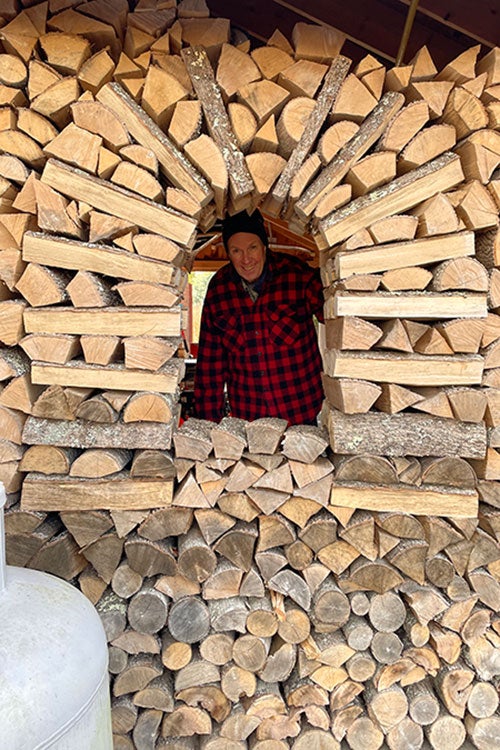
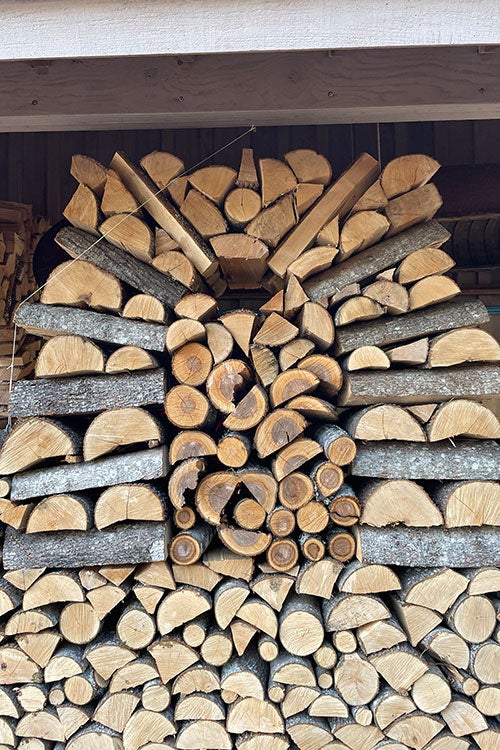
One of those neighbors, Chris, has a wood stack that’s much admired around town. He builds it under the eaves of his woodshed, which has open sides, as all respectable woodsheds should. Chris worked in a logging operation in central Maine for 24 years, first cutting wood, then in various supervisorial roles. That’s where he met his wife, 43 years ago. She is a forester, and the many Norway maples—an invasive species—growing in a gully on their property dismay her. Chris cuts them down, saws them into rounds, splits them, and stacks the splits in his woodshed using a method he landed upon after substitute teaching a sixth grade social studies class on ancient Roman architecture.
We talked about the particular pleasure we get from all this labor. People often place their wood stacks outside a window, where they can see them every day. I can attest that I never get tired of looking at mine. “When you spend all day cutting, splitting, and stacking wood,” Chris observed, “you have something to look at that shows what you’ve accomplished.” The product of so much of today’s work is immaterial, but a wood stack is the physical manifestation not only of what you’ve achieved but also of how warm it will keep you through the winter. A blizzard may strike and the power may go out, but with a good pile of dry splits and a wood-burning stove, you will get by and stay cozy.
For years, I marveled at the keyhole arch in Chris’ wood stack and wondered how he does it. Recently, he demonstrated the method he adapted from the Roman technique for making stone arches. First, he builds the arch out of Norway maple splits, using another variety of wood as support. Then, when it’s complete, he gently taps out the support pieces, a few at a time.
Laura Miller
Laura Miller
Of course, eventually we have to disassemble our wood stacks, something the ancient Romans never had to face with their arches, some of which still stand today. For our wood to warm us that final time, it’s got to be burned. This, it turns out, is the hardest part of the holzhausen process: destroying our creations to bring the pieces inside to the stove. In cold climates, the wood we burn is the stuff of life, and life is inherently temporary. Even the most beautiful wood stack will someday be reduced to ashes. During these, the darkest days of the year, when sun goes down at 3:30 p.m., this leads to somber thoughts. But then the days slowly begin to lengthen, and I start to think about my spring wood order and how I’ll stack it. And the cycle starts all over again.

Sign up for Slate’s evening newsletter.