
Andrew RogersBBC Newsbeat
 Creative Assembly

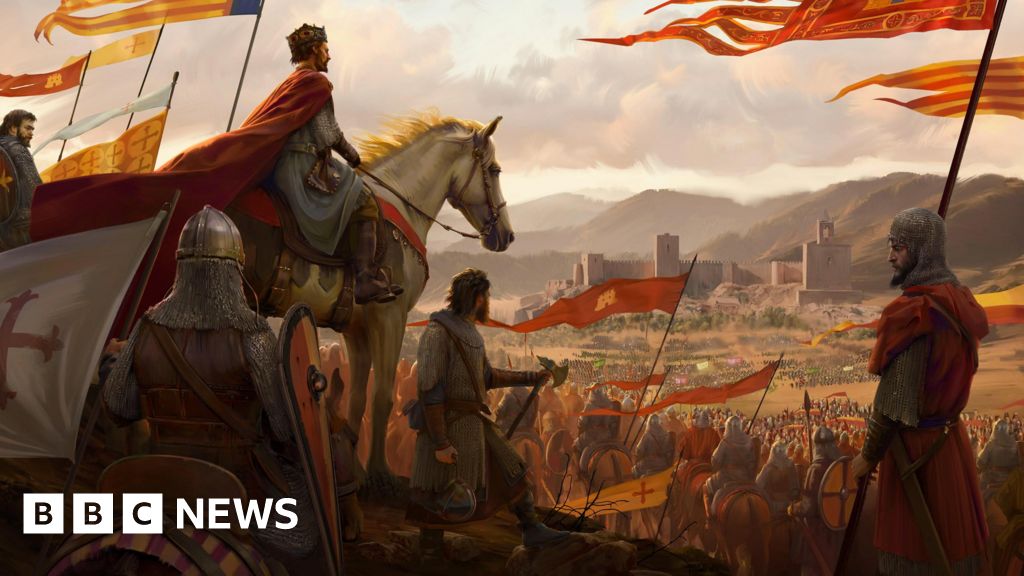
Creative Assembly have announced the Total War games are returning to medieval Europe
The year is 2026, and we still haven’t invented a working time machine.
But if you did want to try your hand at changing the course of history, the Total War video games could be a good place to start.
The real-time strategy series puts players in the role of historical leaders charged with managing resources and armies as they seek to conquer or control the world.
Developed by British studio Creative Assembly, Total War has sold more than 35 million copies since its launch 25 years ago, with instalments set in ancient Rome, feudal Japan and ancient Egypt.
The games have always been grounded in history, but their developers have been going to greater than ever lengths to make sure they reflect the time periods they’re based in.
Bringing history to life
That’s where Prof Peter Wilson, the University of Oxford’s Chichele Professor of the History of War, comes in.
He’s one of the world’s leading authorities on how war is fought and how it affects societies.
BBC Newsbeat meets him in his office at All Souls College, surrounded by floor-to-ceiling bookshelves stuffed with texts.
His latest role has been as an adviser on the upcoming Total War: Medieval III.
“The company approached me and asked if I wanted to be involved and I thought it sounded very exciting,” he says.
He explains that a big part of his job is engaging with the public outside the university about the impact war has had in the past.
These days, he thinks that communication shouldn’t just be through books, TV or podcasts, but also via the medium of video games.
But this relationship first started after one of the developers at Creative Assembly read one of Wilson’s books, and decided to go straight to the source.
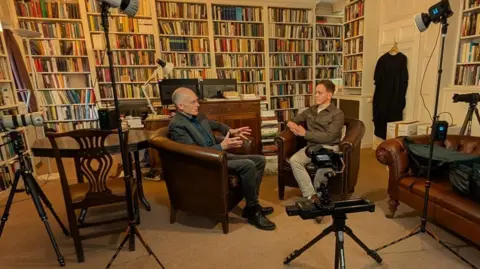
Prof Peter Wilson spoke to BBC Newsbeat at his University of Oxford office
While he hasn’t played any of the games himself, he was already familiar with Total War because his son owned them. Now he’s helped to shape them.
One example he gives is how different seasons affected warfare in the medieval era.
“Early modern and medieval warfare was really warfare in the era of grass,” he says.
“If you didn’t have grass, nothing could move. That’s the fuel for your horses and transport animals.”
In the game, therefore, launching military campaigns during winter is more difficult, as it would have been at the time.
It need not be a one-way street either. Wilson explains that it’s not just history informing games, but that games can also help us better understand the past.
“It gets you to think about fundamental questions: what were the motivations, what counts as a victory or success, what counts as meaningful change,” he says.
“Being compelled to think like that is useful because many of those questions are the questions that good historians should be asking themselves anyway.”
Accuracy versus authenticity
Total War isn’t the only series to venture into the past and let players visit eye-catching moments from history.
Red Dead Redemption puts you in the saddle for a Wild West cowboy fantasy, while Crusader Kings simulates all the drama of European royalty.
Assassin’s Creed has also taken us back to a wide range of historical eras, from Viking Britain to Golden Age Baghdad. The latter won praise for working with local experts and historians to bring its setting to life with full Arabic voice acting.
This does beg one question though. Does all this work make the games more fun to play?
Luke Holmes, who’s a senior designer at Creative Assembly, thinks so.
“If you can capture the feel of a period I think that actually makes it more fun. It’s more grounded, the stakes are higher,” he says.
“It makes you feel like what you’re doing is real and it matters. You’re learning something, you’re doing more than just playing a game.”
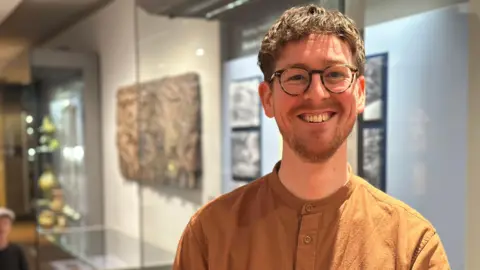
Some of the team at Creative Assembly like Luke describe themselves as big history nerds
But Luke admits there are limits, because total accuracy across the board would make the game a bit of a slog.
“We sometimes avoid using the word accuracy and use authenticity, because authenticity is about the feeling of the past,” he says.
“Many times it’s actually more important than just the straight facts.”
He says the Total War games will always diverge from the “real” path of history, because the games allow players to make decisions that alter the course of events.
Total War’s game director Pawel Wojs agrees and says allowing players to answer their own “what if” questions is a big part of the appeal.
“It’s a sandbox game so the player can change it ultimately, but we want to set the stage as authentically as possible.
“Then the player makes their own history.”

Listen to Newsbeat live at 12:45 and 17:45 weekdays – or listen back here.