
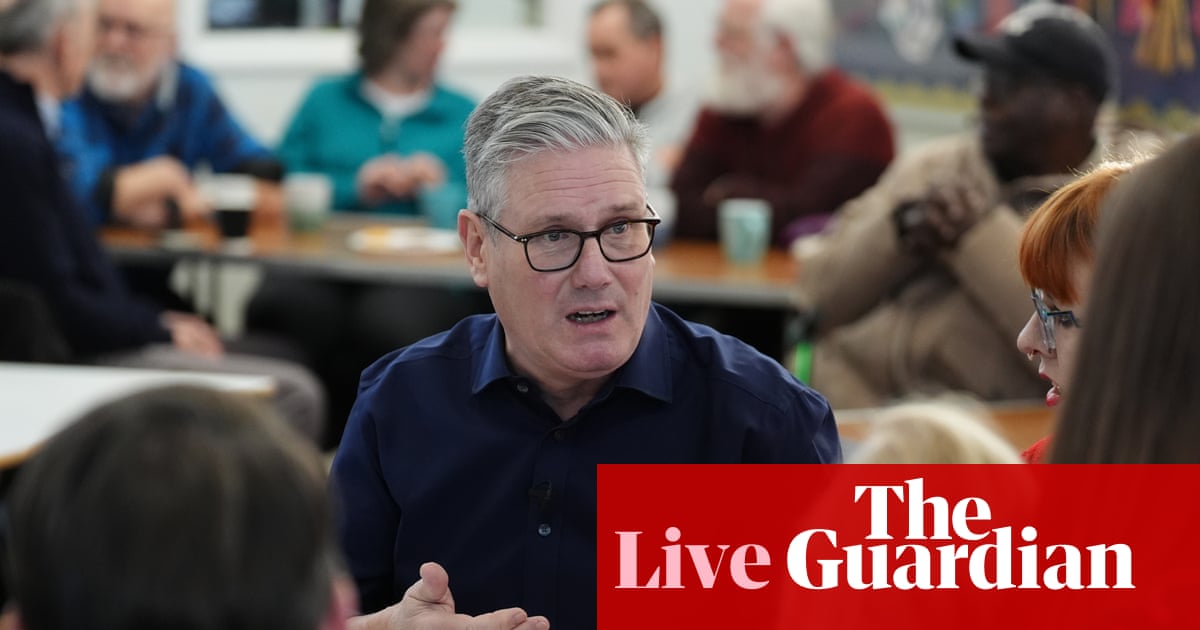
No 10 suggests UK would not vote for UN security council resolution condemning US arrest of Maduro
The Downing Street lobby briefing was mostly taken up with questions about Venezuela. Here are the main points.
The PM’s spokesperson did not contest the Times report claiming that, if the UN security council votes on a resolution criticising the US intervention in Venezuela, the UK will abstain. (See 12.11pm.) The spokesperson confirmed that Yvette Cooper, the foreign secretary, will make a statement to MPs this afternoon about Venezuela and he suggested she would cover this point in her statement.
The spokesperson claimed it was “hypothetical” to suggest, as Emily Thornberry did in her Westminter Hour interview, that the US move would encourage China or Russia to topple leaders that they don’t like. Asked if Thornberry had a point, the spokesperson said:
I don’t think it’s massively helpful to get into hypothetical scenarios or make comparisons. We respect international law, and we expect countries to do the same.
The spokesperson also declined to comment on Trump’s suggestions that he might seek to topple the regimes in power in Cuba or in Colombia. Asked about these countries, the spokesperson said these were “hypotheticial scenarios”. When it was pointed out that Trump’s threats to these countries go beyond the hypothetical, the spokesperson replied:
The UK’s position on this is clear. We respect international law and any soveriegn state that recognises international law must set out the legal basis for its decisions and actions. That is for the US to speak to.
The spokesperson said that Cooper reiterated the UK’s support for international law when she spoke to Marco Rubio, her US counterpart, last night.
But the spokesperson would not say whether or not the government thinks the US did break international law. Asked about this, the spokesperson referred to what Mike Tapp, the migration minister, said this morning about the need for the US to justify its decision. (See 9.56am.) Asked again what the government thought, the spokesperson also said that there is a long-standing principle that governments don’t publish their internal legal advice. Asked if there were any circumstances in which kidnapping the head of state of another country could be legal, the spokesperson said:
We have long supported the transition of power away from Maduro. He’s an illegitimate president. We shed no tears about the end of his rule in Venezuela.
The spokesperson repeated what Keir Starmer said this morning about the future of Greenland being a matter for Greenland and Denmark, not Trump. (See 12pm.) But he said Nato countries agreed that they faced a threat from Russia in the Arctic. Nato was stepping up to respond, he said.
The spokesperson would not say whether the UK would withhold intelligence from the US if it had concerns about the Americans breaking international law. Asked about this, he just said he would not comment on intelligence matters.
Updated at 08.07 EST
Key events
Show key events only
Please turn on JavaScript to use this feature
Zack Polanski describes Starmer’s support for international law as ‘hollow’
Zack Polanski, the Green party leader, has said suggested that Keir Starmer cannot claim to be a genuine supporter of international law.
Commenting on a clip of Starmer dodging a question about whether the US rendition of Nicolás Maduro was in breach of international law, Polanski said:
The more Starmer insists he’s “long been an advocate for international law”, the more hollow it sounds.
This isn’t ignorance. It’s a choice – made with eyes wide open.
ShareAnas Sarwar tells Scots Holyrood elections shouldn’t be about ‘how much you like or dislike UK government’
Anas Sarwar, the Scottish Labour leader, has urged Scots not to treat this year’s Holyrood elections as a referendum on the UK government.
In a speech this morning, he said that he knew Scottish people were “angry, frustrated and impatient with the pace of change at Westminster”. He went on:
I do believe that no Labour government at Westminster, however well intentioned, principled or capable, could have undone the damage of two decades in just two years.
The UK Labour government has many meaningful achievements which they need to shout louder about, but it is also fair to say that they haven’t got everything right.
And there are many challenges they still must confront.
I get it. I don’t just see it. I feel it across Scotland.
I know the prime minister and the UK Labour government are not popular with the public right now.
So, I am not running to be Scotland’s first minister in denial of that truth. I am running to be Scotland’s first minister in defiance of it.
Sarwar said he had a message for his fellow Scots.
In four months you can decide a different, bigger and more important question than how much you like or dislike the UK government.
In four months you will choose who leads Scotland’s government.
Arguing the case for Labour, he focused on four policy areas,
Scotland’s choice between the SNP’s record of failure on the NHS, or my plan to clear the backlogs, end the 8am rush for a GP appointment and make our NHS fit for the future.
Scotland’s choice between the SNP’s record of falling standards in our schools, or my plan to back teachers, make schools safe and guarantee opportunity for every young person with 9,000 more apprenticeships.
Scotland’s choice between the housing emergency created by the SNP, or my plan to end rough sleeping and build the homes Scotland needs.
Scotland’s choice between the SNP’s soft touch on crime, or my plan to build safe communities with at least 360 officers returned to the frontline in our neighbourhoods.
Sarwar also said Scottish Labour already had £1m to spend on its campaign, and he said it would be “unleashing the most sophisticated and largest digital operation of any party in Scotland, reaching one million Scots every week”.
In a post on social media, Paul Hutcheon from the Daily Record points out that there was no Labour branding on the banner behind Sarwar when he was speaking.
Updated at 10.50 EST
Ben Wallace, the former Tory defence secretary, has said that the government should stop equivocating about whether or not it supports the US arrest of Nicolás Maduro. He says:
Whatever the UK government thinks it needs to be clear about it. They can support Trump’s actions or they can condemn it. But clucking around like headless chickens damages UK deeply. No leadership, no principles and no ideas.
ShareStarmer accuses Farage of ‘peddling falsehoods’ about Brexit
Keir Starmer has accused Nigel Farage of “peddling falsehoods” about Brexit.
In an interview this morning with GB News, which is more pro-Brexit than any mainstream UK broadcaster and which has a lot of pro-Brexit viewers, Starmer said:
My message would be that Nigel Farage says a lot of things that aren’t true and don’t come to fruition.
So he stood in front of your viewers in the Brexit referendum and said, ‘If we leave the EU, migration will come down.’ Well, it didn’t come down. It quadrupled, the Boris Johnson wave.
He said, ‘If we leave the EU, you’d have £350m a week for the NHS.’ That didn’t turn out to be the case.
And he said, ‘If we left the EU, we’d cut lots of red tape.’ Try telling that to anyone who is dealing and doing business with the EU.
So what you get with Nigel Farage is a lot of slippery things that are said, but when you hold them up to the light, they’re not actually true, and peddling falsehoods is no way to solve the problems of this country.
In fact, Starmer is wrong on his second point. The claim that leaving the EU would save an extra £350m a week that could be spent on the NHS came from the Vote Leave campaign, run by Boris Johnson, Michael Gove and Dominic Cummings, not from Farage. After the campaign was over, Farage said he did not agree with that claim and that he regarded it as a mistake.
The Brexit referendum took place 10 years ago this summer. But Starmer is talking about it because, after not wanting to discuss the flaws with Brexit for several years (Labour did not want to alienate the leave supporters it needed ahead of the 2024 election), Starmer is now increasingly willing to highlight the problems caused by the policy, and the dishonest claims made by those campaigning for it in 2016.
He has also become increasingly keen to find ways of undermining Farage’s popularity given Reform UK’s persistent lead in the polls. Yesterday More in Common published an MRP poll suggesting, if an election were held now, Farage would be PM with a majority of 112.
Kemi Badenoch says on social media she will be in the Commons this afternoon to respond to the Yvette Cooper statement on Venezuela on behalf of the Conservatives.
She also claims (without explaining why) that the incident show Starmer is not respected abroad.
The events in Venezuela have shown that the Prime Minister is on the outside looking in, not respected abroad or at home.
I will be in Parliament later today to ask what Starmer’s foreign policy strategy is in light of the US’s actions.
He should be telling us himself.
In her interview on ITV’s Good Morning Britain this morning, Badenoch claimed that that fact that Starmer was not consulted by Donald Trump ahead of the arrest of Nicolás Maduro showed that Starmer lacked influence.
(In practice, it is hard to see why Starmer would or should have been consulted.)
ShareSwinney says he ‘cannot see’ how Maduro arrest complied with international law
John Swinney, Scotland’s first minister, has said he does think the US arrest of Nicolás Maduro was a breach of international law.
Speaking at the SNP event in Glasgow this morning, Swinney said:
I am deeply concerned at the situation which has unfolded in Venezuela.
There is no doubt that the Maduro regime was an illegitimate and authoritarian regime.
However, I am clear that all nations must abide by the international, rules-based system.
Having listened carefully to what has been said by the United States administration in recent days, I cannot see how international law has been respected here.
Ed Davey, the Lib Dem leader, has welcomed Keir Starmer’s comments about Greenland. (See 12pm.) He posted this response on social media.
About time.
Let’s hope this is the start of Keir Starmer standing up for Britain and our allies when it really matters.
ShareDo MPs have any real influence over foreign policy?
A reader asks:
What realistic control does parliament have over foreign policy? Does it have any at all?
I know parliament now votes on war but that’s only a convention not a law. What about everything else? Treaties are a power reserved for the prime minister but can parliament affect their contents in any meaningful way? Is foreign policy democratically accountable?
Good question. And broadly you are right. Much foreign policy does not involve legislation, but does involve the exercise of prerogative powers (where ministers can take decisions at will on the grounds that they are acting on behalf of the king). Keir Starmer did propose before the election legislating to ensure that MPs would always have a vote on going to war, but that seems less of a priority now. MPs do vote on treaties, under the Constitutional Reform and Governance Act 2010 (Crag). But, even here, their powers are limited; they can’t rewrite treaties, only delay their implementation a bit.
But it would be a mistake to assume this means prime ministers can do what they want in foreign policy. As ever, they are constrained to an extent by what their MPs and ministers will tolerate. Of the 10 post-war prime ministers who left office not because of an election defeat but for another reason, half of them were forced out largely or in part because of foreign policy. They were: Eden (Suez), Thatcher (Europe), Blair (Gaza – Labour MPs thought he was too supportive of Israel in the 2006 conflict), Cameron (Brexit) and May (Brexit).
The latest episode of our Politics Weekly UK podcast is out. Pippa Crerar and Kiran Stacey are discussing Keir Starmer’s reticence when it comes to criticising Donald Trump’s flouting of international law.
The Commons statement from Yvette Cooper, the foreign secretary, won’t start until around 5.30pm. That is because there will be three urgent questions first.
3.30pm: Victoria Atkins, the shadow environment secretary, asks a UQ on the farm inheritance tax U-turn announced just before Christmas.
Around 4.15pm: Robert Jenrick, the shadow justice secretary, asks a UQ on the two dangerous offenders absconding from HMP Leyhill on New Year’s Day.
Around 5pm: James Cartlidge, the shadow defence secretary, asks a UQ on the Northern Ireland Troubles bill.
ShareNo 10 suggests UK would not vote for UN security council resolution condemning US arrest of Maduro
The Downing Street lobby briefing was mostly taken up with questions about Venezuela. Here are the main points.
The PM’s spokesperson did not contest the Times report claiming that, if the UN security council votes on a resolution criticising the US intervention in Venezuela, the UK will abstain. (See 12.11pm.) The spokesperson confirmed that Yvette Cooper, the foreign secretary, will make a statement to MPs this afternoon about Venezuela and he suggested she would cover this point in her statement.
The spokesperson claimed it was “hypothetical” to suggest, as Emily Thornberry did in her Westminter Hour interview, that the US move would encourage China or Russia to topple leaders that they don’t like. Asked if Thornberry had a point, the spokesperson said:
I don’t think it’s massively helpful to get into hypothetical scenarios or make comparisons. We respect international law, and we expect countries to do the same.
The spokesperson also declined to comment on Trump’s suggestions that he might seek to topple the regimes in power in Cuba or in Colombia. Asked about these countries, the spokesperson said these were “hypotheticial scenarios”. When it was pointed out that Trump’s threats to these countries go beyond the hypothetical, the spokesperson replied:
The UK’s position on this is clear. We respect international law and any soveriegn state that recognises international law must set out the legal basis for its decisions and actions. That is for the US to speak to.
The spokesperson said that Cooper reiterated the UK’s support for international law when she spoke to Marco Rubio, her US counterpart, last night.
But the spokesperson would not say whether or not the government thinks the US did break international law. Asked about this, the spokesperson referred to what Mike Tapp, the migration minister, said this morning about the need for the US to justify its decision. (See 9.56am.) Asked again what the government thought, the spokesperson also said that there is a long-standing principle that governments don’t publish their internal legal advice. Asked if there were any circumstances in which kidnapping the head of state of another country could be legal, the spokesperson said:
We have long supported the transition of power away from Maduro. He’s an illegitimate president. We shed no tears about the end of his rule in Venezuela.
The spokesperson repeated what Keir Starmer said this morning about the future of Greenland being a matter for Greenland and Denmark, not Trump. (See 12pm.) But he said Nato countries agreed that they faced a threat from Russia in the Arctic. Nato was stepping up to respond, he said.
The spokesperson would not say whether the UK would withhold intelligence from the US if it had concerns about the Americans breaking international law. Asked about this, he just said he would not comment on intelligence matters.
Updated at 08.07 EST
UK will abstain if UN security council has to vote on resolution criticising US arrest of Manduro, report claims
The UK will abstain at the United Nations security council if it it asked to vote on a resolution criticising the US arrest of Nicolás Maduro, the Venezuelan president, Steven Swinford from the Times reports. Swinford says:
Britain will refrain from criticising the US over the capture of Maduro amid concerns about angering Donald Trump
The UK will not make any assessment on whether the action is lawful. If the issue is pushed to a vote at the UN Security Council the UK will abstain
The view is that it is not for the UK to make a judgement on a unilateral action by the US which the government knew nothing about in advance The government is concerned that doing so would risk jeopardising relations with the US at a critical time, particularly on the future of Ukraine
A senior government source said: ‘This was a decision by the US. It is not for us make a judgment on whether it was lawful’
Updated at 07.23 EST