

Listen to this article
Estimated 5 minutes
The audio version of this article is generated by AI-based technology. Mispronunciations can occur. We are working with our partners to continually review and improve the results.
As the Yellowhead Trail freeway conversion program enters its sixth year of development, construction efforts on the major roadway are shifting to tackle a core part of the overall project.
With only two years left until the conversion’s expected completion, several key stages are still needed to fully transform the expressway into a freeway, though some Edmontonians living near the construction say the project can’t end soon enough.
Kris Lima, the director of the Yellowhead Trail portfolio with the City of Edmonton, said this massive construction project is still on track, noting that he doesn’t anticipate any major delays with the program’s schedule.
“We are really pushing hard for the 2027 commitments and we’re on target. I think we can do that,” said Lima.
WATCH | Update on Yellowhead Trail conversion project: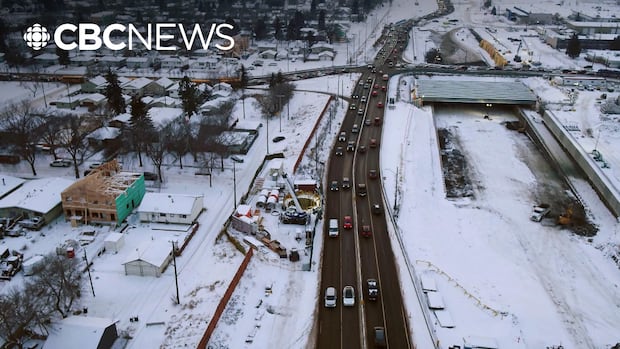
Major construction work still to come on Yellowhead freeway but city expects to be done in 2027
The conversion of Edmonton’s Yellowhead Trail to a freeway was expected to be a 10-year project. There’s still major construction expected between 97th Street and St. Albert Trail, but as Travis McEwan reports, the city expects it to be completed in 2027.
The conversion program will turn the expressway into three lanes of free-flowing traffic with a speed limit of 80 km/h through the whole city. In order to do that, all signalized intersections and direct accesses on or off Yellowhead Trail will need to be removed.
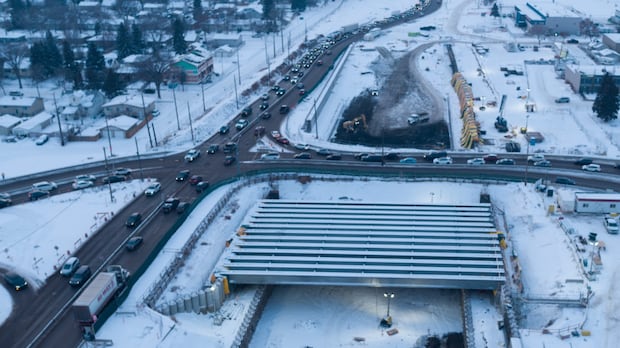
Lima noted that while several key phases of the infrastructure development are already finished, the focus is now shifting to the important stretch of Yellowhead Trail between St. Albert Trail and 97th Street.
He described this section of the roadway as the “keystone project” in the grand scheme of the development, noting that the price tag for this section will account for more than half of the conversion’s more than $1 billion budget.
As part of that plan for the stretch between St. Albert Trail to 97th street, construction will focus on completing two new interchanges at 127th Street and 121st Street. Crews will also build a new roadway connection that will link 121st Street and 107th Street to the new 121st Street interchange to maintain access to the freeway.
Since June, Yellowhead Trail between St. Albert Trail and 97th Street has been restricted to two lanes in both directions with a speed limit of 50 km/h. According to the City of Edmonton’s website, these changes are expected to be in place until the overall completion of the project.
Another development that Lima highlighted which still needs to be completed is the intersection removal at 66th Street. He said this change is still being designed, and the intersection will be removed in early 2027.
Lima said that the 66th street intersection will be the final signalized intersection to be removed during the course of the conversion project.
Based on figures from the City of Edmonton’s website, between 63,000 and 81,000 vehicles currently use Yellowhead Trail every day. This figure could balloon up to 155,000 vehicles per day within 20 years.
However, Lima said this conversion will have a big payoff in the long run for commuters in the Edmonton area.
“I think people will see their commute times shorten, safety will be better and the flow of traffic would just be all-in-all improved greatly than what we’ve seen in the last 40 years,” he said.
Patience for construction running thin
Despite these potential improvements to the city’s commuter flow, the patience of residents living near the construction may be running thin.
“It’s been frustrating living across the street from the construction,” said Dajanna Fabjanovic, a resident of the Sherbrooke neighbourhood whose home is exposed to the construction on the St. Albert Trail to 127th Street portion of Yellowhead Trail.
“Things have been delayed and, in addition to that, the noise pollution, the light pollution, the dust that comes flying into our homes has been terrible,” she said.
Dajanna said her “patience is at an ultimate low” for the conversion project.
“As residents, we feel like we are not being heard or seen in terms of how this is impacting our lives on a daily basis.”
Chelsea Mani, another Sherbrooke resident living close to the construction, said she is eager for the project to wrap up as soon as possible.
“I think everyone in the neighbourhood is looking forward to it being done, and just fingers crossed there’s no delays,” she said.
Lima said the municipality is trying to keep affected residents informed while mitigating the inconvenience and disturbance caused by the massive construction operation.
He said the noise wall along the south border of the roadway that separates the community of Sherbrooke had to be taken down. But Lima noted the City will try to build another noise wall as soon as possible early next year.