
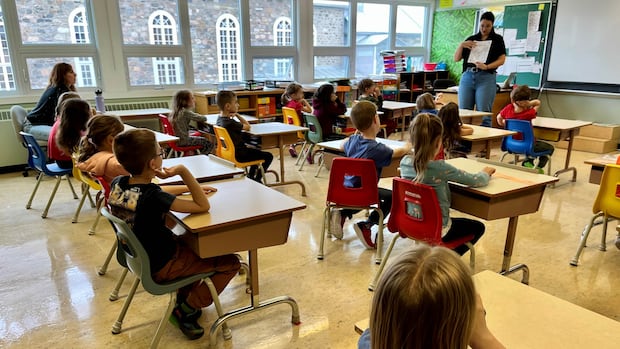
It’s a new year and new rules are awaiting Quebec students as they return to the classroom after the winter holidays.
Students in elementary and high schools across the province are now required to use formal language when addressing teachers and staff.
In the English school system, that means using a title, such as Mr. or Ms., while in the French-language school system, students are being asked to use the more formal and polite form of ‘you’ in French — vous rather than tu.
Schools also have an obligation to formalize the value of respect in their codes of conduct and parents have to sign that code to ensure they are aware of it.
Katherine Korakakis, president of the English Parents Committee Association of Quebec, said she believes the change is a good thing.
“I think it’s going to go a long way into instilling a level of respect between pupils and administrators and teachers,” she said.
Korakakis added that using titles serves as a reminder of an existing hierarchy or barrier where “students and teachers and staff are not friends.”
“They’re there to learn from each other. And it’s an important thing,” she said.
Julie Blais Comeau, a business etiquette specialist, also believes the use of formal language in the classroom will be beneficial and is an important life skill.
Blais Comeau explained that using vous rather than tu is a form of respect and puts interactions and relationships into context and serves as a filter for words, actions and behaviours.
“Having that awareness of the context [of] whom I’m addressing and treating others with respect and using vous will certainly be an advantage,” she said.
More resources needed, says teachers’ association
Meanwhile, Heidi Yetman, the President of the Quebec Provincial Association of Teachers (QPAT) says since the pandemic, violence in schools has gone up.
A recent survey by the Fédération autonome de l’enseignement (FAE), a federation of unions representing more than 66,500 teachers, revealed that 90 per cent of its members have faced violence while on the job.
And while respect is important, Yetman doesn’t believe adding a new rule about being formal and civil is going to change much in terms of reducing violence.
“Children already are fairly respectful,” she said, adding that in English-language schools, students, for the most part, already use titles when addressing teachers.
“What we’re seeing now is the very young children in primary that kind of lose control and that’s not going to change whether they’re respectful or calling somebody Mr. or Mrs.,” she said. “When a child is dysregulated, they need help.”
WATCH | Quebec teachers point to rising violence in schools:
Quebec teachers say they’re targeted by violence, verbal abuse in schools
Teachers across the province are warning of increased violence directed toward them inside classrooms. A major teachers’ union released a survey documenting the trend and is reaching out to the province for help.
Yetman said more resources are needed to help those children.
She gave the example of having a behavioural technician who could help a student work through anger issues by giving tips or strategies to use when they might be feeling mad.
“Instead of throwing a chair, what can you do? Can you breathe?” she said.
Yetman added that teachers also need more support in the classroom.
“Right now, teachers are kind of by themselves with 28 to 30 students in the class and maybe 10 of them have either behavioural issues or learning disabilities, and there’s no one to help them,” she said, adding that some students get angry when they don’t understand something.
One solution, she said, would be having another individual who could work with struggling students in small groups outside the classroom on subjects or in areas they are having trouble with.
Yetman said having more resources available when the kids are still young, from kindergarten to Grade 3, could have an impact down the line.
“That’s where it all begins. If we can fix that, it might get better as we move along through the school system,” she said.
Formal language a tool, not a panacea
Speaking on Radio-Canada’s Tout un matin radio show on Monday, Quebec Education Minister Sonia Lebel agreed the level of violence being reported in schools is concerning.
But she defended the new rule, saying it wasn’t meant as a panacea but as a tool that can help improve the climate in schools, much like the recently introduced cellphone ban.
She said that initiative was initially met with resistance but is now being applauded in many schools.
In an email to CBC, Marylène Le Houillier, a spokesperson for the education minister’s office, said the purpose of the new rule “is to establish a framework for civic responsibility that promotes respect for everyone in the school environment.”
Lebel said she expects school administrators to use their judgment when applying the regulations.
“It must be done on a case-by-case basis,” Lebel said. “We must ensure that the strict application of the regulation does not create more problems than not applying it.”
She made the comment in response to concerns raised by some teachers about how the use of vous can be confusing for young children and even impede their learning in some situations.
She also said she wouldn’t give directives to schools in the case of teachers who identify as non-binary and don’t want to be called Mr. or Ms.
“I trust the people of that institution to resolve this situation professionally,” she said.
Lebel said the government has taken other steps to address the issue of violence in schools, including injecting more money and hiring more staff, but acknowledged the needs are great.