
Unlock the Editor’s Digest for free
Roula Khalaf, Editor of the FT, selects her favourite stories in this weekly newsletter.
Latvian authorities have searched a ship suspected of damaging an undersea optic cable in the Baltic, the sixth outage or damage to an underwater cable in the region in as many days, as western allies remain on alert for Russian interference.
Latvia’s state police said it had inspected the vessel in the port of Liepāja overnight on Sunday and questioned its crew, but had not found any connection with the incident. The cable was reported damaged in Latvian territorial waters off Liepāja on January 2. The police said they were continuing their criminal investigation into “intentional damage”.
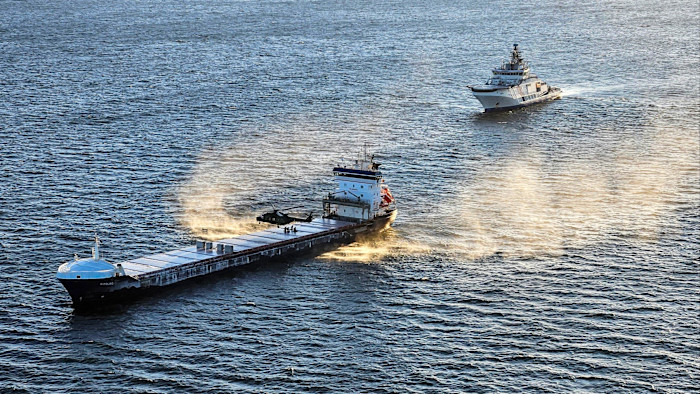
Finnish special forces last week boarded and seized a ship, the Fitburg, suspected of damaging two underwater communications cables between Estonia and Finland. The Fitburg was en route from St Petersburg in Russia to Haifa in Israel with crew members from Russia, Azerbaijan, Georgia and Kazakhstan.
Estonia also reported faults on two communications cables linking it with Sweden and on another linking the island of Hiiumaa with the mainland.
Baltic militaries backed by Nato allies have been on high alert following a series of breakages and damage to communications and power cables and gas pipelines following Russia’s full-scale invasion of Ukraine. The incidents have raised suspicions of Russian sabotage, part of a so-called hybrid war intended to destabilise Kyiv’s European allies, although several cases have been blamed on crew negligence.
The spate of incidents in recent days follows a period of almost a year without reports of damage, which regional security officials attributed to the launch of Nato’s Baltic Sentry maritime operation to protect critical infrastructure.
“Following various incidents — starting with the undersea cables some time ago or the different drone incursions into Nato airspace or aircraft violations — what we’ve seen is that, in response to reactions from the west or Nato, Russia has taken various measures to prevent such incidents from happening again in the future,” Kaupo Rosin, the head of Estonia’s foreign intelligence service, told local television late last month.
Some serving and former officials, however, have downplayed the incidents of the past week, blaming them on poor seamanship and bad weather.
Andres Vosman, former deputy head of Estonia’s foreign intelligence service, told Estonian television: “My strong assessment is that most of the recent incidents in the Baltic Sea have largely been the result of coinciding factors — much heavier ship traffic towards Russia, vessels in poor condition with low crew competence, more underwater infrastructure than in the past and increased public attention.”
Some officials in the Baltic states say a combination of inexperienced captains and bad weather in the shallow waters of the Baltic could be behind the incidents. But others believe that the regularity of the cable-cutting cannot be pure coincidence.
Still, one official added, Finland’s decisive response last week, with the Fitburg seized by helicopter-borne troops and some of its crew held in detention or subject to travel bans, sent a useful message of deterrence to Moscow.
Finland last year brought charges against the pilot and two crew members of a Russian shadow fleet vessel, the Eagle S, for cutting underwater electricity and communications cables.
However, a court in Helsinki ruled that Finland lacked jurisdiction because the incident occurred outside Finnish territorial waters, underscoring the difficulty of prosecuting suspected sabotage.