
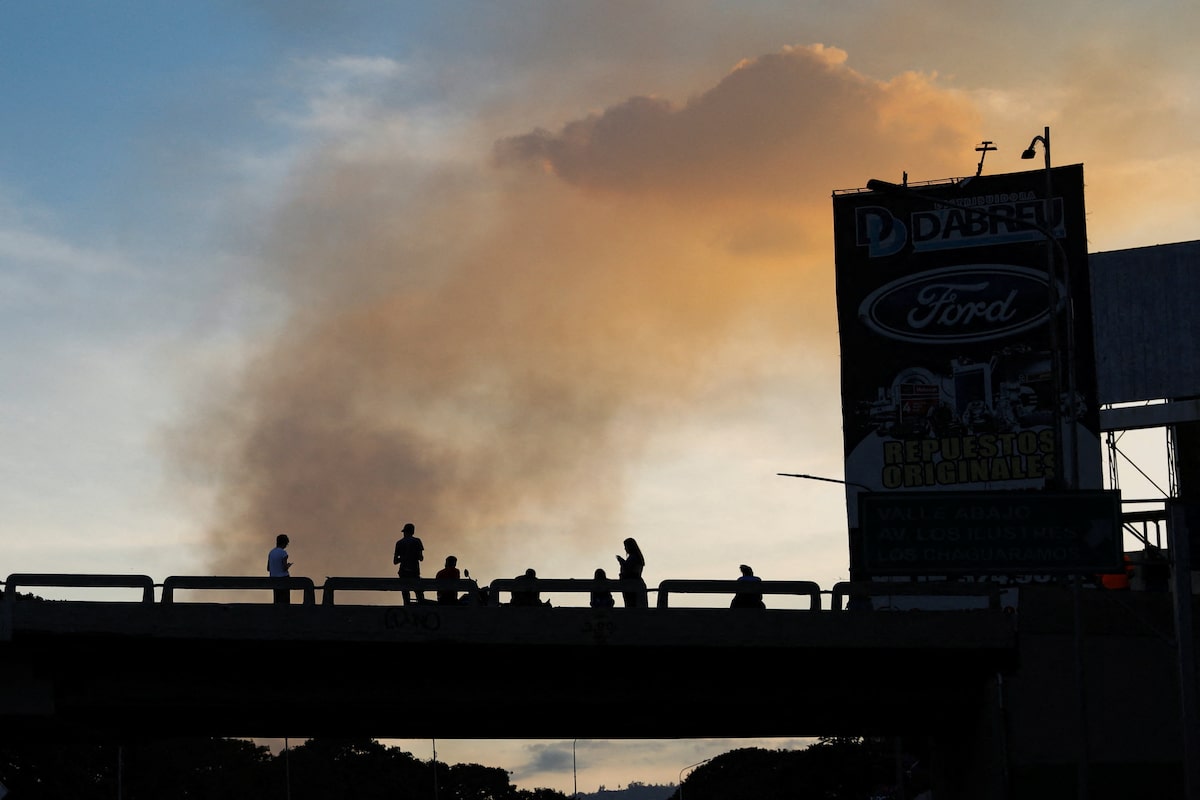
People on a bridge watch as smoke rises near Fort Tiuna, after U.S. President Donald Trump said the U.S. struck Venezuela and captured its President Nicolas Maduro, in Caracas, on Saturday.Leonardo Fernandez Viloria/Reuters
The Canadian government is in wait-and-see mode when it comes to Donald Trump’s military strike on Venezuela, a senior official says, as it tries to determine whether the U.S. President plans unilateral action in other countries.
The Globe and Mail is not identifying the official, who was not authorized to speak publicly about the matter.
Canada is in a particularly vulnerable position right now because it’s expected to shortly begin renegotiation of the trilateral United States-Mexico-Canada Agreement, where Mr. Trump’s administration is expected to seek changes that advantage U.S. business and hurt Canadian industries.
In a carefully worded statement, Ottawa refrained from criticizing the U.S. President’s Jan. 3 attack on Venezuela and seizure of its President Nicolás Maduro. The statement prompted some former politicians and other Canadians to demand stronger language from Prime Minister Mark Carney.
But the senior official said it would be awkward for Canada to have excoriated Mr. Trump for removing the Venezuelan leader when Ottawa itself spent six years publicly urging an end to Mr. Maduro’s regime. In 2019, Canada called Mr. Maduro’s government illegitimate and demanded he step down.
Toppled Venezuelan President Nicolas Maduro pleaded not guilty on Monday to charges of narco-terrorism, after U.S. President Donald Trump’s stunning capture of him rattled world leaders and left officials in Caracas scrambling to respond.
Reuters
Along with a group of Latin American countries, it said the May, 2018, election in which Mr. Maduro claimed victory excluded major political actors, had no independent international observers, and failed international standards “for a free, fair and transparent election.”
Canada suspended operations at its embassy in Caracas in 2019, citing what it called the “illegitimate” Maduro regime’s unwillingness to renew accreditations for Canadian diplomats. The lack of a diplomatic mission in-country has made it more challenging to assess the situation, the official said. Venezuelan matters are handled by Canada’s embassy in neighbouring Colombia.
The Canadian government is watching for further developments, the official said, trying to determine if the action against Mr. Maduro is a one-off or whether Mr. Trump proceeds with threats to move on Cuba or drug cartels inside Mexico.
Mr. Trump said Sunday he wants to annex Greenland, adding that Denmark is not spending enough money to safeguard it from the Russians and Chinese.
“We need Greenland from the standpoint of national security, and Denmark is not going to be able to do it,” the President told reporters aboard Air Force One.
He has faced accusations of flouting international law through his unilateral action against Venezuela, taken without congressional approval or international support.
Mr. Carney independently reached out to Venezuelan opposition leader María Corina Machado after the military strike – despite Mr. Trump’s snubbing of the Nobel Peace Prize laureate – to underline Canada’s interest in a democratic and Venezuelan-led transition. The U.S. President earlier dismissed the idea of working with Ms. Machado, saying she lacked support or respect within her country.
While Mr. Trump has talked of running Venezuela, Mr. Carney in his statement on Ms. Machado said that he “affirmed Canada’s steadfast support for a peaceful, negotiated, and Venezuelan-led transition process that promotes stability and respects the democratic will of the Venezuelan people.” He said that process “must be anchored in the Venezuelan people’s sovereign right to decide and build their own future.”
Mr. Trump’s mercurial and increasingly unpredictable presidency has raised questions about the future of Canada’s relationship with the United States, which has traditionally purchased more than three-quarters of Canadian exports and been a close military ally since the Second World War.
Carney hails ouster of Maduro in Venezuela but calls for respect for international law
A second government official said the Venezuela operation hasn’t altered the Carney government’s 2025 plans to distance Canada from the U.S. Last year, Mr. Carney warned Canadians that the old relationship with the U.S., “based on deepening integration of our economies and tight security and military co-operation, is over.”
The Globe and Mail is not identifying the second official, who was not authorized to speak publicly about the matter.
The second official said the Carney government is proceeding with plans to create greater strategic autonomy for Canada by diversifying diplomatic, security, trade and investment relationships, by boosting its military strength and removing internal barriers to drive domestic economic growth.
The events of the past few days don’t change the Carney government’s policy efforts, the second official said, because it was already headed in a more autonomous direction. In June, 2025, the Prime Minister pledged to boost military spending to the equivalent of 2 per cent of gross domestic product by March 31, and to further raise core defence expenditures to 3.5 per cent of GDP by 2035.