
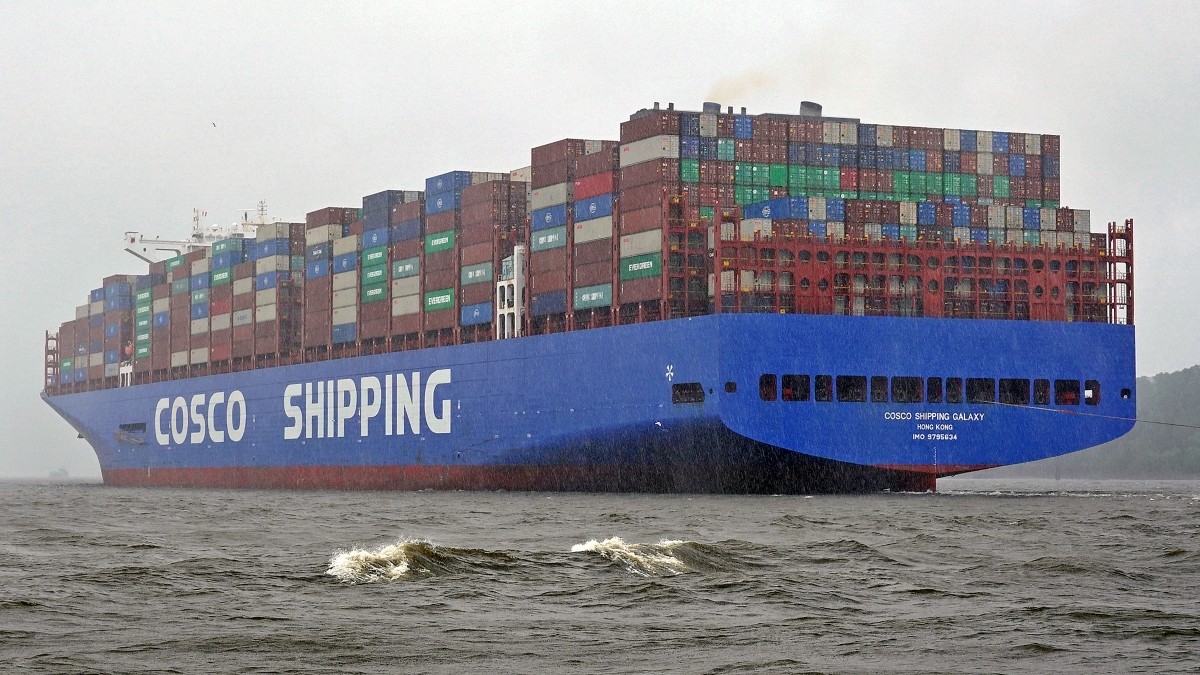
In any war over Taiwan, American commanders will face a problem that barely existed a decade ago: China can hide lethal military systems inside standard commercial shipping containers. These “containerized” missile launchers are modern renditions of an old U.S. Navy concept first marketed in the Russian Club-K and are now reportedly fielded in Chinese variants. They ride on the decks of merchant ships, blend into global commerce, and give Beijing the ability to forward-deploy precision weapons without visibly deploying a single warship.
For U.S. planners, the threat is not hypothetical. It is a feature of modern conflict in the Indo-Pacific. Tens of thousands of container ships, feeder vessels, and mixed-use cargo hulls transport trillions of dollars in trade throughout the first island chain and South China Sea each year. Even if U.S. intelligence could flag a fraction of them as suspicious, which is a major challenge, the U.S. Navy and Coast Guard lack the physical capacity to board and inspect more than a tiny percentage. As noted in these pages, a future Indo-Pacific conflict will blur longstanding distinctions between civilian and military vessels at sea, particularly when commercial vessels are used to support combat operations. Containerized missile systems are an example of how these emerging “rules of war” translate into operational dilemmas long before the first shot is fired.
These missile systems are a threat to the most powerful and expensive assets the United States operates and put thousands of sailors at risk, and yet today, there is little capability to meaningfully combat them. The U.S. military does not have the capacity and, as such, it will likely fall back on its tried-and-true method of fixing shortfalls: contractors. While this may provide some respite, the issue of legality quickly arises when discussing boarding operations. The lack of U.S. military capacity and the legal constraints on contractors point toward a hybrid maritime interdiction force as the most feasible near-term solution. Government boarding teams deployed from contractor-owned, contractor-operated vessels and aircraft, cued by U.S. intelligence, and backed by a pre-negotiated legal framework, allow for rapid boardings in a crisis.
This hybrid model is not merely workable, but a scalable, near-term solution that can operate in the gray zone, persist through escalation, and survive the transition to open conflict.
Too Many Ships, Too Much Ocean
Tens of thousands of commercial vessels move annually through the waters surrounding Taiwan, whether transiting the Taiwan Strait, the Luzon Strait, the Miyako Strait, or the wider South China Sea. Even the most conservative maritime traffic estimates of singular straits show volumes that the U.S. Navy and Coast Guard could never meaningfully inspect at scale. Even if the United States committed every available Coast Guard cutter, every operational Littoral Combat Ship, every destroyer within reach, and every allied frigate willing to assist, the number of ships capable of launching, recovering, and supporting boarding teams would still be a rounding error against the traffic volume. That all of this could occur against the backdrop of a rapidly degrading security environment only underscores how unrealistic it is to imagine traditional naval forces sustaining a large-scale inspection campaign.
Boarding a vessel is not a trivial task. Even cooperative inspections take hours. Intrusive searches can consume half a day if containers are to be opened, sampled, and resealed. Boarding teams require insertion platforms, small boats, aviation support, translation assistance, evidence handling, and force protection. While capable, Coast Guard capacity in the Indo-Pacific is limited. The Navy’s surface combatants, meanwhile, are assigned to missions such as carrier escorts, missile defense, and anti-submarine patrols. This takes clear priority over lengthy inspection evolutions. A destroyer cannot spend hours tied to the side of a merchant hull while Chinese aircraft, submarines, and land-based missile batteries shape the battlespace. Even on interdicted vessels, teams would focus on top-deck or anomalous containers. Opening hundreds of boxes is impossible under threat and unnecessary given the physical requirements of containerized launchers.
The idea that either service could meaningfully inspect Indo-Pacific shipping while preparing for high-end conflict is simply unrealistic. The resources do not exist and building them from scratch would take decades the United States does not have.
What Contractors Can and Cannot Do
Contracting firms can provide both capability and capacity to this fight, but they cannot do everything. Contractors can operate ships, fly aircraft, and provide logistics and subject-matter expertise. They can shadow suspect vessels or transport U.S. boarding teams to and from targets. They can even act as prize-crew mariners for detained vessels. But they cannot compel a ship to stop. They cannot order a vessel to be inspected. They cannot conduct non-consensual boarding. They cannot seize a container, divert a hull, or employ force on the high seas in a law-enforcement capacity.
In short, they can handle mobility, but not authority. They can supply presence, but not coercion. Any system that imagines contractors conducting forcible inspections is illegal under international law and would collapse the moment a vessel resisted.
The hybrid approach solves this by making contractors the backbone of the mission while keeping all coercive authority in government hands. It is a clean division of labor: Contractors provide the platforms and logistics while U.S. boarding teams provide the law enforcement and military authority.
Build the Legal Architecture Now
The United States cannot board foreign vessels at will. Under the United Nations Convention on the Law of the Sea, forcible boarding in peacetime is allowed only under very narrow conditions: flag-state consent, master’s consent, statelessness, piracy, unauthorized broadcasting, or imminently justified self-defense. Containerized missile systems do not fall under any of those categories. If Washington wants the ability to inspect vessels in a crisis before open conflict begins, it needs to assemble a legal framework in advance.
Fortunately, that framework has precedents. U.S. counter-drug operations in the Caribbean and Pacific rely on pre-negotiated boarding agreements with local nations. The Proliferation Security Initiative uses political commitments that allow rapid consent to maritime interdiction operations involving Weapons of Mass Destruction-linked cargo. Commercial carriers often agree to inspection regimes under customs programs. Similar constructs, crafted now in peacetime, could give U.S. boarding teams the ability to conduct cooperative or consensual inspections on a large share of commercial vessels in the Indo-Pacific.
That said, the political difficulty should not be understated. Most states are cautious about arrangements that could be portrayed as siding openly with Washington during a Taiwan crisis, especially those in the Western Pacific or closely tied economically to China through maritime trade. Negotiating advanced authorities will require sustained diplomatic investment, quiet reassurance, and careful perception management. These arrangements should be framed in a similar light as the Proliferation Security Initiative, combatting the proliferation of catastrophic weapons in addition to an infringement of sovereignty, as the weapons would almost certainly be loaded without knowledge or consent of the carrier. These agreements are possible, but they are not simple.
Not all carriers will cooperate. COSCO Shipping, China’s state-owned shipping giant, will not consent to U.S. boardings. More importantly, in a crisis involving Taiwan, China would never grant flag-state authorization for U.S. interdiction of its merchant fleet. Nor would Beijing allow any relevant United Nations Security Council resolution to pass. COSCO vessels, therefore, would be un-boardable prior to open hostilities. They can be shadowed, monitored, or tracked, but not forcibly inspected. COSCO is both the carrier most likely to be used for containerized missile employment in a Taiwan scenario and the carrier least accessible to U.S. law enforcement. Future Indo-Pacific wars are likely to collapse peacetime and wartime legal regimes far faster than planners expect, leaving commanders with fewer off-ramps once merchant vessels are reclassified as hostile.
Once conflict begins, the legal environment changes. As experts note, the law of armed conflict permits civilian vessels to lose protected status if they make an effective contribution to hostilities — a shift that dramatically raises escalation risk. The hybrid interdiction model seeks to reduce that legal and operational ambiguity before merchant hulls are treated as lawful military targets. Merchant vessels participating in hostilities, or reasonably suspected of doing so, can be interdicted, seized, or attacked under the law of naval warfare. In that moment, COSCO ships would immediately move to the top of the U.S. Navy’s priority list. But that transition only reinforces the need to have a hybrid force already trained, chartered, and deployed before the first shots are fired.

How a Hybrid Boarding Force Would Operate
In practical terms, a hybrid force would look familiar to anyone who has spent time around maritime interdiction operations. Contractor-owned, contractor-operated ships would patrol throughout the South China Sea and first island chain, loitering in key lanes. They would shadow suspect vessels, serve as mother ships for boarding teams, and operate from small ports and anchorages the U.S. Navy does not routinely use, extending the reach of the interdiction force into areas that would otherwise go uncovered. They would offer the endurance and deck space to sustain operations that the Navy cannot spare. These contractor-operated platforms would not be immune from risk, but they could complicate Beijing’s escalation calculus: Contractor-operated vessels are far less attractive targets than U.S. surface combatants and would sit well below high-value naval assets on any strike list.
Placing contractors in contested spaces does introduce risk that can be mitigated by tightly constraining contractor roles and operating patterns. Contractor-owned and operated platforms would function under government tasking with clear mission profiles and predictable behavior, reducing opportunities for miscalculation. Harassment short of armed attack, a common Chinese tactic, would be managed through escalation control by government forces, rather than unilateral action by contractor crews.
U.S. Coast Guard law enforcement detachments and U.S. Navy visit, board, search, and seizure teams would rotate among these contracted platforms. When Navy or Coast Guard intelligence flags a high-priority vessel, a contractor ship, not a destroyer, would maneuver to intercept. The boarding team would transfer by small boat or helicopter, conduct the inspection, and make any legal determinations or seizures. If a vessel needed to be diverted to port, a prize crew of civilian mariners could take control, allowing the government boarding team to return to the mission almost immediately. All of this depends on a fused intelligence picture built from U.S. and allied sources, commercial satellites, automatic identification system analytics, and supply-chain data to shrink the search space before a team ever launches. This is easier said than done.
Successful queuing of this hybrid force is perhaps the greatest challenge to solve. China is an extremely capable threat with ample ability to conduct multilayered deception operations to obfuscate containerized missiles. It is likely that many would be embarked weeks or months ahead of conflict. Boarding teams will be operating from imperfect assessments and there will be inspections that yield no results. This reality only reinforces the need for a rapidly scalable force capable of absorbing false positives and conducting repeated, selective inspections over time.
A hybrid system preserves military authority, scales rapidly, uses commercial platforms to expand maritime presence, and keeps the Navy focused on the missions it will be expected to perform in conflict.
Beyond Missiles: Imposing Costs and Countering the Maritime Militia
Containerized missiles and drone swarms are the most dramatic version of the threat, but a hybrid interdiction architecture is useful beyond the missile problem. China’s maritime strategy relies heavily on the ability to weave commercial traffic, state-owned enterprises, and the maritime militia into a single, flexible ecosystem. That ecosystem operates across legal categories, which is precisely why it is so difficult for Washington to respond.
A hybrid presence force could impose friction at multiple points. Even limited, legally justified inspections or diversions of Chinese-linked commercial traffic create operational and economic costs for Beijing. Merchant vessels dependent on predictable schedules and port calls cannot easily absorb delays. Diversions disrupt supply chains and complicate China’s gray-zone strategy. If crisis escalates to conflict, the ability to rapidly seize COSCO vessels gives policymakers an additional means to impose non-kinetic cost while also mitigating the threat of COSCO-carried containerized missiles.
The maritime militia presents a similar challenge. These are not harmless fishermen. Many operate as scouting vessels, harassment assets, and paramilitary auxiliaries. They switch identities as needed. They answer to state direction when it suits Beijing and disavow it when caught. A hybrid approach gives the United States a scalable way to monitor, document, inspect, and — when necessary — detain militia vessels operating under civilian cover, again without tying down destroyers or escalating into a naval confrontation.
Alternate Solutions
Purely contractor solutions are inviable due to legality issues and all-military solutions are capable but lack capacity. Marine expeditionary units, with their maritime raid force consisting primarily of reconnaissance marines, and their air combat element could provide some additional capacity to U.S. Coast Guard and Navy teams. However, the vessels that these units embark on are highly susceptible to Chinese anti-ship missiles, necessitating support from surface combatants, which pulls vital capabilities from the primary fight. Marine expeditionary units could go ashore and operate from areas like the western Philippines or Singapore, but they would lose considerable flexibility. A better solution is to employ the maritime raid force and some marine aircraft with contractor support throughout the Western Pacific, preserving flexibility and maximizing coverage.
Another possible solution is to hold certain high-priority vessels at risk using armed long endurance drones, but this ties down limited assets and intelligence is unlikely to reach the level of confidence required for such a tasking. Aside from actively holding a vessel at risk, the United States does not have the capability to respond prior to a missile launch once receiving indications and warnings due to the rapid launch window.
The most practical solution is to board suspected vessels prior to launch using a capable, high-capacity hybrid force that has the flexibility to respond from competition to conflict.
A System That Should Be Built Before the Crisis
A hybrid maritime interdiction force cannot be improvised after a missile launches or a blockade forms around Taiwan. Washington should negotiate legal authorities in advance, charter and equip contractor platforms, train boarding teams alongside the vessels they will actually operate from, and certify prize crews before a crisis begins. The intelligence community should rehearse its processes in advance to ensure that threat prioritization is automated rather than ad hoc.
No single institution can solve the containerized-missile problem — not the Navy, the Coast Guard, the intelligence community, or contractors. But if each institution contributes what it is uniquely suited to provide, the United States can create an interdiction architecture that is legally sound, operationally flexible, and strategically scalable.
In the Indo-Pacific, geography, shipping volume, and Chinese strategy all favor the side that can blend military assets into civilian patterns. The United States cannot match China ship-for-ship in commercial traffic, nor can traditional force structures solve the problem. It should instead build a force designed for the world as it is: one in which maritime threats are dispersed, ambiguous, and deliberately embedded in global commerce.
Most importantly, a hybrid interdiction force provides a way to impose cost on the Chinese Communist Party, counter the maritime militia, and neutralize covert missile deployments without overextending the U.S. Navy at the moment it is needed most. The Indo-Pacific is too large, the threat too blended, and the stakes too high for any single institution to handle alone. A hybrid force of government authority riding atop contractor-provided mass and intelligence-driven prioritization is not a luxury. It is the best near-term solution that matches the scale and complexity of the challenge.
Zane Tremmel is an intelligence officer in the U.S. Marine Corps. He previously served as a target planner in the Joint Integrated Fires and Effects Center at the U.S. Pacific Fleet and a target intelligence officer for the U.S. Marine Corps Forces, Pacific.
The views expressed here are his own and do not represent those of the U.S. Marine Corps, the Defense Department, or the U.S. government.
**Please note, as a matter of house style, War on the Rocks will not use a different name for the U.S. Department of Defense until and unless the name is changed by statute by the U.S. Congress.
Image: Wikimedia Commons