
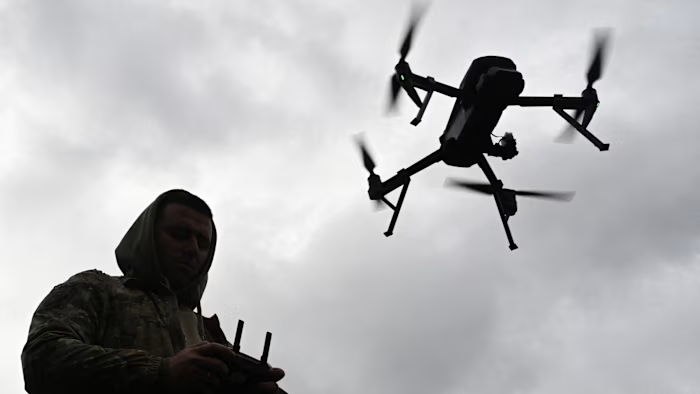
The US military will lead high-tech monitoring of any ceasefire line in Ukraine to allocate blame for possible violations, according to two people briefed on proposals being negotiated by Kyiv and its western allies.
The detailed proposal for a US-led unmanned system using sensors, drones and satellites to adjudicate on possible attacks by either Russian or Ukrainian forces was discussed in the latest talks between the US, Ukraine and Kyiv’s “coalition of the willing” of western backers in Paris on Tuesday.
The ceasefire monitoring would complement and show Washington’s support for a postwar, European-led “reassurance force” in Ukraine.
A joint statement drafted ahead of the meeting and set to be published afterwards stated: “There will be a continuous, reliable ceasefire monitoring system. This will be led by the US with international participation, including contributions from members of the Coalition of the Willing.”
“US capabilities such as intelligence and logistics” would be part of the European-led air, sea and land deterrence force, according to the draft document seen by the Financial Times, “with a US commitment to support the force in case of attack”.
The ceasefire-monitoring capability is seen by European capitals as a significant step by the Trump administration to maintain support for the country and ensure its postwar future.
The Paris talks mark the most significant offer from Washington to participate in the multinational effort aimed at reassuring Ukraine that it will not suffer renewed Russian aggression after any end to the full-scale invasion launched by President Vladimir Putin in February 2022.
Two senior Ukrainian officials involved in the talks said Kyiv was so far pleased with the proposed Paris declaration, but acknowledged that significant work on it remained. The key now, said one of the officials, was how the declaration could be turned into a binding agreement and how quickly. Details from the declaration were first reported by Bloomberg.
“One should understand that the Paris declaration is not to substitute the package of drafts in work or any individual one of them,” said a second senior Ukrainian official. “It is a political message from the discussion in today’s meeting. And it’s very important.”
US President Donald Trump’s son-in-law Jared Kushner and his top Russia negotiator Steve Witkoff met Ukraine’s President Volodymyr Zelenskyy and French President Emmanuel Macron in Paris ahead of a larger meeting of dozens of leaders from the coalition, including Alexus Grynkewich. commander of the US armed forces’ European command.
Grynkewich, who also serves as Nato’s supreme commander, has played an increasingly prominent role in the negotiations with Ukraine in recent months and had been the driving force behind advancing the technical details of the ceasefire monitoring initiative, the officials added.
Senior military officials from the coalition met ahead of the leaders’ talks in Paris to discuss the monitoring proposals and separate pledges by European allies to provide concrete security guarantees to postwar Ukraine in order to uphold the ceasefire.
The US-led peace talks with Ukraine and its backers have not yet involved trilateral discussions with Russia. It is not clear how much, if any, of the proposals Moscow would accept.
The Kremlin has said it would reject any changes to Trump’s initial proposal from the autumn, drafted with input from Moscow, and said it would toughen its stance further after accusing Ukraine of targeting one of Putin’s residences.
Trump initially backed the Russian claims but said last week the US had determined Ukraine did not attack the residence. The US president also said he was “not thrilled with Putin”, who he said was “killing too many people”.
An updated 20-point peace plan being negotiated contains various clauses on support to Kyiv, concessions to Russia and postwar benefits that would be reversed in the event of fresh aggression by either side. Officials involved in the negotiations said that meant a trustworthy and neutral monitoring system was critical to a potential agreement.
“Therefore, we must ultimately agree on how this ceasefire can be observed, monitored and verified — not through the deployment of soldiers, because we are talking about a 1,400km line and the presence of soldiers on the line makes no sense, either tactically or strategically,” said an Élysée official.
Sticking points remained on how to characterise possible ceasefire violations, officials said. After Russia’s initial invasion of Crimea and eastern Ukraine in 2014, violations of an agreed ceasefire line were reported every day.
Recommended

Under the so-called Minsk agreements of 2014 and 2015 there was no clarity in the line of contact between the two sides, no fully fledged disengagement zone to keep forces apart and no accountability for ceasefire violations.
Ukrainian officials also claimed unarmed monitors from the Organization for Security and Co-operation in Europe, the body charged with overseeing the ceasefire agreement, were not robust enough to call out ceasefire breaches. Kyiv is determined to ensure this time any truce is properly enforced.
“What is very important is that we all have the means to observe the situation on the ground. This is done with technical resources, drones, satellites, etc,” the Élysée official said, adding that it would also require “that we — Americans, Europeans and Ukrainians — are collectively clear on what we must do should the ceasefire be broken”.
The White House and US defence department did not immediately respond to requests for comment.