
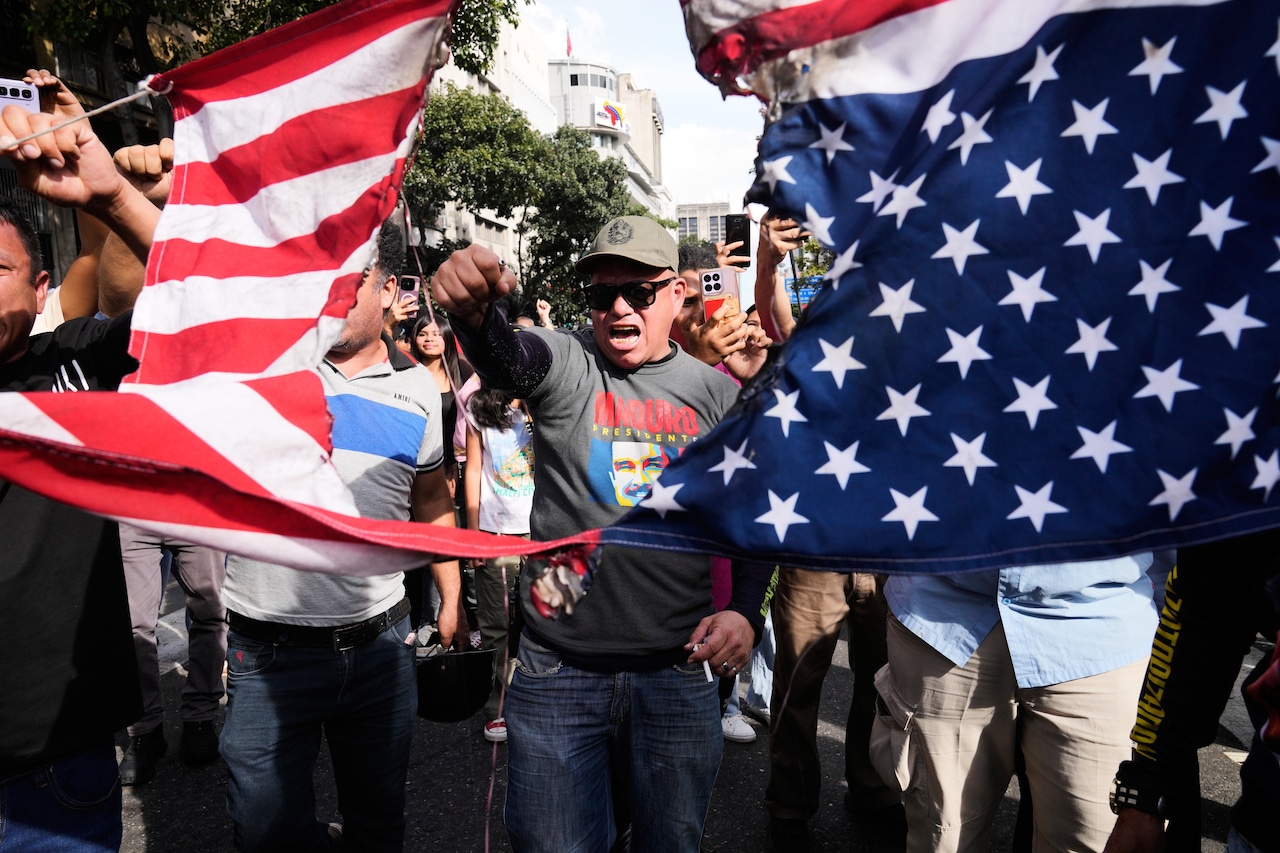
Columbia University professor Jeffrey Sachs warned that U.S. intervention in Venezuela could “carry consequences of the gravest kind” while addressing the United Nations Security Council on Monday.
“The issue before the Council today is not the character of the government of Venezuela,” Sachs said. “The issue is whether any Member State—by force, coercion, or economic strangulation—has the right to determine Venezuela’s political future or to exercise control over its affairs.”
Sachs, who serves as president of the UN Sustainable Development Solutions Network, painted a bleak picture of Venezuela’s possible future after President Donald Trump’s stunning operation to capture and arrest Venezuelan President Nicolas Maduro on Jan. 3.
Trump’s claim that the U.S. is now “in charge” of the oil-rich South American nation, Sachs said, was reminiscent of previous regime-change operations undertaken by American forces in Iraq, Libya, Syria and Honduras.
“The methods employed are well established and well documented,” Sachs said. “They include open warfare; covert intelligence operations; instigation of unrest; support for armed groups; manipulation of mass and social media; bribery of military and civilian officials; targeted assassinations; false-flag operations; and economic warfare aimed at collapsing civilian life.”
He added that those measures are “illegal under the UN Charter, and they typically result in ongoing violence, lethal conflict, political instability, and deep suffering of the civilian population.”
While Maduro pleaded not guilty to federal drug trafficking charges in a U.S. courtroom on Monday, Trump has loudly declared his intent to take control of Venezuela’s oil industry.
“We’re going to take our oil back,” Trump said. He added that Venezuelan interim leader Delcy Rodríguez would “pay a very big price, probably bigger than Maduro” if she did not cooperate, The Atlantic reported.
However, Rodriguez, Venezuela’s vice president since 2018, has called the seizure of Maduro an “atrocity” and labeled Trump’s administration “extremists.”
Trump also has not mentioned any plans to give the country’s reins to opposition leader Edmundo González, who was kept out of power by Maduro despite winning Venezuela’s 2024 presidential election in overwhelming fashion.
Meanwhile, U.S. ambassador to the UN Michael Waltz reiterated Trump’s message during Monday’s Security Council meeting in New York.
“This is where we live – and we’re not going to allow the Western Hemisphere to be used as a base of operation for our nation’s adversaries, and competitors, and rivals of the United States,“ Waltz said. ”You cannot continue to have the largest energy reserves in the world under the control of adversaries of the United States.”
While Maduro’s dictatorship has seemingly ended, Sachs warned that “anarchy” could envelope Venezuela and further destabilize the nation if the U.S. does not learn from the missteps made in Iraq and other recent regime-change operations.
“The realist school of international relations, articulated most brilliantly by John Mearsheimer, accurately describes the condition of international anarchy as ‘the tragedy of great power politics,’ Sachs said. ”Realism is therefore a description of geopolitics, not a solution for peace. Its own conclusion is that international anarchy leads to tragedy.”