
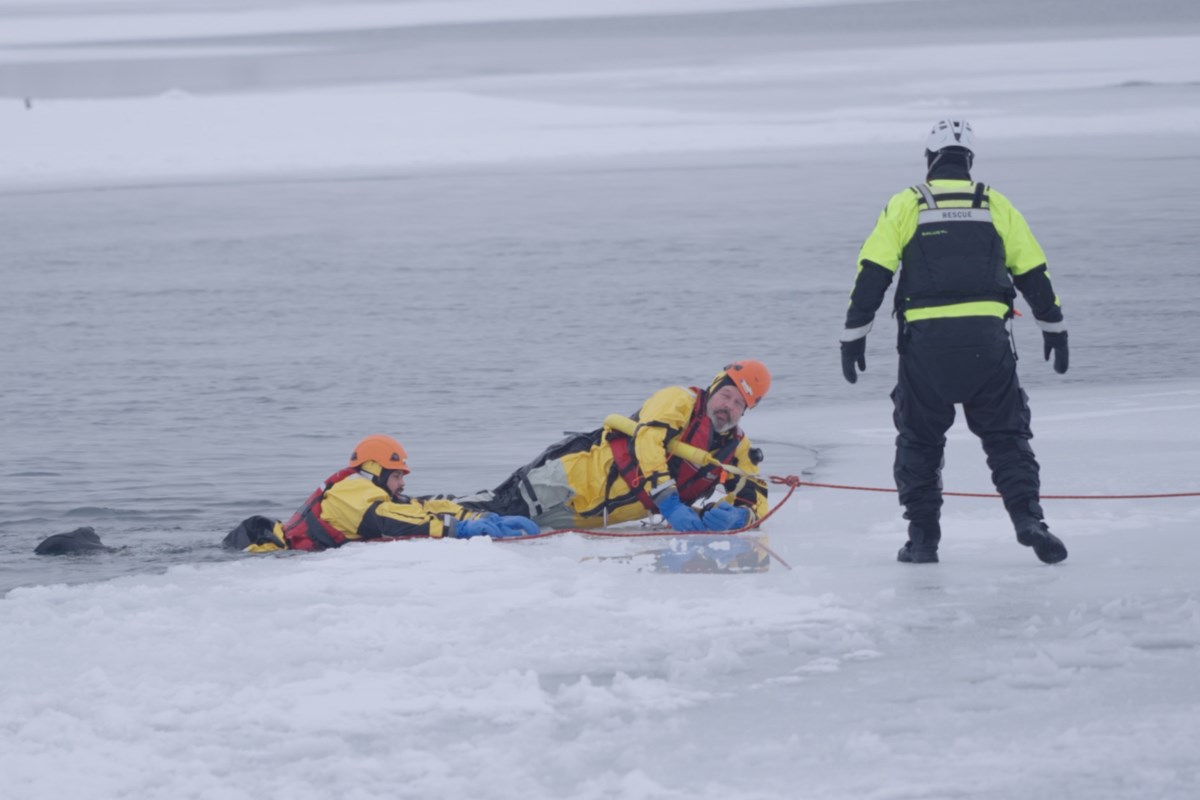
‘When the trainer thinks the ice is soft enough, our guys jump up and down till they fall through,’ said the president of Sault Search and Rescue
The frigid waters at Bellevue Marina were buzzing with activity today as Sault Search and Rescue volunteers performed training on what to do if you fall through the ice.
“The training is about how to get somebody out of the water and how to deal with them when they’re out of the water,” said Randy Roy, Sault Search and Rescue president.
Nine SSAR volunteers were receiving instruction from Access Rescue Canada, a southern Ontario-based private rescue training company.
Sault firefighters were also present at Bellevue Marina to conduct their own ice rescue training.
“We sent two guys away last year to get this training and we thought it was so valuable that we brought this company in to train these people,” Roy said.
A big component of today’s training was self rescue.
“They’re looking at equipment, what they should be wearing, how long they can survive in the water, everything they need to know when they’re out on the ice,” Roy said.
“When the trainer thinks the ice is soft enough, our guys jump up and down till they fall through. Then once they fall through it’s a self rescue situation. They have to pull themselves out,” Roy said.
The volunteers wore flotation gear and special suits sufficient to keep them in the water for up to 50 minutes.
SSAR personnel also performed team rescue scenarios.
“If there’s somebody in the water, they crawl out to them, put a rescue collar around them and pull them out of the water with the rest of the team pulling on the lines to pull them out of the water.
“And then they have situations where they actually have to go in the water, grab the guy, harness them up and then pull them out,” Roy said.
The training is vital as it prepares SSAR volunteers to help others in distress in icy water.
“It’s really important for us. In the last few years we’ve been called out twice to do real life rescues.
“I’ve been out where somebody has fallen through the ice. We’re out in all weather and all conditions. We got a call last year for two people on snow machines that went through the ice. So we never know when the call is going to come in but we like to be prepared,” Roy said.
If someone sees an individual in peril in icy water, call 911 immediately, Roy said.
“Do not waste time. Call 911. If the people that respond think they need us, we’re on 24-hour call for them. They’ll page us and we’ll get a crew out.
“If they need us, they’ll page us and we’ll get there as quickly as we can. A lot of the time we’re there to support another organization (such as police or fire services).”
Wearing a flotation device is crucial for survival but what should a person do if they fall through ice?
“Don’t panic,” Roy said.
“You have one minute to get control of your breathing. You have 10 minutes to figure out what you’re going to do. And if you’re dressed properly and with the right equipment on, you can survive up to an hour.
“Raise your arms to the ice. It will hold you afloat and keep your body above the water. Don’t panic and put yourself in a position where someone can find you.”
No one should venture out alone on icy waters, Roy added.
“You should know the ice you’re on. Ice is not always safe. I remember years ago that I actually had a guy go through the ice. There was three feet of ice and he walked over a spot and went through.
“So, you have to know the situation, you have to know the ice and you have to be prepared,” he said.
Equipment such as ice picks, flotation gear and flotation suits are not overly expensive, available at many retailers and outfitter stores and should be worn while out on ice, Roy said.