Toplines
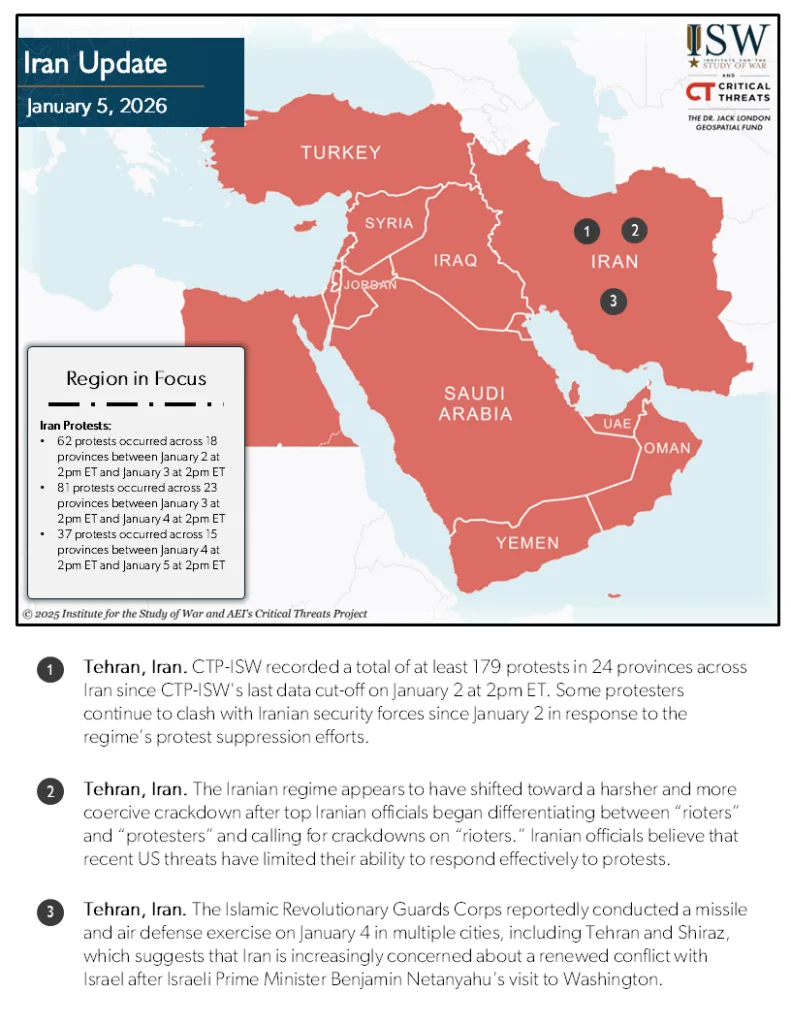
CTP-ISW recorded a total of at least 179 protests in 24 provinces across Iran since CTP-ISW’s last data cut-off on January 2 at 2 pm ET.[1] The following number of protests have occurred since January 2:
· 62 protests occurred across 18 provinces between January 2 at 2 pm ET and January 3 at 2 pm ET.[2]
· 81 protests occurred across 23 provinces between January 3 at 2 pm ET and January 4 at 2 pm ET.[3]
· 37 protests occurred across 15 provinces between January 4 at 2 pm ET and January 5 at 2 pm ET.[4]
CTP-ISW has recorded a total of 369 protests in 28 of the 31 provinces across Iran since the protests began on December 28.[5]
CTP-ISW recorded 17 medium-sized protests, which CTP-ISW defines as more than 100 participants, across Iran since January 2.[6] The Governor of Qom Province told Iranian state media on January 4 that around 150 to 200 people participated in the protests in Qom Province on the night of January 2 and 400 to 450 people on January 3, most of whom were between the ages of 14 and 28.[7] CTP-ISW cannot confirm the number of protestors in Qom on these dates.
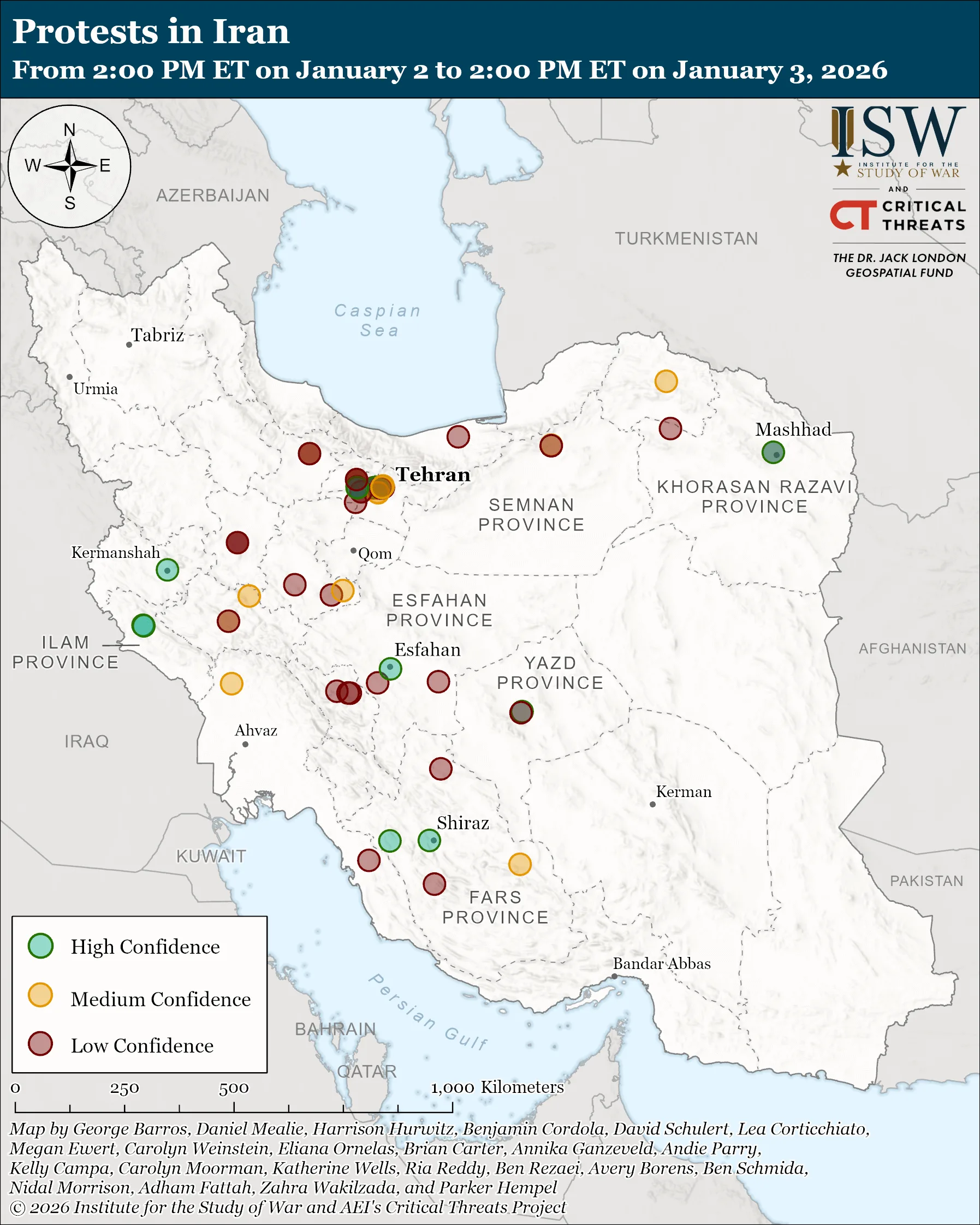
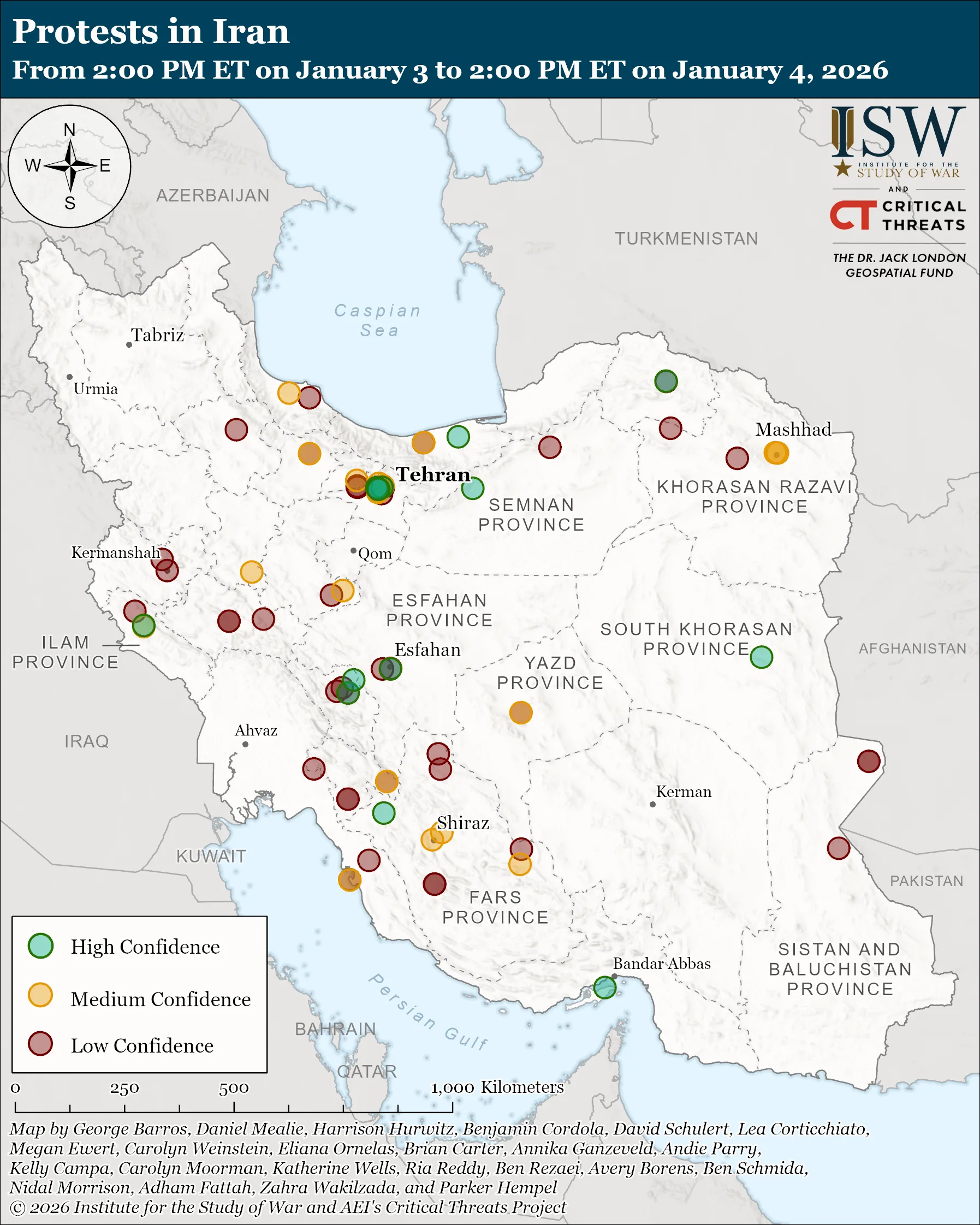
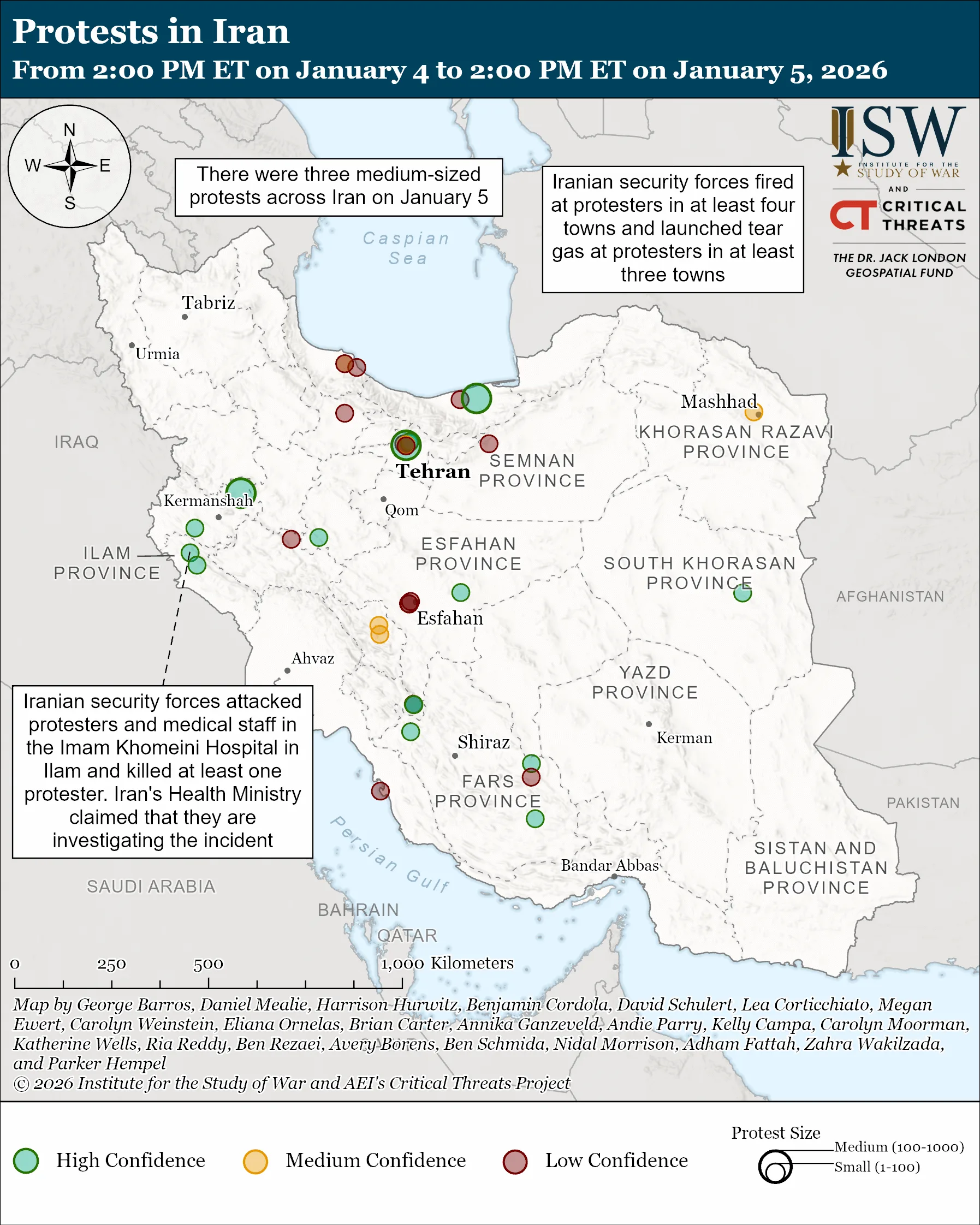
Some protesters have continued to clash with Iranian security forces since January 2 in response to the regime’s protest suppression efforts. An individual brandished a rifle and shot into the air while chanting “Death to Khamenei,” allegedly in a protest in Sarableh, Ilam Province, on January 4.[8] CTP-ISW cannot confirm if this incident happened at a protest or if the video was new. Iranian protesters also threw Molotov cocktails at Iranian security forces in Shazand, Markazi Province, and Lahijan, Gilan Province, on January 4 and 5, respectively.[9]
The Iranian regime appears to have shifted toward a harsher and more coercive crackdown after top Iranian officials began differentiating between “rioters” and “protesters” and calling for crackdowns on “rioters.” Iranian Supreme Leader Ali Khamenei delivered a speech on January 4, stating that while protesting is acceptable, it differs “from rioting.”[10] Khamenei added that speaking with “rioters” is useless and noted that “rioters should be put in their place.”[11] Iranian Judiciary Chief Gholam Hossein Mohseni Ejei similarly called for the judiciary to act decisively against rioters and said that ”this time [the regime] will show no mercy to the rioters.”[12] Mohseni Ejei also stated on X on January 5 that “this time, we [the regime] will show no mercy to the rioters.”[13] Armed Forces General Staff Chief Major General Abdol Rahim Mousavi stated during a meeting with Law Enforcement Command (LEC) commanders on January 4 that the LEC will “put the rioters in their place” with public support.[14]
These aggressive statements by top officials come amid growing reports of arrests and casualties linked to the protests. Iranian authorities have arrested nearly 1,000 people, including minors, and killed at least 16 people since the protests started on December 28.[15] Several media outlets reported that Iranian security forces raided a hospital in Ilam City, Ilam Province, to arrest wounded protesters.[16] Security forces also fired tear gas into the hospital compound and entered the wards and rooms to search for injured protesters.[17] Malekshahi, Ilam Province, in western Iran, has been a main focal point of protest activity and regime repression in recent days.[18] Islamic Revolutionary Guards Corps (IRGC)-affiliated Fars News Agency claimed on January 3 that some unrest in western provinces has taken the form of “organized cells” and ”semi-militant attacks.”[19] The IRGC Hazrat-e Abolfazl Unit in Lorestan Province, western Iran, also issued a statement on January 5 and warned that the “appeasement period” toward “elements of unrest” has ended, citing recent remarks by the Supreme Leader.[20]
Iranian officials appear to have considered a less violent approach to contain the protests, but have since shifted toward a harder and more coercive crackdown after Khamenei’s January 4 speech. Three unspecified Iranian officials told the New York Times on January 4 that the Iranian Supreme National Security Council (SNSC) held an emergency meeting on January 2 to discuss containing the protests with “less violence” in order to avoid fueling public anger.[21] The SNSC convened on January 2, before Khamenei’s speech on January 4. Both Mousavi and Mohseni Ejei are also SNSC members.[22] Mousavi’s and Mohseni Ejei’s statements suggest that the regime has shifted toward a harsher approach to suppress ongoing protests, however.
Iranian officials believe that recent US threats have limited their ability to respond effectively to protests. Unspecified Iranian officials told Reuters on January 5 that US President Donald Trump’s threat to intervene in Iranian protests has complicated Iran’s efforts to quell recent anti-government protests.[23] Trump told reporters on January 4 that the United States will “hit [Iran] hard” if the Iranian regime continues to violently target protesters as it has done in the past.[24] One Iranian official noted that some Iranian officials fear that the United States may target Iran after the January 3 US strikes in Venezuela.[25] Another unspecified Iranian official noted that these external pressures have narrowed the regime’s room to maneuver between public anger and protests, and hardening US demands, leaving Iranian leaders with the perception that there are “few viable options and high risks on every path.”[26]
The IRGC reportedly conducted a missile and air defense exercise on January 4 in multiple cities, including Tehran and Shiraz, which suggests that Iran is increasingly concerned about a renewed conflict with Israel after Israeli Prime Minister Benjamin Netanyahu’s visit to Washington.[27] IRGC-affiliated media previously reported on December 22 that the IRGC Aerospace Force launched missiles as part of a missile exercise in unspecified locations in five provinces.[28] Iran reportedly conducted a missile launch in an unspecified location in Ilam Province, near Iran’s western border with Iraq, on December 30.[29] CTP-ISW cannot independently verify these reports. Iran’s reported missile exercises highlight the regime’s concerns about a renewed Iran-Israeli conflict as Iran tries to prepare its air defense systems and missile capabilities. The Israel Defense Forces (IDF) established air superiority over western Iran and Tehran by destroying over 40 Iranian air defense systems in the first 24 hours of the June 2025 Iran-Israel War.[30]
The Riyadh-based, Saudi-supported Yemeni President and Presidential Leadership Council (PLC) President, Rashad al Alimi, summoned Southern Transitional Council (STC) leaders to Riyadh on January 4 for “discussions,” likely as part of a Saudi effort to pressure the STC to end its hostilities against the Saudi-backed National Shield Forces (NSF).[31] Emirati-backed STC forces seized key areas of Hadramawt and Mahra governorates in eastern Yemen in early December 2025, which triggered an NSF counteroffensive on January 2.[32] A Yemen analyst reported that Alimi summoned senior STC leadership, including STC Vice President and PLC Vice President Abu Zaraa al Muharrami, for a PLC meeting in Riyadh on January 4.[33] Alimi summoned the STC officials to discuss recent events in southern Yemen and to prepare for a Saudi-hosted conference for all southern Yemeni factions ”to discuss just solutions to the southern cause,” which Alimi requested on January 2.[34] STC President and PLC Vice President Aidarous al Zubaidi reportedly did not attend the January 4 PLC meeting, however.[35] STC leadership, including Muharrami and STC Vice President and PLC Vice President Tariq Saleh, also met with Saudi Defense Minister Khalid bin Salman in Riyadh on January 3 and 4 to discuss Saudi-Yemeni coordination to stabilize Yemen.[36]
Saudi Arabia almost certainly backs Alimi’s summons in order to reunify Yemen’s anti-Houthi factions and de-escalate the conflict between the Republic of Yemen Government (ROYG) and STC. Yemeni actors will presumably view Alimi’s summons as a summons from Saudi Arabia. Saudi Arabia frequently uses the legitimacy of its Yemeni partners to provide a Yemeni veneer to Saudi political maneuvers. Saudi Arabia similarly gathered Yemeni factions in Riyadh in 2022 before orchestrating the ouster of former Yemeni President Abed Rabbo Mansour Hadi and his replacement with Alimi.[37] Saudi Arabia could use the summons to reprimand the STC and attempt to compel it to de-escalate with Alimi and northern Yemeni factions within the ROYG.
STC officials’ support for the Saudi dialogue conference suggests that the STC may be willing to ease tensions and increase dialogue with the Yemeni government.[38] STC-affiliated media reported on January 5 that Zubaidi and STC leadership held a cabinet meeting in Aden, during which STC members praised Saudi Arabia’s efforts to hold the southern Yemeni dialogue conference and affirmed their readiness to “actively participate in ensuring the conference’s success.”[39]
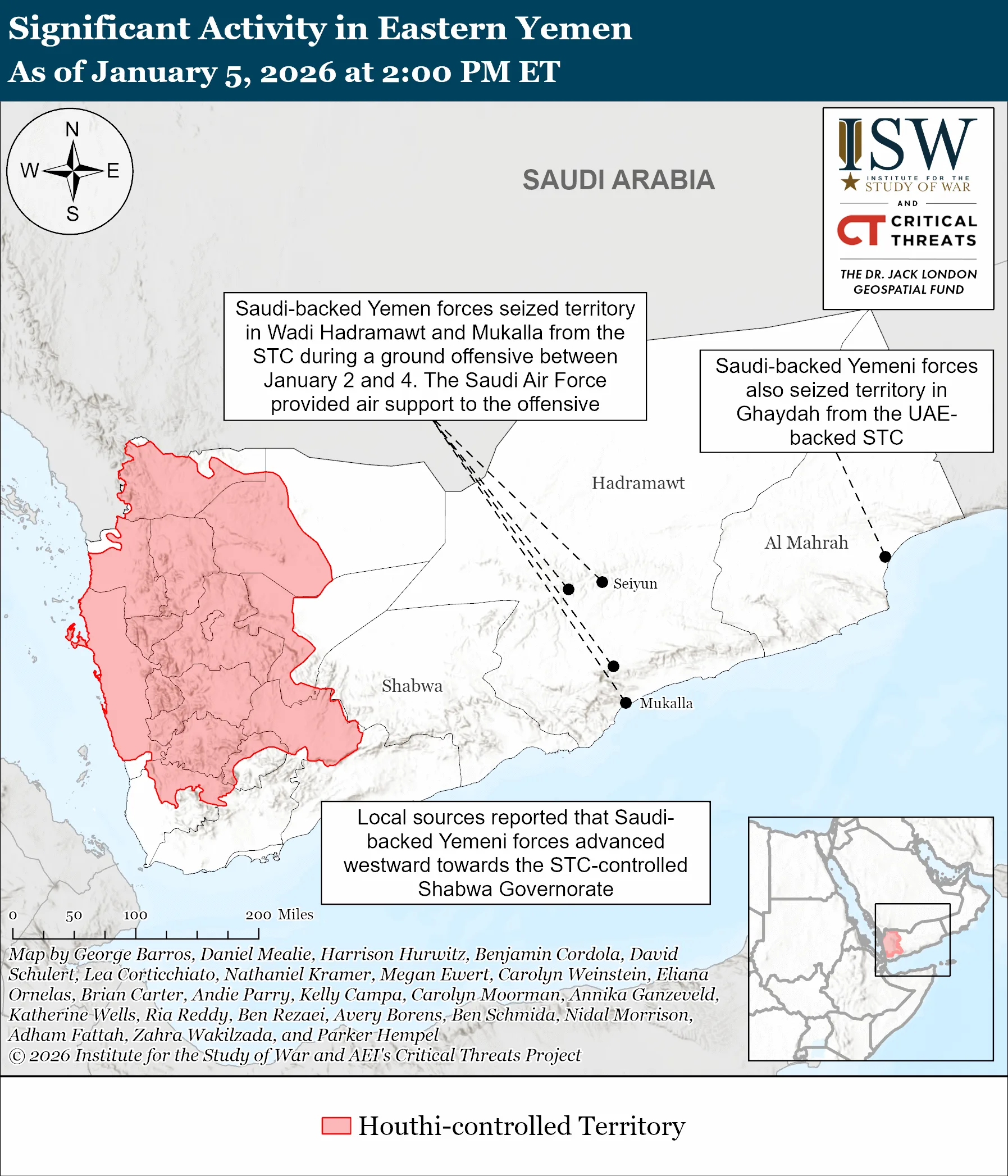
The Saudi-backed NSF, supported by Saudi airstrikes, forced the Emirati-backed STC to withdraw from Hadramawt and Mahra governorates between January 3 and 5. It is unclear to what degree the STC withdrew under pressure, but there were relatively few ground engagements reported in Yemeni media.[40] The NSF, with significant Saudi air support, advanced from Khashaa, Hadramawt Governorate, through Wadi Hadramawt to seize al Qatn and Seiyun, Hadramawt Governorate, on January 2 and 3, according to local Yemeni media.[41] NSF commander and ROYG Hadramawt Governor Salem al Khanbashi called on STC forces to withdraw from both areas.[42] Saudi Arabia supported Khanbashi’s call and conducted airstrikes targeting the STC units that did not comply.[43] Yemeni media reported that NSF forces then seized al Adwas, Hadramawt Governorate, on January 3, and allowed STC forces to withdraw to Aden Governorate after surrendering heavy weaponry and armored vehicles.[44] Yemeni and the Associated Press reported that NSF units seized Mukalla, Hadramawt Governorate, and al Ghaydah, Mahra Governorate, on January 4, and have since begun to establish ”security and stability duties” in Mahra Governorate.[45] Military sources told Yemeni media on January 4 that the STC has begun to reinforce positions in Shabwa Governorate with STC units that withdrew from Hadramawt Governorate alongside reinforcements from Aden, Lahij, and Dahle governorates.[46] Yemeni media reported that NSF forces began to advance toward Shabwa Governorate on January 5.[47]
Syrian government and Syrian Democratic Forces (SDF) leadership met in Damascus on January 4 to negotiate the SDF’s integration into the Syrian state after the initial integration deadline passed on December 31, 2025.[48] The SDF’s media office announced on January 4 that the parties did not finalize an integration agreement, but that periodic meetings will continue.[49] The SDF delegation consisted of SDF commander Mazloum Abdi and General Command members Sozdar Derik and Sipan Hemo.[50] SDF sources reported that Combined Joint Task Force-Operation Inherent Resolve Commander Brigadier General Kevin Lambert also attended the meeting.[51]
This meeting indicated that the Syrian transitional government and Turkey have chosen—at least in the near term—to pursue diplomacy rather than using military force to integrate northeastern Syria and the SDF into the state, even as the agreement term ”expired.”[52] Turkey has repeatedly threatened to attack the SDF if it failed to integrate into the Syrian state by the end of 2025 and has expressed concerns about the future security situation in northeastern Syria if the SDF retains its current influence there.[53] Turkey slightly reversed this position throughout December 2025, and on December 31, the Turkish government said that it supports the Syrian government’s efforts to extend negotiations.[54]
The SDF and Syrian government still disagree over fundamental issues for the future of Syria, however. SDF officials reiterated their fundamental negotiating positions before the meeting, including the centralization of state power, which indicates that the Syrian government and the SDF still disagree on their vision for a Syrian state.[55] The Syrian transitional government insists that a central authority should rule Syria through appointed governors and views SDF decentralization as a path toward secession.[56] The SDF views decentralization as a way to secure local authority over regional affairs and sees the government’s push to concentrate power in Damascus as an attempt to impose autocratic rule.[57]