
Stay informed with free updates
Simply sign up to the War in Ukraine myFT Digest — delivered directly to your inbox.
The writer is president of the Kyiv School of Economics and a former minister of economic development, trade and agriculture in Ukraine
Whether our war with the Russian empire ends in weeks, months or years, all Ukrainians know that the big question for our future is this: how do we build a new Ukraine that is stronger, freer and more prosperous than the one that Vladimir Putin invaded in 2014 and 2022? How do we avoid the pitfalls of corruption and cronyism, bureaucracy and inefficiency, that made us vulnerable to a tyrant’s aggression?
The answer is simple to describe but will be difficult to deliver. We will need to harness the same approaches that have enabled the Ukrainian armed forces to resist a full-scale invasion by one of the largest and best-equipped armies in the world over the past couple of years.
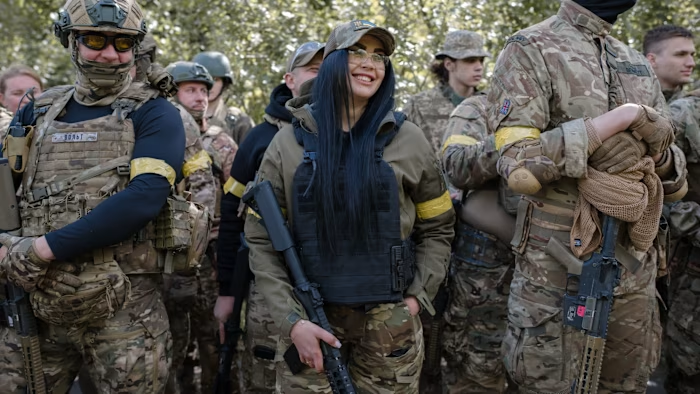
First, we need to spread a start-up culture throughout the government and civilian economy. In wartime, it has been military units like Khartiia and the 3rd Assault Brigade that have transformed the methods and morale of the Ukrainian military and made it a world leader in technological innovation and tactical agility.
After the war, government departments and state-owned businesses must institutionalise the same approach. They should create small and agile teams with the authority to bypass bureaucracy and deliver quick but effective fixes to problems. We need ministers to follow the example of defence minister Mykhailo Fedorov, former minister of digital transformation, and treat policy challenges like engineering, adopting “tech” methods of decomposition — breaking down a problem into smaller parts — prototyping and rapid testing.
Second, we need to copy the armed forces’ relentless focus on results. Commanders in Ukraine’s best battalions are assessed against a range of measures — the value of enemy equipment destroyed per mission and the efficiency of strikes by type of equipment used. The results are translated into electronic scores which are then used to support procurement, resource allocation and personnel promotions.
After the war, the government should adopt a set of deliverables (energy resilience, defence output, investment inflows, school recovery, anti-corruption enforcement) and publish regular progress reports on each measure. Ministers and officials should be promoted and rewarded based on the outcomes they deliver. Budgets and procurement should be open and subject to independent audit. A focus on results combined with intense accountability and radical transparency can apply the shock treatment that lethargic bureaucracies need to become dynamic and productive.
Third, we need to invest in our natural strengths: people and innovation. We didn’t hold off the invaders because we had bigger tanks or more artillery. We did so by being cleverer and more creative. We designed new drones for both airborne and maritime deployment, developed experimental methods and tactics in applied laboratories and trained our troops to exploit the possibilities offered by artificial intelligence and big data.
After the war, we need to increase the amount we spend on the education of the maths, science and engineering students who will become the authors and enablers of the technologies of the future. At the Kyiv School of Economics, we spend $10,000 per student while most publicly funded Ukrainian universities spend far less than $3,000 by my estimation.
We need to accompany increased spending on students’ education with investment in laboratories and research infrastructure to underpin our burgeoning military, health and agritech sectors.
There are few places in the world where the new possibilities of AI have been put to faster or more practical use than in Ukraine’s fight against Russia. We must make our country a centre for the rapid application of AI to civilian purposes too.
If we tear up the old Soviet ways of doing things and embrace a culture that values people who innovate and achieve results, we can build a new Ukraine. Like the people of West Germany after 1945, and the people of South Korea after 1953, like our neighbours in Poland after 1989, we can become an example to the free world. As a member of the European Union, and a close ally and partner of the United Kingdom and the United States, we can build a fortress of freedom and prosperity out of the rubble of war.
In 2022 the Ukrainian people discovered within themselves the capacity for greatness and astonished the world. We can do it again.