
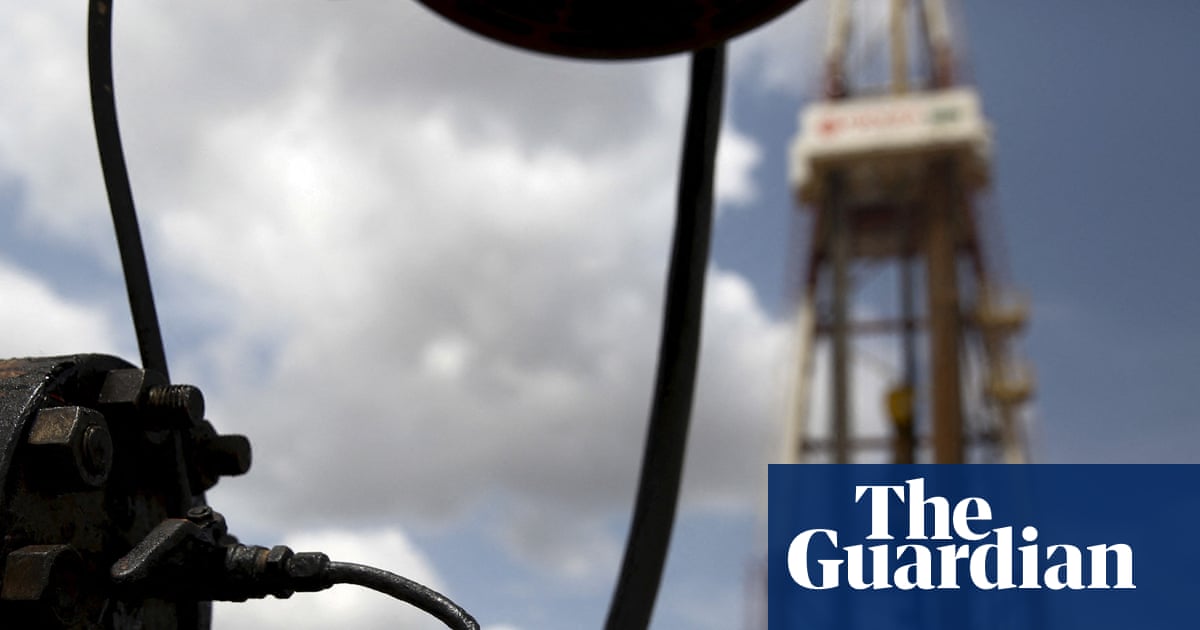
Venezuela will reportedly continue supplying oil to the US beyond the initial 50m barrels announced by Donald Trump after the American military’s capture of Nicolás Maduro.
The US would remove some sanctions on Venezuela to allow sales of oil “indefinitely”, according to the broadcaster CNBC, which cited White House sources.
Trump said on Tuesday that Venezuela would hand over 30m to 50m barrels of the country’s blockaded crude to the US. The deal would give the US president the power to sell up to $3bn (£2.2bn) worth of Venezuelan crude stranded in tankers and storage facilities into an already oversupplied global market.
A continuing supply of crude from Venezuela could act as a drag on oil prices, which last year recorded their steepest annual fall since the Covid pandemic and could plummet further as oil producers continue to pump more than needed by the global economy.
Global oil prices fell on Wednesday, although they recovered some ground in morning trading in New York. The international benchmark, Brent crude, fell to just over $60 a barrel on Wednesday, while the US oil price fell by 0.9%, to $56.72 a barrel, after earlier falling below $56.
The oil grab also raises the prospect of a disruption to Venezuela’s oil exports to China, which takes about 80% of its crude exports, potentially forcing Beijing to pay higher prices for its crude and increasing tensions with the White House.
China’s foreign ministry said on Wednesday that Venezuela “enjoys full and permanent sovereignty over its natural resources and economic activities” and US demands for the country to hand over its oil “violate international law, infringe upon Venezuela’s sovereignty, and harm the rights of the Venezuelan people”.
In a post on his Truth Social platform late on Tuesday, Trump said: “That money will be controlled by me, as President … It will be taken by storage ships, and brought directly to unloading docks in the United States.”
Trump has said he wants Venezuela’s interim president, Delcy Rodríguez, to give the US and private companies “total access” to Venezuela’s oil industry. The US energy secretary, Chris Wright, is in charge of executing the deal, Trump said, adding that the oil would be taken from ships and sent directly to US ports.
Wright said on Wednesday that the Trump administration plans to control future sales of Venezuelan oil and use the proceeds to rebuild the country’s economy. “If we control the flow of oil and the flow of the cash that comes from those sales, we have large leverage,” he told a Goldman Sachs energy conference in Miami. “We need … control of those oil sales to drive the changes that simply must happen.”
The US will seize control of Venezuela’s crude days after Saturday morning’s attack on Caracas led to the capture of the then president, Nicolás Maduro, and after Trump vowed that US companies would reignite the country’s struggling oil industry.
US oil executives from Chevron, ConocoPhillips and ExxonMobil are expected to meet Trump at the White House on Friday to discuss plans to pour billions of dollars into the industry in Venezuela.
Chevron is the only US oil company that still operates in the country after the assets of ConocoPhillips and Exxon were nationalised by the former president Hugo Chávez in the mid-2000s, a move Trump has described as “the greatest theft in the history of America”.
The US oil majors have so far declined to outline publicly any such plans for investment and there is scepticism that big listed companies would be willing to invest in a political unstable region amid falling global oil prices without iron-clad guarantees that their investments would be protected.
There is also scepticism over whether Venezuela, which holds the world’s largest reserves of crude, could once again produce meaningful amounts after years of neglect and corruption that caused its output to fall from highs of 3.5m barrels of oil per day 25 years ago to about 1m bpd – or less than 1% of the global market.
The multibillion-dollar investment needed to increase Venezuela’s oil production to its heyday in the late 1990s could require 15 years of work to repair the country’s degraded infrastructure and capital spending of up to $185bn, according to analysis by Rystad Energy, a global consultancy.
The US Department of State was approached for comment.