
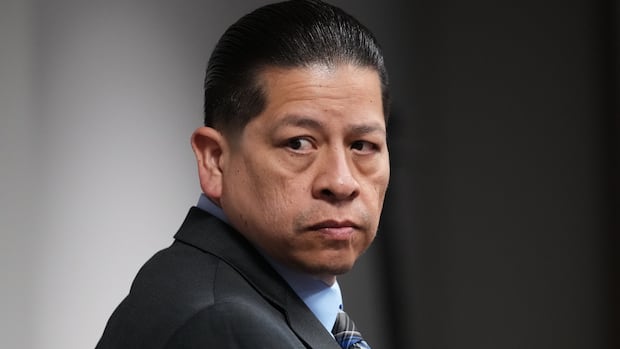
The first day of the trial of a police officer who responded to the 2022 shooting at a Texas elementary school that killed 19 students and two teachers was interrupted on Tuesday after a witness provided testimony not previously presented to the defence.
Texas state Judge Sid Harle dismissed the jury until Thursday and ordered the prosecution and defence to return on Wednesday to work through the issues raised by the testimony from a former teacher at the Robb Elementary School in Uvalde.
The defence’s objections to the testimony could lead to it being stricken, or to the extreme and rarely granted remedy of a mistrial.
Former Uvalde school district police officer Adrian Gonzales, 52, is on trial in Nueces County Court in Corpus Christi for his role as one of 376 officers from local, state and federal agencies who responded to the shooting.
Police were criticized for waiting 77 minutes before entering a Robb Elementary School classroom where the gunman was holed up, despite teachers and children making lengthy calls to 911 emergency services, saying they were in the room with the gunman and surrounded by bodies.
Gonzales pleaded not guilty on Tuesday before opening statements began in the courtroom in Corpus Christi, where the trial was moved after the defence successfully argued he could not get a fair trial in Uvalde.
WATCH | Police response ‘an abject failure’: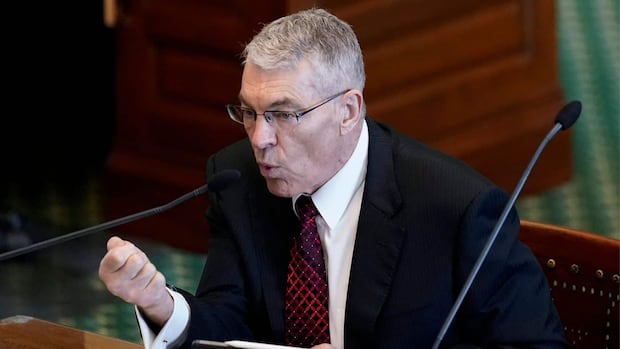
Police response to Uvalde shooting called ‘abject failure’
A hearing into how police handled the mass shooting in Uvalde, Texas, heard that police arrived just three minutes after the gunman, but left him alone in the school for more than an hour; a response one official called ‘an abject failure.’Teacher testimony surprises defence
Stephanie Hale, who was teaching at Robb Elementary the day of the attack, struggled through tears to describe running with students from the playground to the school building and hiding in a classroom.
She testified that she saw the gunman on the south side of the school and also that she saw dust kicked up on that side of the school, potentially indicating that shots were fired.
Defence lawyer Jason Goss, during cross-examination, said he was surprised by Hale’s testimony, adding that she did not tell police or a grand jury about seeing the gunman or seeing dust kicked up when she spoke with investigators after the shooting.
Hale was then allowed to listen to the interview she gave investigators shortly after the shooting, without the jury present.
Goss asked Hale if she would now agree that she never told investigators that she had seen the gunman or dirt flying up, to which Hale replied, “Correct.”
Hale was then asked by Goss if, during preparation for the trial, she had told prosecutors details about seeing the gunman and the dirt, to which she replied, “I believe so, yes.”
Goss said that if Hale had reported such matters to the prosecution, his side was entitled to have been informed before trial under U.S. law.
“This is a trial by ambush,” Goss said in court, evoking the legal requirement that the prosecution not be surprised by the defence with evidence.
Uvalde County District Attorney Christina Mitchell, who is overseeing the prosecution, told the judge that Hale had never told her team the specific location where she had seen the gunman or that she saw dirt flying up.
Outside court, the main defence lawyer, Nico LaHood, told reporters that a mistrial “is a remedy allowed by law, but we’re not saying we’re going to take that remedy or not, or argue for that remedy.”
WATCH | What happened during the shooting: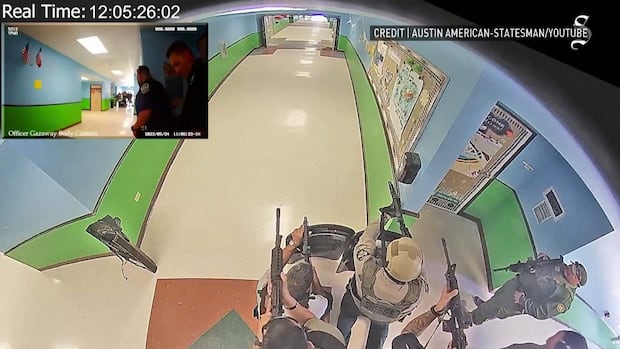
Video shows police response during Uvalde, Texas, school shooting
Edited hallway video and audio from Robb Elementary School in Uvalde, Texas, released by the Texas’ Austin American-Statesman newspaper shows the shooter entering the school. It also shows how police later arrived but stayed in the hallway both during and after the shootings. WARNING: This video is disturbing and contains the sound of gunfire.Police stayed outside as shooting began: prosecution
Gonzales, who had spent a decade as a Uvalde city police officer before joining the school district’s force about a year before the shooting, was charged in 2024 with 29 counts of child endangerment. His indictment said that he “failed to engage, distract and delay the shooter” and that he also failed “to follow his active shooter training to respond to gun fire by advancing toward the gun fire.”
Each count carries the possibility of two years in prison.
Special prosecutor Bill Turner told the jury during his opening statement that within seconds after arriving at the school, a teacher told Gonzales where the gunman was and that he had relayed that information over his radio.
Within seconds, the gunman was firing shots with his AR-style rifle from outside the school building into classrooms, and then made his way into the school through a door that had been propped open. He began firing inside the school, while Gonzales remained outside.
“Adrian Gonzales does nothing more than … tell other officers what’s going on,” Turner said, repeatedly choking back tears as he spoke.
The children inside the building were hiding and waiting for officers to come to their aid, the prosecutor added, but Gonzales and other police waited outside “as the slaughter begins.”
Scene was chaotic, situation unclear: defence
Two defence attorneys, in their opening statement, emphasized the chaotic scene and said that at no point did Gonzales see the gunman or fully understand where the gunman was, making it difficult to confront him.
The gunman, who had wrecked his car near the school just minutes before he opened fire inside classrooms, had at first fired on a funeral parlour across the street from the school. When Gonzales arrived soon after, he did not understand the gunman was intent on killing students, but rather thought he was trying to escape the scene of the crash and funeral parlour shooting, the attorneys said.
They said the gunman entered the school about one minute after Gonzales arrived on campus and drove straight toward the only person he saw outside the building — a teacher who they said gave him incorrect information on the shooter’s whereabouts. Gonzales was one of the first three officers to enter the school.
“The government wants to make it seem like he just sat there,” defence attorney Nico LaHood said of Gonzales. “He didn’t just sit there. He did what he could with what he knew at the time.”
“Pure evil visited that precious community,” LaHood said of Uvalde. “But it’s not rectified with injustice.”
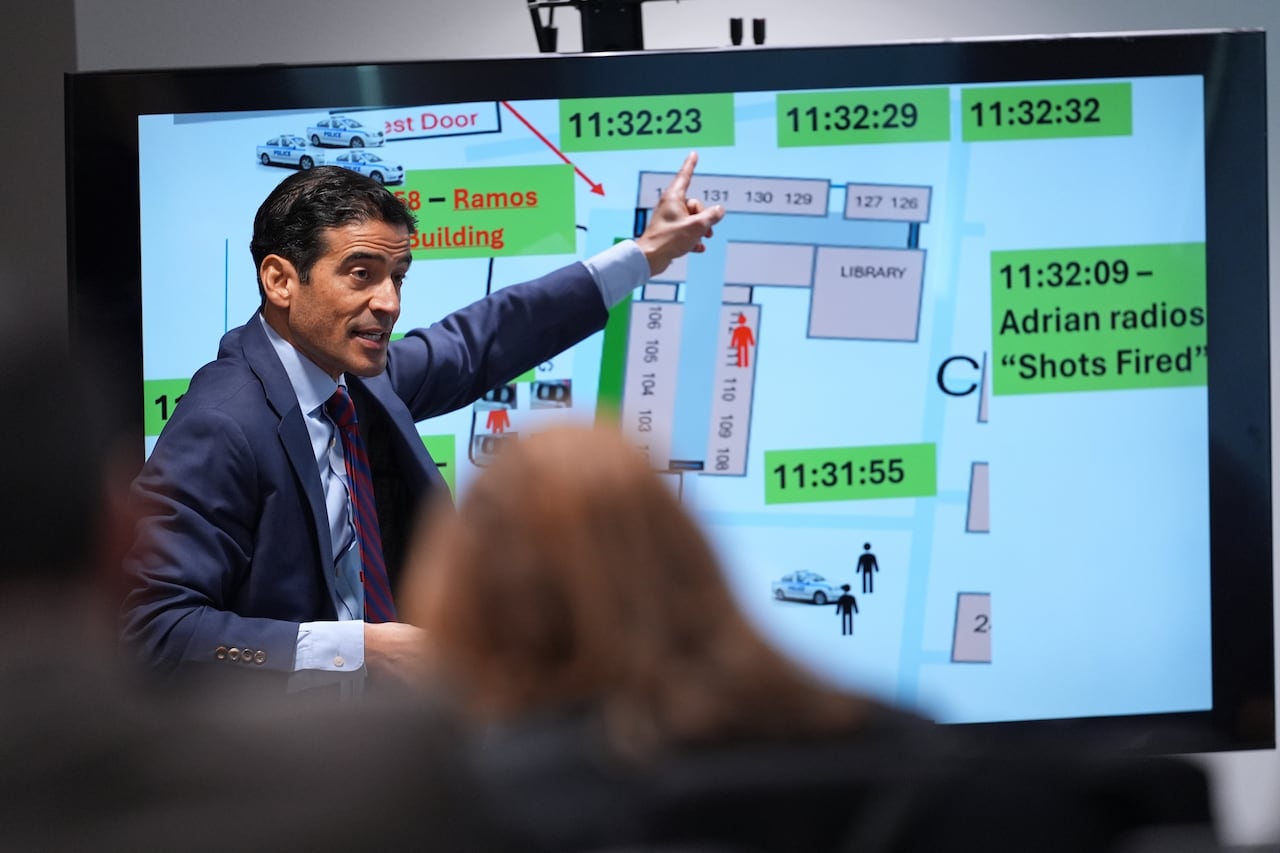 Attorney Nico LaHood makes opening arguments Tuesday during a trial for former Uvalde school district police officer Adrian Gonzales. The trial is taking place in Corpus Christi, Texas. (Eric Gay/The Associated Press )
Gonzales is one of two officers charged in connection with the school shooting.
Pedro “Pete” Arredondo, the former chief of the Uvalde schools police and the person who investigators say was the officer in charge of the scene, faces 10 counts of the same charge. His trial has not yet been scheduled.
Former U.S. attorney general Merrick Garland, in remarks made while presenting the federal report on Uvalde in 2024, said that “lives would have been saved” had the police immediately confronted the gunman.
U.S. school shootings in the past two decades have ignited debates between proponents of gun control measures and defenders of the constitutional right to bear arms, but have resulted in far fewer new restrictions on gun ownership than opponents of firearms would like to see.