
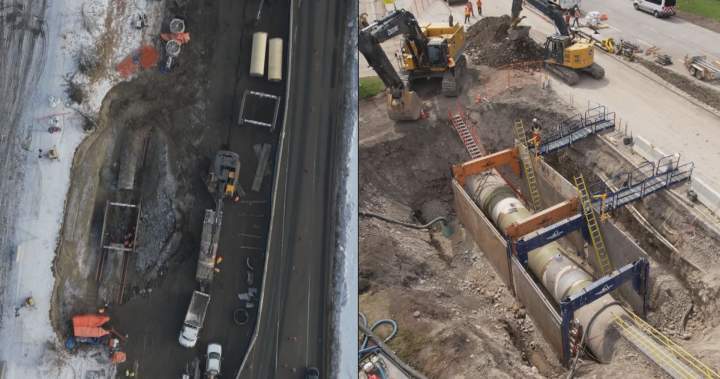
City of Calgary officials are warning the Bearspaw feeder main is at the end of its life, but it remains unclear what that could mean for recurring water conservation efforts until it’s replaced.

Last week, the Bearspaw feeder main, which carries 60 per cent of Calgary’s drinking water, suffered its second “catastrophic” break in less than two years.
Emergency repairs are underway along the ruptured pipe in northwest Calgary, as the new section of pipe has been delivered to the site and installation of the pipe will start after an inspection is completed.
Once water starts flowing through the line again, City of Calgary Infrastructure Services general manager Michael Thompson said it will need to be “run differently” as officials cannot guarantee the pipe won’t rupture again.
“We’ll have to run it at lower pressures and with less water flowing through it,” he told reporters Monday. “That’s why it’s critical that we all save water as we get through this initial repair.”
Story continues below advertisement
2:10
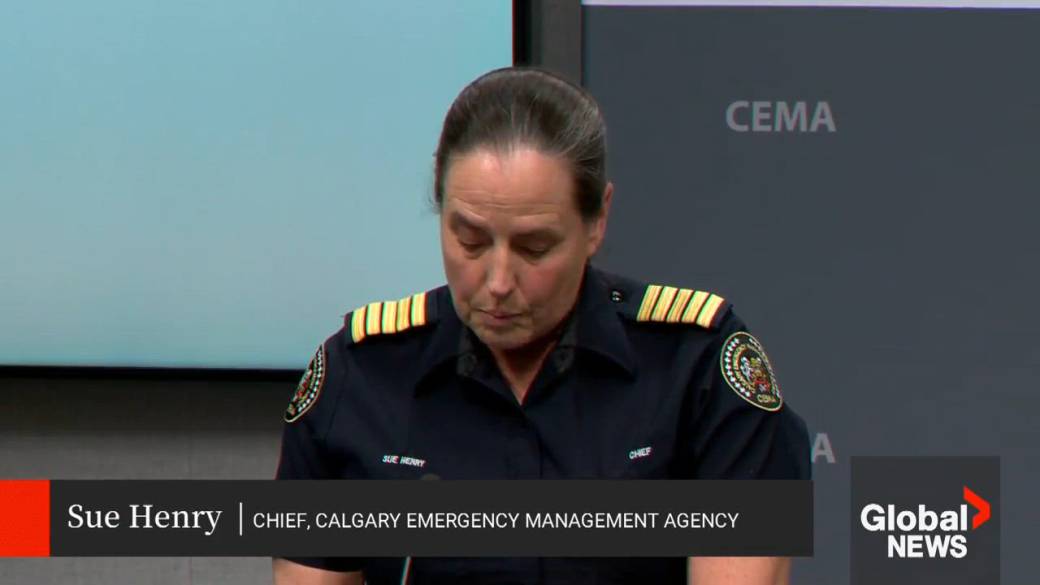
Calgary begins ‘new reality’ of water use restrictions
Ron Hugo, director of the University of Calgary’s Pipeline Engineering Centre, said the move is standard practice when there is damage on a line.
“That in turn reduces the operating pressure and in turn that puts less stress on the pipe itself,” he said
Get daily National news
Get the day’s top news, political, economic, and current affairs headlines, delivered to your inbox once a day.
As a result of the break, Calgary is currently under Stage 4 water restrictions which prohibits all outdoor water use, and Calgarians are being asked to follow voluntary conservation measures like limiting the length of showers.
Thompson said future water conservation plans will be discussed in the future.
“They have to operate at a lower pressure, so less reliance on the Bearspaw feeder main and that puts pressure on the Glenmore Reservoir and the distribution from there,” Hugo said. “So we will need to live with this for a longer duration of time.”
Story continues below advertisement
However, city officials warned water restrictions are likely moving forward due to ongoing repairs to the feeder main.
The water line will need to be shut down in the spring and the fall moving forward “to conduct additional inspections and repairs,” until the pipe is replaced, Thompson said Monday.
City officials are still determining where those repairs will be needed using data and information collected from the current feeder main break to find areas that require reinforcement, similar to the concrete encasement work conducted in the summer of 2024.
City crews are expected to begin surveying on Wednesday around 16 Avenue N.W. and 33 Avenue N.W.
“What it shows is that the line has come to the end of its useful lifespan, and so they have to urgently look at replacing the line,” Hugo told Global News.
Construction on the first phase of replacing the Bearspaw feeder main, between the Shaganappi Pump Station and 73 Street N.W. on the west side of the Bow River, was already scheduled to start this spring.
The second phase continues from 73 Street N.W. to 89 Street N.W., with “a potential extension to the Bearspaw Water Treatment Plant.”
Trending Now

Trump’s actions in Venezuela suggest Canada is ‘on the menu’: ex-UN envoy
WestJet passenger says he was ‘fat-shamed’ by staff on flight to Mexico
A map of the project to replace Calgary’s Bearspaw feeder main.
Global News
The project will replace the six kilometres of feeder main pipe that has been deteriorating since the rupture back in June 2024.
Story continues below advertisement
“We had already accelerated the replacement project, completing the design in eight months instead of two years,” Thompson said Monday. “We now need to bring an increased urgency to this replacement project.”
The project is part of $1.1 billion in new city funding for several water infrastructure projects including a feeder main running north from the Bearspaw Water Treatment Plant as well as new feeder mains in south and northeast Calgary.
City crews plan to use micro-tunnelling on the first phase of the replacement project, due to “existing pipe alignment and significant crossings” near 16 Avenue, the Bow River, Sarcee Trail and the CPKC rail line.
More on Calgary
More videos
Matti Siemiatycki, director of the Infrastructure Institute at the University of Toronto, told Global News the replacement project needs to move forward with “warp speed.”
“Every review needs to be taken by saying how can you do that in half the time? How can you make this go faster? Because the impacts are so severe,” he said.
“Given the urgency, the severity and the cost of this current situation, it can’t stand, and every avenue should be looked at.”
City officials said the plan was to have the Bearspaw feeder main’s placement completed by 2028, but there are plans to accelerate the timeline.
Story continues below advertisement
“We are going to go faster,” Thompson said. “We don’t know what that looks like yet. We have teams working on it and we’re going to get this new pipe installed as fast as we can so the city is not vulnerable going forward.”
© 2026 Global News, a division of Corus Entertainment Inc.