

Listen to this article
Estimated 5 minutes
The audio version of this article is generated by AI-based technology. Mispronunciations can occur. We are working with our partners to continually review and improve the results.
Former City of Winnipeg chief administrative officer Phil Sheegl has paid the city $1.15 million in damages, fees and interest stemming from a 2022 Court of King’s Bench decision that found he accepted a bribe from the contractor responsible for the city’s police headquarters and favoured that contractor in the tendering process.
Current Winnipeg CAO Joseph Dunford informed city councillors Wednesday morning that Sheegl followed through Tuesday on a court order to pay the city $677,200 in damages, $398,800 in legal costs and $75,700 in interest.
“These funds will be recognized in 2026 in the [city’s] general revenue fund as ‘other income,’” Dunford said in an email to all members of council.
The payment of the funds ends one component of a 17-year series of legal and administrative proceedings over the procurement and construction of the Winnipeg Police Service’s downtown headquarters.
The purchase-and-renovation project is the focus of a provincial public inquiry set to begin in earnest in February and has already been the subject of two external audits, a five-year RCMP investigation and two civil lawsuits, including the city’s legal action against Sheegl.
That lawsuit ended with a 2022 King’s Bench decision against Sheegl, which was upheld by a Manitoba Court of Appeal decision the following year.
That 40-page decision stated Sheegl engaged in 14 breaches of duty from 2010 to 2012, when Winnipeg was selecting a contractor to convert the former Canada Post complex on Graham Avenue into a new police headquarters.
Some of those breaches involved providing confidential information to Armik Babakhanians, the owner of police HQ contractor Caspian Construction, as well as manipulating the tendering process to favour Caspian.
In addition to those breaches, the appeal court stated Sheegl accepted $327,200 from Babakhanians in 2011 and was involved in “conjuring up a sham transaction” with Babakhanians in Arizona to try to explain the payments away.
“The evidence of Sheegl’s dereliction of duty is nothing short of staggering,” appeal court Justice Christopher Mainella wrote in that decision on behalf of himself and fellow justices Janice leMaistre and Freda Steel.
Mainella wrote in that judgment the punitive damages awarded by the Court of King’s Bench could have been higher in order to adequately punish and denounce Sheegl for his actions and deter future ethical breaches by municipal officials.
“There can be no reasonable debate that Sheegl failed to provide the city with the required loyal and disinterested advice in several ways during the tendering of contracts on the project, separate and apart from the bribery allegation,” Mainella wrote in the decision.
The appeal court also noted Sheegl refused to disclose relevant emails to the city during the civil lawsuit launched against him by the City of Winnipeg, effectively “obstructing discovery of truth” to the point where the city had to take the “extraordinary remedy” of compelling the RCMP to hand over files compiled during a criminal investigation of the police HQ project.
The appeal court also stated that although former Winnipeg mayor Sam Katz was not a party to the lawsuit and is not accused of any wrongdoing, he can be considered a material witness.
Katz “received precisely half the money” paid to Sheegl by Babakhanians, Mainella noted.
Both Katz and Sheegl are expected to testify at the provincial public inquiry into the police headquarters project, inquiry counsel Heather Leonoff said in September.
Caspian, Babakhanians payment yet to come
Dunford told city councillors the city is still waiting to receive full payment from Babakhanians and Caspian as part of a settlement of a separate civil lawsuit from the city.
The defendants have paid the city $500,000 to date, Dunford said.
The city is entitled to a total $28 million if Caspian and Babakhanians do not pay the city in full by March 24 and the city files for a consent judgement, according to the terms of the settlement.
That settlement includes properties the city can claim from the defendants if the money is not paid in full by March 24, Dunford said.
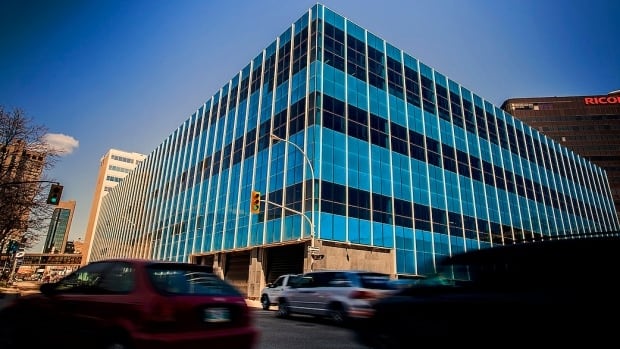 The Winnipeg police headquarters has been the subject of 17 years of administative and legal proceedings. (CBC News )
The Winnipeg Police Service headquarters opened in 2016 after the city spent $214 million buying Canada Post’s former office tower and warehouse complex on Graham Avenue and converting it into a new home for the police force.
City council originally approved the project in 2009 at a total cost of $135 million for both the purchase and construction. The construction component alone ballooned to $137.1 million by 2011 and then eventually to $156.4 million, not including additional work outside the scope of the core contract, described as “soft costs” by the city.
The real estate procurement portion of the project was one of the subjects of a 2014 audit that found the city did not seriously consider any other location for the project.
The construction component of the project was subject to a city-commissioned external audit in 2014 that concluded city procedures were not followed, and a five-year RCMP investigation that concluded in 2019 without any charges.