
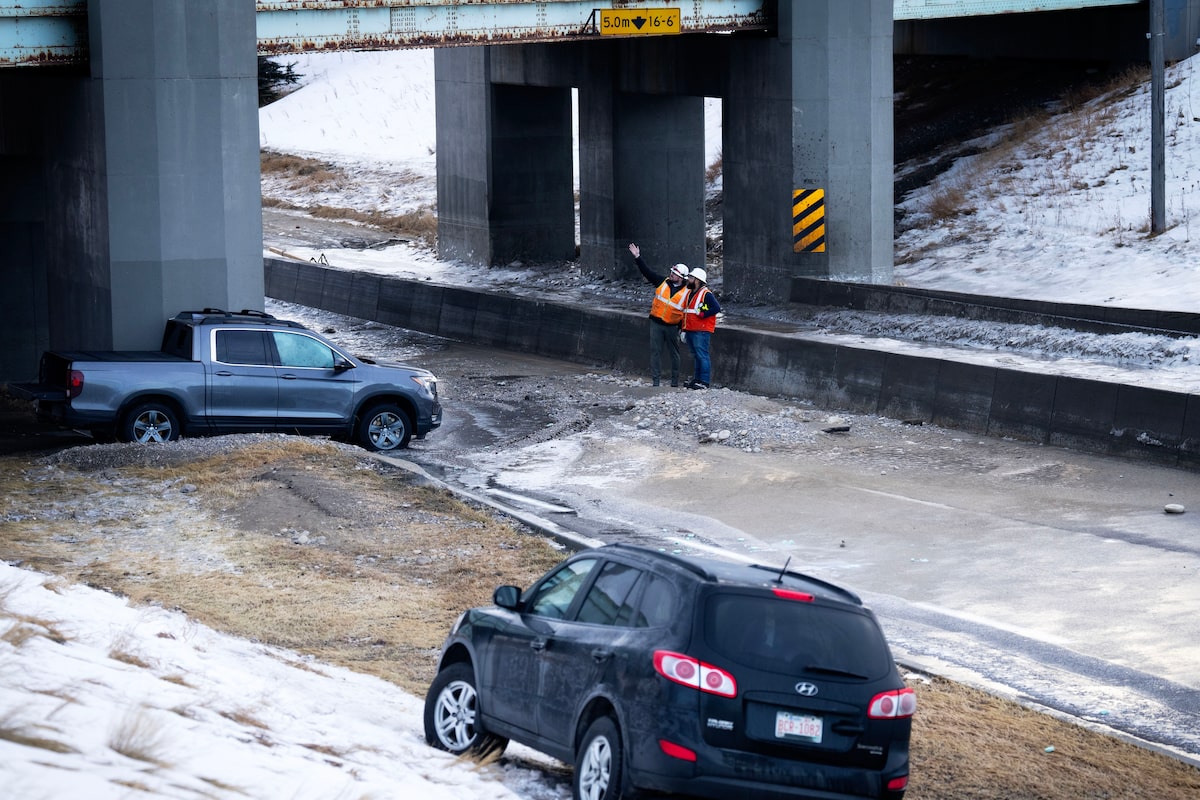
City crews check the damage on the Trans-Canada Highway from a reported water main break in Calgary on Dec. 31.Todd Korol/The Globe and Mail
With Calgary reeling from a second catastrophic water main break in 18 months, an independent panel has faulted the city for ignoring two decades of warnings about the pipe’s vulnerabilities and recommended the creation of a municipally controlled water corporation.
The six-member panel of industry experts was formed to investigate a June, 2024, break along the city’s Bearspaw South Feeder Main, which carries roughly 60 per cent of Calgary’s potable water.
The failure prompted a local state of emergency that forced residents to follow various levels of water restrictions for months and exposed massive weaknesses in one of the country’s biggest water systems. Repairs have cost more than $38-million.
In a report released on Wednesday, the panel found that officials became aware of vulnerabilities in the piping as early as 2004, when a similar type of water line – called a pre-stressed concrete cylinder pipe (PCCP) – ruptured elsewhere in the city.
Opinion: Calgary’s water-use restrictions are a symptom of a much larger problem in Canada
Follow-up assessments found the Bearspaw South Feeder Main was susceptible as well, but ineffective management, lack of foresight and budget constraints all contributed to Calgary overlooking the problem until disaster struck.
“We found that there were systemic gaps that have existed for a long period of time in the city’s water utility and the way it’s being operated,” panel chair Siegfried Kiefer, a former ATCO executive, told city council during a special meeting on Wednesday afternoon.
The report lands as the city is grappling with another major break along the same line. On Dec. 30, a new rupture brought new restrictions and localized boil-water advisories that have since been lifted. Mayor Jeromy Farkas and other officials have asked Calgarians to conserve water until the break can be fully repaired.
But the report warns of more disruptions to come unless the city takes both immediate and long-term actions.
“We are sitting on a bit of a ticking time-bomb in terms of the reliability of an essential artery to our water delivery,” said Mr. Kiefer. “As such, we would say that management and council need to do whatever they can to get out of this crisis.”
PCCP consists of a concrete core surrounded by a thin steel cylinder wrapped with high-tensile wires and encased in mortar. When it was installed in 1974, it was supposed to have 100-year lifespan.
Even though water utilities throughout North America experienced premature PCCP failures, Calgary continued to downplay the possibility of risk and failed to build in redundancies, the report states. The panel found “numerous” instances in which requests for inspection of the pipe were made but never acted upon, said Mr. Kiefer.
Rapid population growth and budget pressure put new stresses on city infrastructure without corresponding investment. Over a 20-year period, the water utility only spent its budgeted capital twice, “chronically underinvesting and deferring important projects that could have increased the resilience of the system to outages,” the report states.
“What crept into the city’s management culture was an acceptance or tolerance of too high a risk level for an essential service utility operation,” Mr. Kiefer said.
Northwest Calgary business owners fear customers will shop elsewhere because of water main break
The panel urged the city to use emergency measures to complete a steel pipe duplication of the Bearspaw South line within 12 to 14 months, ramp up monitoring of pipe conditions, and prepare emergency response plans to cope with future failures.
Over the longer term, the panel recommended that Calgary create a dedicated water department led by a chief operating officer, adopt new risk-management processes and establish an independent water oversight body.
The report points out that aging water infrastructure isn’t just a Calgary problem. Around 27 per cent of Canadian water lines require upgrading, according to Statistics Canada.
“Calgary is a wake-up call for the rest of the country,” said Alireza Bayat, engineering professor at the University of Alberta and director of the Canadian Underground Infrastructure Innovation Centre. “The state of water infrastructure in Canada is not healthy.”