
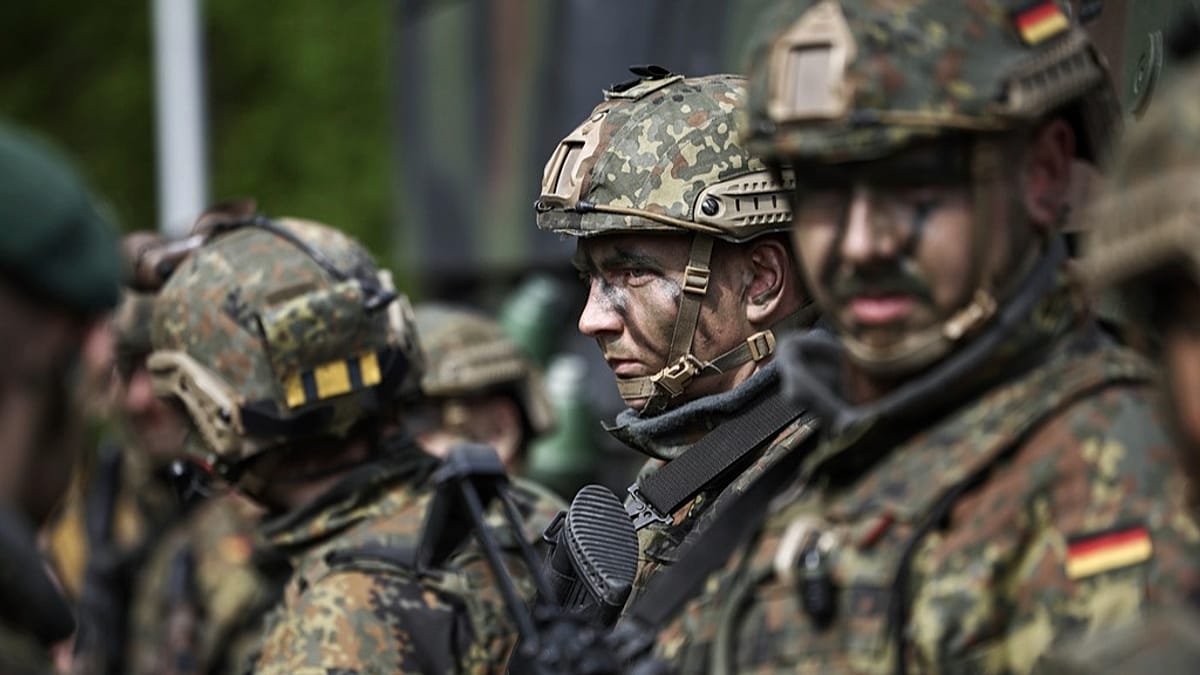
German Chancellor Friedrich Merz announced on Tuesday that his country could play a military role in securing a potential peace in Ukraine, following key talks in Paris among Ukraine’s allies known as the “Coalition of the Willing”.
“This could include, for example, deploying forces on NATO territory neighbouring Ukraine after a ceasefire,” the Chancellor said, adding that he was not ruling out any options.
France and the United Kingdom, on the other hand, committed themselves to a troop presence following a peace agreement, saying they would “establish military bases across Ukraine” to deter future invasions.
Although Merz did not endorse this approach, his remarks drew criticism and were interpreted by many media outlets as suggesting that the Bundeswehr could also be deployed in Ukraine after a peace deal.
Criticism among the opposition
Sören Pellmann, co-leader of Die Linke’s parliamentary group in the Bundestag, told Euronews that European governments were still “remarkably vague” about their security commitments to Ukraine.
“It is unclear what mandate the protection force Germany wants to join would actually have. A security arrangement based solely on NATO troops carries a real risk of escalation, as they could find themselves in direct conflict with Russia in a crisis,” Pellmann said.
In his view, this was “not the right path”. “What is needed instead are genuine UN peacekeepers accepted by both Ukraine and Russia. Any UN peacekeeping mission should largely consist of troops from neutral countries and BRICS states. Only that would offer a credible guarantee of peace for the Ukrainian population.”
Moscow has vehemently rejected any Western troop presence in Ukraine, describing such forces as a “legitimate targets”. So far, no BRICS country has offered sending troops to help secure a future peace settlement.
Merz’s remarks also drew critisicm from the far-right. In a statement to Euronews, AfD co-leader Alice Weidel said his remarks followed “a familiar and dangerous pattern”.
“Unable to impose himself within his own coalition and failing to deal with the economic, energy and migration crises at home, he is engaging in international grandstanding that ignores both reason and realpolitik,” Weidel said.
She warned that Merz was willing to risk “dragging Germany into a military confrontation with unforeseeable consequences”.
Can Merz decide on sending German troops to Ukraine?
Speaking at a press conference after the meeting in Paris, Merz said that any decision on a German military contribution would have to be taken jointly by the federal government and the Bundestag, once the relevant conditions were clear.
In Germany, the armed forces are not directly controlled by the president or the chancellor, as the Bundeswehr is a parliamentary army, meaning it is firmly under the authority of parliament.
This system is a direct legacy of Germany’s Nazi past, when the Wehrmacht operated with little to no parliamentary oversight. To prevent a repeat, the Bundeswehr was placed under strict parliamentary control from the moment it was created.
The principle is laid down in the defence constitution of 1956. In practice, it means that parliament controls the defence budget, oversees a standing defence committee and is supported by a Parliamentary Commissioner for the Armed Forces, whom soldiers can approach directly with complaints or concerns.
Any deployment of German troops to Ukraine would count as an overseas operation. Under German law, all armed missions abroad require the approval of the Bundestag. These rules have been set out in the Parliamentary Participation Act since 2005. Mandates for such deployments are usually granted for one year at a time and must then be renewed by parliament.
There are also strict limits on who can be sent abroad. Soldiers with a service commitment of less than twelve months – including those still completing their mandatory military service – cannot be deployed overseas against their will.
According to the Bundeswehr, they may only take part in foreign missions if they have explicitly agreed to do so in writing. In practice, overseas deployments usually require a service commitment of at least twelve months.
Where is the Bundeswehr currently deployed?
The Bundeswehr is already part of several international missions abroad, from traditional peacekeeping and stabilisation operations to training and protection roles. These include UN, EU and NATO missions in Kosovo, Lebanon, Bosnia and Herzegovina, South Sudan and Western Sahara.
Alongside combat troops, Germany also deploys military observers and other specialised personnel to these operations.
Germany is additionally also involved in a number of maritime operations, including protecting commercial shipping in the Red Sea, monitoring the arms embargo on Libya in the Mediterranean, and taking part in NATO maritime security missions.
The Bundeswehr is also supporting international partners in Iraq and Jordan in the fight against so-called Islamic State, mainly through training and advisory roles.