
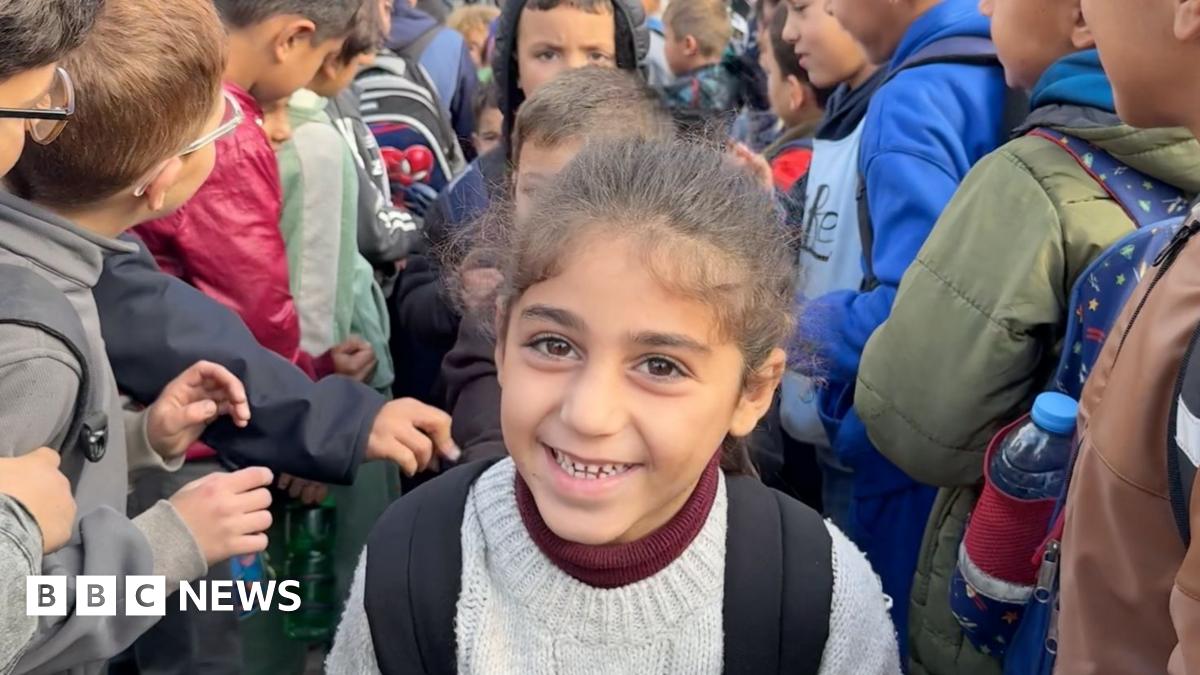
Fourteen-year-old Naeem al-Asmaar used to attend this school before it was destroyed. He lost his mother in an Israeli air strike during the war.
“It was the hardest thing I’ve ever been through,” he says quietly.
Although he was displaced for months, Naeem’s home in Gaza City survived. After the ceasefire, he returned with his family.
“I missed being in school a lot,” Naeem said adding that the difference is stark.
“Before the war, school was in real classrooms,”
“Now it’s tents. We only study four subjects. There isn’t enough space. The education is not the same – but being here matters. School fills all my time and I really needed that.”
Rital Alaa Harb, a ninth-grade student who once studied here too, wants to become a dentist.
“Displacement affected my education completely,” she says. “There was no time to study. No schools. I missed my friends so much – and I miss my old school.”
The makeshift school is run by Unicef and brings together children from the original Lulwa school and others displaced by the war.
It does not teach the full Palestinian curriculum – only the basics: Arabic, English, mathematics and science.
The principal, Dr Mohammed Saeed Schheiber, has worked in education for 24 years. He took over management of the site in mid-November.
“We started with determination,” he said, “to compensate students for what they lost.”