

Listen to this article
Estimated 3 minutes
The audio version of this article is generated by AI-based technology. Mispronunciations can occur. We are working with our partners to continually review and improve the results.
Holed away in the corner of a cluttered lab at Kelowna’s B.C. Cancer centre is a 3D printer that looks like it could be found in an artist’s studio or at an engineering firm.
But cancer clinicians and physicians call it a “first-in-Canada” tool that can revolutionize care for people battling cervical, vaginal and recurrent endometrial cancers.
“This was the dream of myself and a physician who has since moved back to Quebec,” said Dr. Deidre Batchelar, a medical physicist, who pioneered the project.
“We were frustrated, by having patients where we couldn’t get radiation in the shape that we wanted to treat our patients,” she says.
“We felt we were really underserving those women. So we just had dreamt this up, almost literally on a napkin, at a conference.”
Lobbying for funding and working with a graduate student for over four years, Batchelar obtained the medical hardware and wrote specialized software to operate it.
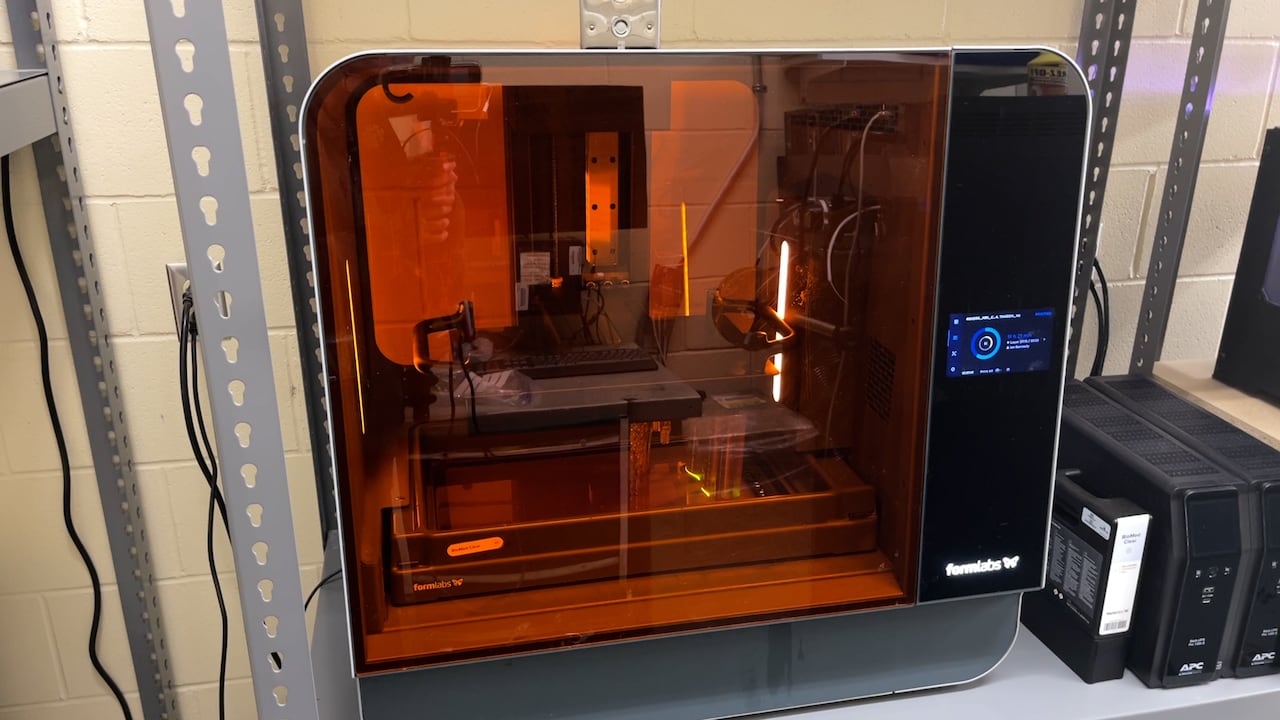 B.C. Cancer Kelowna purchased the $60,000 3D printer and wrote specialized software that takes a patient’s MRI and CT scans and creates a tool that can target tumours with an unprecedented level of accuracy. (Kimberly Davidson)
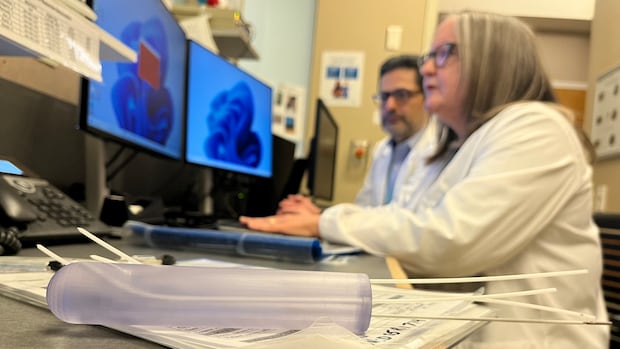
Using each patient’s specific MRI and CT scans, the 3D printer creates a custom, personalized, applicator for brachytherapy.
Brachytherapy is a specialized form of internal radiation treatment. Applicators are inserted near cancerous tissue and then guide the angle and the depth of radiation treatment needles to the most effective spot to kill a tumour.
Generic, commercial, applicators are commonly used. But gynecological cancers often appear in complex, varied anatomy.
The new bespoke applicators printed in Kelowna are formed to fit the patient’s unique body and specific contours of the tumour, targeting cancer with an unprecedented level of accuracy.
“It means that you are going to increase the [radiation] dose to the tumour while you’re protecting the normal structures and that really translates into an improved outcome,” said Dr. Hamad Raziee, a radiation oncologist at B.C. Cancer Kelowna.
Raziee also says because the custom applicator is more precise, fewer needles are needed, which creates a less invasive and more comfortable procedure for patients.
In 2025, B.C. Cancer Kelowna completed 31 procedures using the 3D-printed cylinder.
Each year, over 250 British Columbians are diagnosed with cervical cancer with approximately 55 annual diagnoses in the Interior.
Kelowna clinicians purchased the $60,000 3D printer through the donor supported B.C. Cancer Foundation equipment fund which enables centres to buy specialized technology.
B.C. Cancer says the program fosters innovation and brings new treatment to patients sooner.
“We did win a B.C. Cancer Excellence Award in teamwork for this,” Dr. Batchelar said.
Batchelar and B.C. Cancer Kelowna are now actively collaborating with brachytherapy centres in Vancouver, Victoria and Abbotsford, B.C., to help them establish similar programs.