
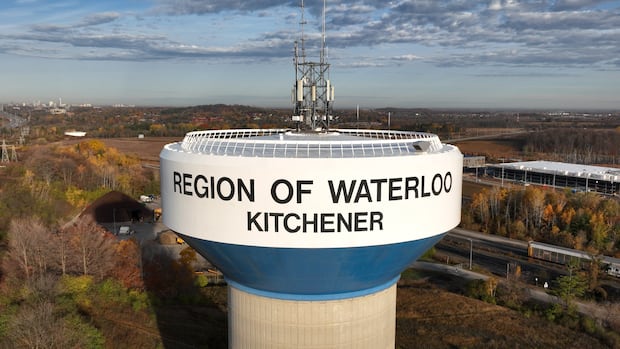
The Region of Waterloo says it won’t support the approval of new developments as questions about the amount of water the municipality has access to in high-growth areas remain.
The region says there are no immediate concerns for residents and this is not a water quality issue, but the amount of water currently available may not support the expected growth in some areas of the community.
A staff report released Tuesday afternoon as part of the agenda package for next week’s sustainability, infrastructure and development committee meeting offers more information about the water capacity issue raised by the region last month.
The report notes that staff have used two methodologies to determine water capacity for a part of the region covered by the Mannheim Service Area, which includes Kitchener, Waterloo, and parts of Cambridge, Woolwich, and Wilmot.
WATCH | Region provides an update on water quantity concerns:
Region provides an update on water quantity concerns
The Region of Waterloo says it won’t support the approval of new developments in some parts of the community until it’s able to answer questions around water capacity. The region says it’s concerned about long-term availability in high-growth areas, specifically in the cities of Kitchener and Waterloo. Mathieu Goetzke is the acting CEO for the region. He spoke to CBC K-W’s Aastha Shetty about findings from a peer review done by third-party researchers that back the concerns regional staff raised last month about long-term water quantity and growth.
One methodology is based on guidelines from the Ontario Ministry of the Environment, Conservation and Parks. It showed the region’s water capacity is stable.
The other is the methodology that was tweaked by staff to provide a broader picture of the water capacity in the region.
Regional Chair Karen Redman told CBC K-W’s The Morning Edition host Craig Norris this week that this second methodology is the one that has shown there are concerns about how much water is available.
“The Ministry of Environment,[ Conservation and Parks] has used a method of calibrating how much water we have. And what our staff came up with is saying 80 per cent of our potable water is groundwater and we’re not sure that this is as accurate a measurement as possible,” Redman said.
“So they figured out what they thought was a more accurate way of assessing our capacity.”
LISTEN | Regional Chair Karen Redman talks water capacity, regional growth:
The Morning Edition – K-W10:06Regional Chair Karen Redman gives a preview of year ahead
Waterloo region is growing and it turns out there are still some growing pains. Concerns about whether there’s enough water. Building a new transit hub and communications centre for police. Finding homes for everyone. Plus, there’s a municipal election later this year. It’s a lot. Regional Chair Karen Redman talks about the months ahead.
The region had a third-party consultant, Cambridge-based Agile Infrastructure Ltd., review staff’s methodology and make recommendations on how to move forward.
After that review, the region says it will continue to use the revised water supply methodology as it moves into next steps of determining how to address the capacity concerns.
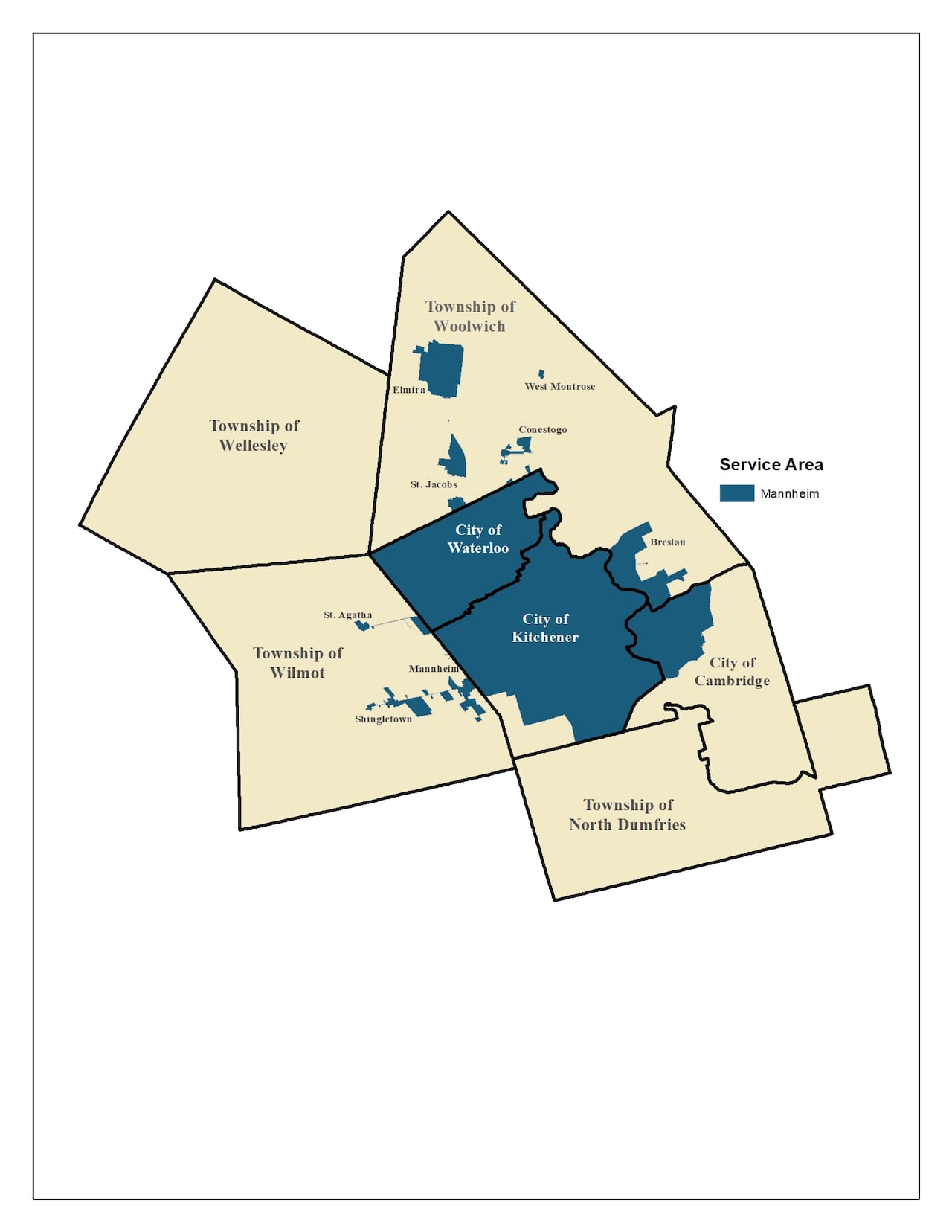 The Region of Waterloo has found a future water capacity issue in the Mannheim service area, which supplies water to large parts of Kitchener and Waterloo. Smaller parts of Cambridge, Wilmot and Woolwich are also affected. Residents won’t notice any changes in their water supply. (Region of Waterloo)Development approvals paused
Developments like new buildings and homes are approved at the lower-tier level, by the cities or townships. The region provides comments on those applications.
The staff report says currently, “the region is not able to enter into new servicing agreements.”
“Until available water capacity is confirmed, development applications within the Mannheim Service Area will receive advisory comments. These comments outline that there is a water capacity constraint … and the region does not support approval for development applications at this time,” the report says.
The region has already started to offer these comments. An email to City of Kitchener staff dated Dec. 30 was shared in a package to city councillors for a meeting Monday night about a planned development of three residential towers on Courtland Avenue.
In the email, the region’s associate director of regional development services, Amanda Kutler, says because “concerns have been identified regarding water servicing capacity” that meant “the region is not in a position to support approval of this application at this time.”
Kitchener councillors voted to defer a decision on the development by the Zehr Group until more is known about the water issues.
‘Significant’ infrastructure and funding needed
The region’s report says while developments currently in the planning phase would take “some time to draw on the water supply” staff can’t approve them just yet.
“Significant infrastructure projects and investment are required to be able to support these future growth needs,” the report says.
The next steps for the region are to create a list of short and mid-long term opportunities to create new capacity. Ultimately, staff say new infrastructure will be required for the region to be able to support the approval of future development applications.
The region is expecting to hire engineering consultants and advisers this year to further investigate the issue, which is anticipated to cost $1.3 million.
These expenses will be tracked as a “variance” to the 2026 budget and at the end of the year, if needed, reserve funds will be used to cover the costs.
“A more fulsome impact of the capacity issue to the 2026 operating and capital budget is anticipated to be available late [quarter] one,” the report says, meaning a more expansive look at costs would come back to council before the end of March.
“In an effort to improve affordability of services, an emphasis has been placed on finding savings and optimizing existing water infrastructure,” the report says.
“Going forward, the region will work with the province to identify funding and fast track approval opportunities” to build and improve water infrastructure, the report adds.
WATCH | Regional Chair Karen Redman on water capacity concerns:
Chair Karen Redman talks region’s water capacity, transit hub and what’s ahead in 2026
Waterloo region is continuing to grow and regional council is facing a number of challenges in the year ahead. That includes concerns about how much water capacity there is as well as local transit projects. Regional Chair Karen Redman spoke to CBC K-W’s Diego Pizarro about what the region is focusing on in the coming months. Experts will ‘help navigate the way forward,’ Redman says
The water capacity issue has raised concerns for local groups, including WilmotCAN, which has advocated against the region buying land in Wilmot Township for a future industrial development.
The group says the “recent astounding announcement of a serious water supply shortfall and unprecedented stop of all development approvals by the region” means the land purchase project in Wilmot Township should come to an end.
Another advocacy group called Hold The Line WR, which calls on city boundaries not to be extended into township farmland, said it is “gravely concerned about this surprise threat to Waterloo region’s drinking water supply.”
“Our region is the largest urban community in Ontario relying almost exclusively on groundwater. In recent years, we have seen a chipping away at policies that protect our water recharge areas and the countryside,” the group said in a letter co-signed by other local advocacy groups including Grand River Environmental Network and Water Watchers.
“With this recent revelation of a water capacity issue, we must re-commit to growth planning that protects our countryside line and groundwater aquifers.”
Redman says there’s a lot to talk about with the province as they move forward.
“We’ve got aging infrastructure, we’ve got water in some areas of the region that isn’t necessarily where the growth is happening. So there’s a whole lot of things that we’re talking to the province about remedying,” she said.
“We will continue to study it and it [will be] experts that’ll help navigate the way forward.”
Regional councillors are set to discuss the report next Tuesday.