
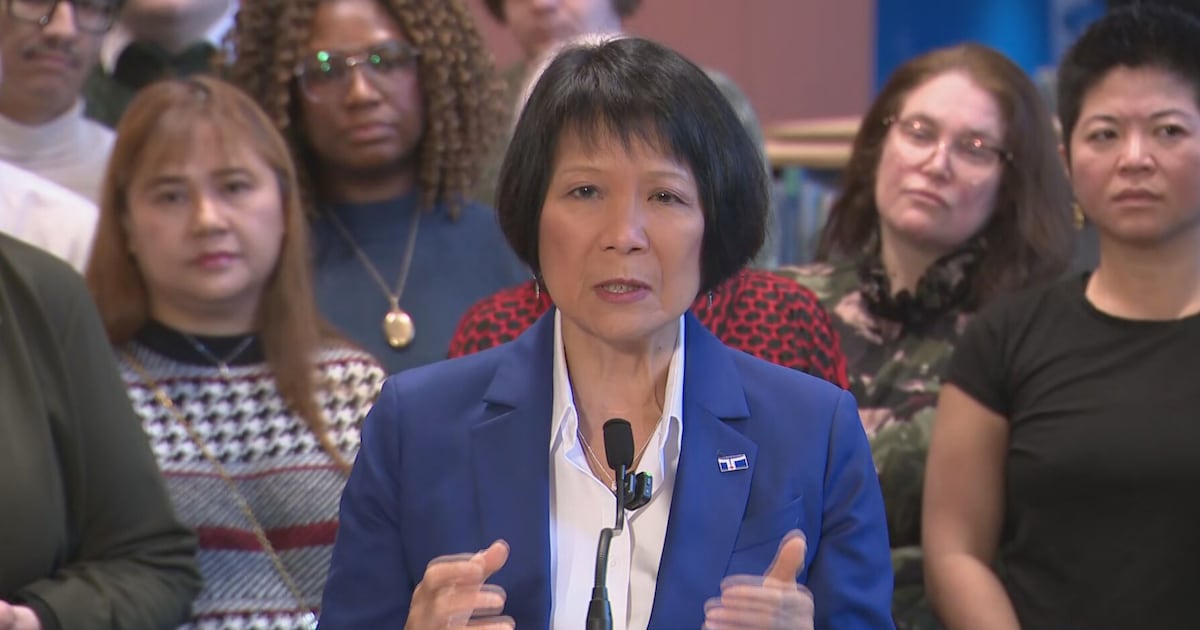
Mayor Olivia Chow unveiled Toronto’s 2026 budget, which has an emphasis on affordability. Natalie Johnson reports.
City officials unveiled Toronto’s 2026 budget at city hall Thursday, saying affordability is the key focus.
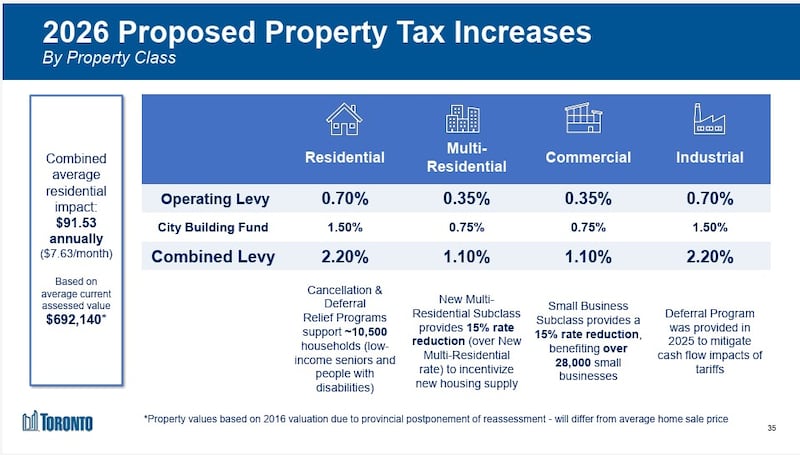
The budget includes a fare freeze for the TTC, as well as a monthly price cap for riders. It also includes a small property tax increase of 2.2 per cent.
In a budget presentation at city hall, City Manager Paul Johnson and CFO Steven Conforti laid out the key elements of the plan.
Proposed 2.2 per cent tax increase for property owners would add around $91.50 to average homeowner’s billBudget includes a previously approved 3.75 per cent increase to Toronto Water and Solid Waste Management Services rates and fees and a 1.25 per cent increase for participants in the Industrial Water Rate Program.Savings found through hiring slowdown, line-by-line budget reviews, hiking some fees to adjust for inflation, $323 million reserve fund draw, limiting spending on some programs, like long-term careBudget adds 27 more traffic agents, 96 more camp nutrition programs, “enhanced” crisis services on TTC, 1,000+ AC units for low-income residents MORE: Here’s why Toronto could see a smaller property tax increase this year
Follow along here for updates as the city provides more details on where it plans to spend money in 2026.
4:30 p.m. – Budget town halls to be held in coming weeks
Budget presentations have concluded for today. There’s plenty more to come in terms of the budget process, though. Detailed budget notes for each city department are expected to be posted later today and will be reviewed and debated in the coming weeks.
The city will be holding telephone town halls about the budget on January 14 and 15, with further presentations to the budget committee on January 20 and 21.
Mayor Olivia Chow is expected to table her version of the budget, with feedback, by Feb. 1, with a final vote on the budget at city council on Feb. 10.
3:30 – Some community centre projects to be deferred for savings
In a briefing for the media, City Manager Paul Johnson and CFO Steven Conforti say that some community centre projects will be deferred as part of the cost savings found in this year’s budget.
“So we have deferral of mostly community centre projects,” Conforti said when asked for examples of deferrals on capital projects.
“So what we would be doing, and for the most part, you’re looking at almost a cascading deferral across the entire plan, where project one may get pushed out 18 months, then project two, and so on and so forth.”
He said the deferrals amount to around $200 million worth of projects.
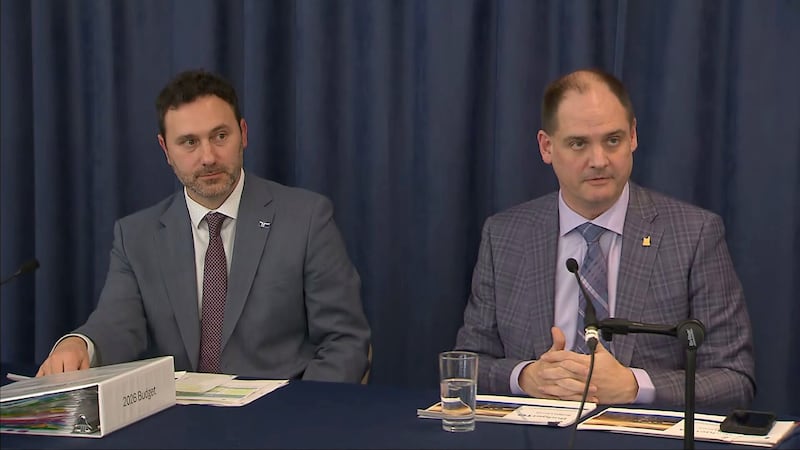 Johnson and Conforti City Manager Paul Johnson (right) and CFO Steven Conforti provide a technical briefing to the media on Toronto’s 2026 budget Thursday December 8, 2026. 3 p.m. – Bradford says Chow bringing ‘election budget’ to improve re-election chances
Coun. Brad Bradford is expressing doubt about the savings found through the budget, saying he plans to go “line by line” to see how they were achieved.
“What typically happens in this process is the staff bring forward a list of things that they would like to have, not things that have actually been committed to, and then those things fall off the list, and they identify them as savings,” Bradford said.
“Those aren’t real savings. We all run household budgets. We understand what it really means to find savings in your household budget. It’s not just fictitious things that you didn’t end up spending money on.”
Bradford, who has said he plans to run for mayor again this year, said Chow has brought forward a budget with an ultra-low property tax increase to improve her odds of re-election.
“This is an election budget that she is bringing forward in an attempt to improve her prospects in the fall with re-election,” Bradford said. “But Torontonians are going to be on the hook paying for that.”
Chow said earlier in the day she has not decided if she will run, and denied she had a target in mind before the budget process.
1:10 p.m. – Average annual impact of this year’s increase $91.5
Here’s a look at how the city says the proposed 2.2 per cent tax bump will affect tax bills in the city.
Officials say the small increase will cost the average homeowner an extra $91.53 a year.
 Property Tax Increase – Toronto 12:55 p.m. – capital plan totals $63.1 billion
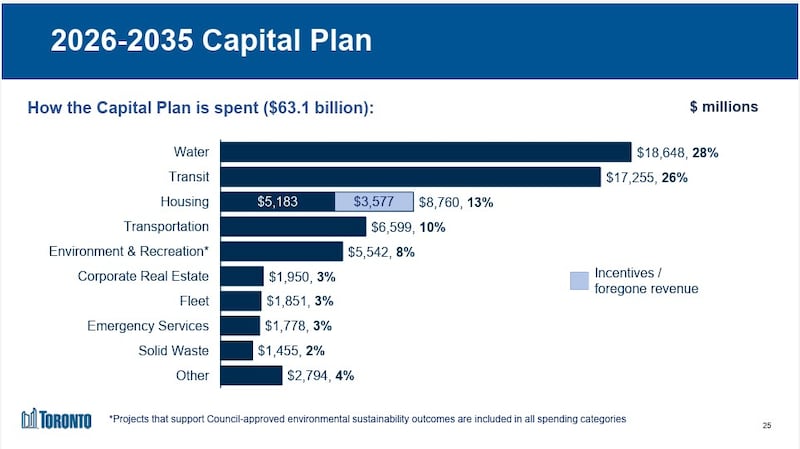
The city’s 10-year capital plan totals $63.1 billion and includes billions for maintaining and repairing aging infrastructure and bolstering housing, transit and water, city officials say.
 Toronto capital plan 12:45 p.m. – Other savings found
Conforti says other savings were found in the budget through several other measures, including:
Adjusting revenue projections and increasing user fees to match inflation.Line-by-line budget reviews to cut underutilized or unnecessary spending, saving $78 million.Moving to electric vehicles to save on fuel costs Identifying $135 million in actual reductions, including $57 million from permanent efficiencies such as streamlining service delivery, improved purchasing, and automation.Better debt planning to save on borrowing costs12:30 p.m. – Hiring slowdown to continue on 2026
To fully offset the opening pressure through a property tax change alone would have required a 27 per cent property tax increase, officials say.
Conforti says savings in the budget include expected savings from the proposed continuation of a hiring slowdown for non-frontline positions throughout 2026.
“Staff will continue to review which positions will be included in the slowdown, with a lens on the impacts that delaying the hiring of those roles will have on frontline services,” he says.
12:20 p.m. -Taylor Swift an example of city not benefiting from economic growth
Conforti says the massive success of Taylor Swift’s appearances in Toronto emphasizes the city has been left out of key revenue opportunities from economic growth, With little of that money flowing into city coffers.
“When Taylor Swift was in Toronto back in 2024 It was estimated that her six concerts generated $282 million in economic benefit to the region, including $40 million in total government tax revenue. Of this, the only revenue that the city directly received that didn’t offset added costs to support those concerts was additional net revenue or municipal accommodation tax revenue that we estimate was ultimately less than $500,000 beyond what we normally would have generated over that period of time,” Conforti said.
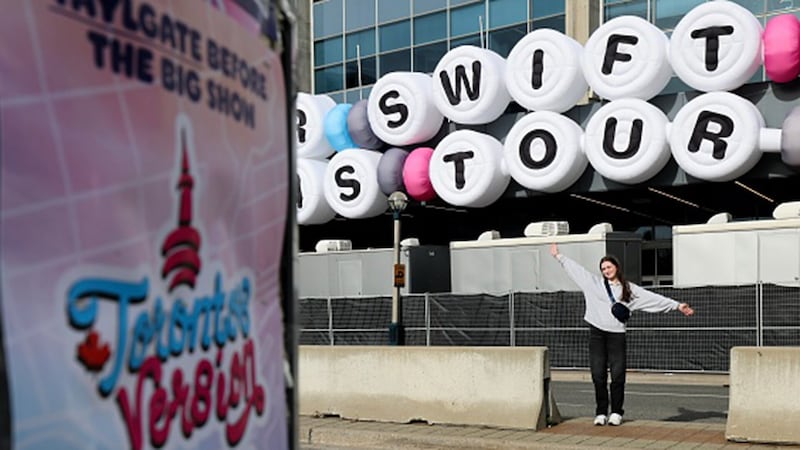 Swift mania hits OverDrive Bryan Hayes, Jeff O’Neill and Frank Corrado discuss the start of the Taylor Swift concerts in Toronto, the craziness around the city, the availability of the tickets and more.
“In comparison, other orders of government have access to sales tax and income taxes, which directly benefit from economic growth, so that when they experience additional costs like those associated with inflation or population growth, unlike municipalities who respond with tax rate increases, they have the benefit of mitigating these costs through natural economic growth.”
12:10 p.m. – Pressure included speed cameras, low TTC ridership and shelters
Conforti says following final budget submissions, opening pressure actually increased by $268 million
“One of the most significant added pressures came from provincial changes to automated speed enforcement, where we can no longer expect to receive fine revenue to offset road safety and policing costs,” he says.
Lighter TTC ridership than expected also contributed to the budget pressure, he says.
“Since 2021 we had experienced gradual increases in transit ridership as we inch closer to pre-pandemic ridership levels,” Conforti says. “However, in 2025 not only did we not see an increase in ridership and associated revenue, we actually saw a decline from the prior year, resulting in an added $39 million pressure expected in 2026 compared to our original outlook.”
At the time of budget submission, the city was also still in discussions with the federal government on supports for refugee claimants and asylum seekers, adding additional pressure ahead of finalizing the budget.
“What this means is we ultimately had to find $1.34 billion through reductions, offsets and other actions to present a balanced budget for 2026 with an opening pressure of over $1.3 billion.”
12 p.m. – CFO details $18.9 billion operating budget
Chief Financial Officer Steve Conforti is breaking down some of the key numbers in the 2026 operating budget.
11:55 a.m. – Shelter demand still high, but fewer encampments
Johnson says while the city continues to experience high demand for shelter services, there are fewer encampments now than there were a year ago, with encampments in 48 city parks today compared to 107 at this time last year.
Overall there were 360 encampments a year ago, while there are about 170 today, Johnson says.
He says there are 3,000 refugees and asylum claimants in Toronto shelters now, down from 6,500 a year and a half ago.
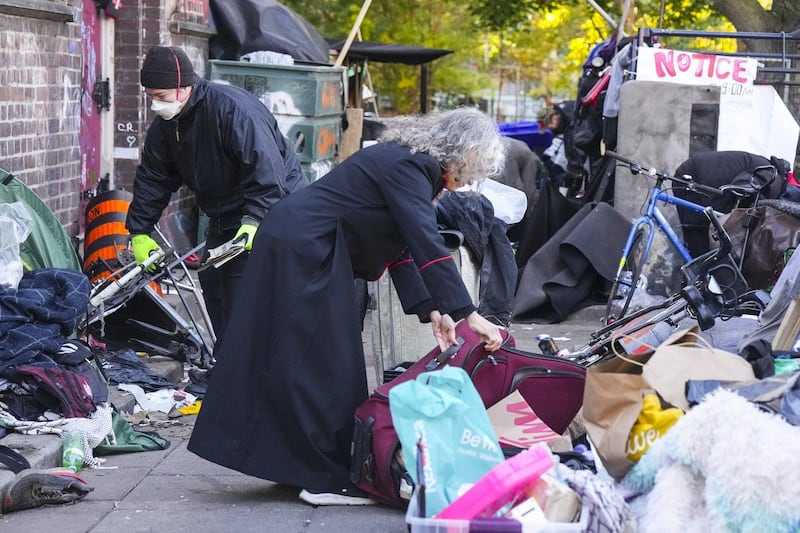 toronto encampment Rev. Canon Maggie Helwig, centre, helps move a resident’s belongings as Toronto city workers prepare to clear the encampment at St. Stephen-in-the-Fields Church, in Toronto, on Thursday, Oct. 16, 2025. (THE CANADIAN PRESS/Chris Young
Chris Young)
“We’re very pleased that we’ve come to an agreement with the federal government moving forward about how we will both receive funding as well as change our operational structure to continue to have an appropriate sized part of our shelter system that is there to support those who flee other countries and end up in Toronto and end up in Canada,” he said.
11:40 a.m. – Budget limits spending on some programs
Johnson says the city has had to make some hard choices in reducing spending.
“We’ve restructured some programs to make better use of our current economic situation and be more financially responsible, and we’ve limited new spending on programs that, quite frankly, we can’t afford,” he says.
“That happens in important areas like long term care and some of the operation of our transit line. And it is not for a minute that we don’t find those services important. It is that we need a new type of financial relationship in order to make sure that we can continue to expand those services.”
11:30 a.m. – Johnson says financial plan working
Johnson points to still-large, but shrinking budgetary pressures over the last few years and says the city is making progress on getting its fiscal situation in order.
“It’s also a signal to our other partners, particularly our government partners about the commitment we are making here at the City of Toronto towards the capital side of our budget,” he says.
Johnson says city officials understood in 2023 When Toronto held a special council meeting to deal with its difficult financial situation that “movement towards a more sustainable future was a multi-year process” that would take time.
“There was no way out of this in one budget cycle, it was going to take time. I’m proud to say that there are major portions of our long term financial plan that are working.”
11 a.m. – Budget presentation begins
The budget committee is now getting a presentation from City Manager Paul Johnson. You can watch the livestream on this page.
10 a.m. – City and feds reach deal on asylum seekers
Chow revealed the city and the federal government have made a deal for funding when it comes to sheltering refugees and asylum seekers.
“We’ve made a deal with the federal government, and there’s no shortfall, so more details will come later,” the mayor said.
In the past, Chow has pointed to the issue as a major strain on city finances and pressured the federal government to do more.
Near the start of the budget process this year, she had suggested that covering that funding gap could drive up property taxes. However she later said the same day she wouldn’t ask Toronto residents to cover the cost as it wouldn’t be “fair.”
9:50 a.m. – Chow calls budget ‘very affordable’
Chow says that despite leaning on departments for efficiencies, dipping into reserves and a remaining budget pressure of around $1 billion, the city can afford a smaller property tax increase this year.
“Absolutely the City of Toronto can afford this very affordable budget,” Chow said.
Carroll added that “your (property tax) bill is actually a piece of cumulative math” and said that the city might raises property taxes by more in the future, but the bill will still overall be lower because of the smaller increase this year.
9:30 a.m. – Chow still mum on election
Asked whether the lower property tax increase has to do with a potential re-election bid this year, Mayor Olivia Chow says she didn’t have a number in mind when the budget process started.
When asked, Chow says she has not made a decision about whether she will run for re-election in a few months.
9:20 a.m. – Small business tax cut in budget
Budget Chief Shelley Carroll says as part of the budget committee’s process, the city will be cutting taxes to small businesses by an additional five per cent through an expansion to the small business sub class discount.
“What this does is cut taxes for small businesses so that they can continue to grow, to hire and to create those good local jobs exactly when Toronto needs the most small businesses,” Carroll said.
9:10 a.m. – Chow speaks ahead of budget
Mayor Olivia Chow says the budget this year is focused on affordability, safety and good jobs.
She said the general property tax increase is also lower because of some of the taxes she’s implemented.
Mayor Chow unveils proposed 2026 City Budget Mayor Olivia Chow unveiled Toronto’s 2026 budget, which has an emphasis on affordability. Natalie Johnson reports.
“We make the budget more fair by shifting the burden from families like yours to speculators and luxury property buyers,” Chow said.
She said the higher Municipal Land Transfer Tax on homes above $3 million will bring in $150 million, while the vacant home tax will bring in $100 million.
8:45 a.m. – Lowest tax hike of Chow’s mayoral tenure
Speaking with CP24, Budget Chief Shelley Carroll says the relatively small property tax increase this year of 2.2 per cent was part of a multi-year plan following much higher property tax increases of 9.5 per cent and 6.9 per cent respectively, over the last two years.
“You know, we’re still paying the COVID bill that was left behind. So starting with the 2023, budget, we needed you to make significant investment, and Torontonians did. We’re really grateful for that. But what I have been promising all along that it needs to be an arc, that it needs to come back down to something you can afford,” Carroll said.
City budget chief explains how the city can afford a lower property tax increase in 2026 City Budget Chief Shelley Carrol discusses how the proposed 2026 budget is the culmination of ‘a three-year effort.’
She added the city needs to save now because “we just don’t know what’s going on in this economy. ”
Carroll also said that moving forward the city will be looking to try and tap into revenue sources tied to the economy through the next phase of it’s new deal with the province.
“The premier acknowledged, quite frankly, when we when we got that first three year deal, that he knows that what we really need in the City of Toronto is that sustainable fix, some sort of way to address the fact that we don’t have access to the economy as it recovers.”