
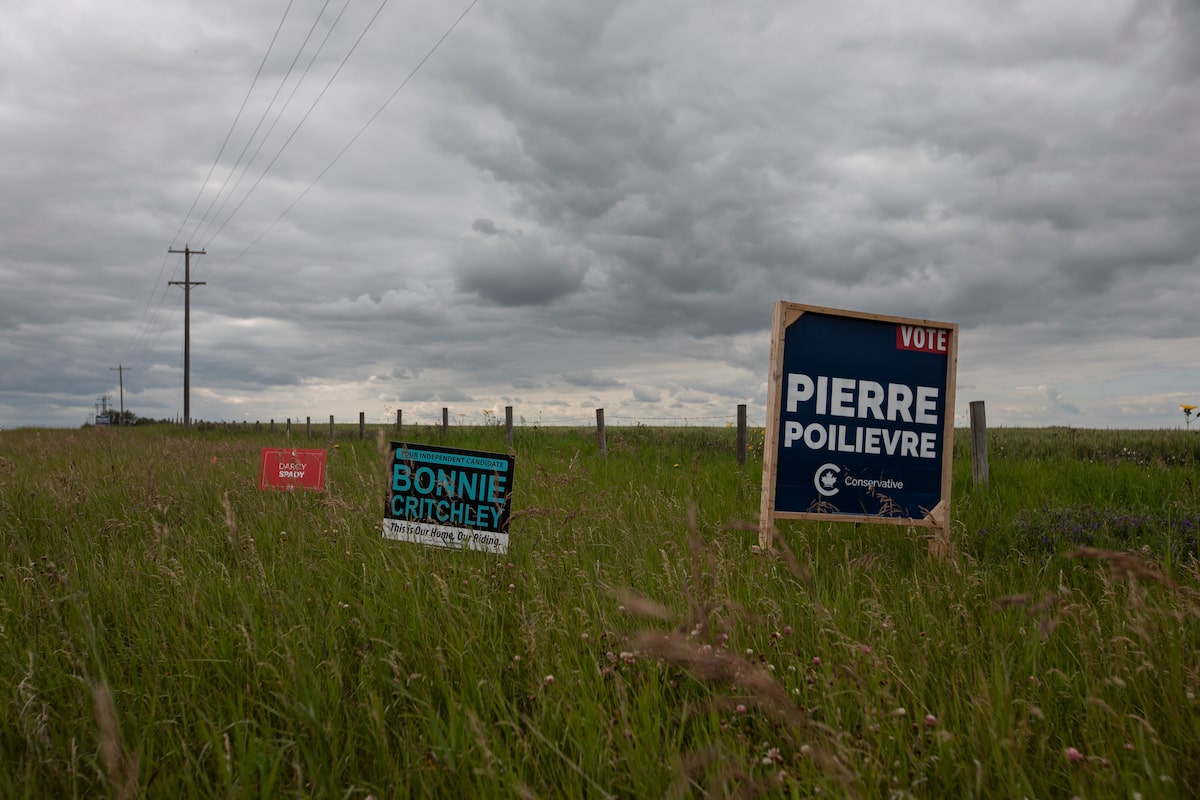
Campaign signs for Independent candidate Bonnie Critchley, Pierre Poilievre and Darcy Spady in the riding of Battle River-Crowfoot in Camrose, Alta., on July 22. Elections Canada decided to switch to a write-in ballot to deal with the unusually large number of candidates.AMBER BRACKEN/The Canadian Press
Alex Banks first became aware of the Longest Ballot Committee through social media two years ago.
At first, he said he didn’t pay too much attention to it. But over time, he started following the feeds of more people who were involved.
When organizers made a call for people to join as candidates in the 2024 Toronto-St. Paul’s by-election, he decided to sign up. It’s a fun form of protest for a cause he believes in, he said.
“I thought it was a low-impact, high-visibility way” to protest in favour of electoral reform, he said. “You’re not shutting down streets. You’re not interfering in people’s daily lives, but you’re clearly making a point.”
Elections Canada to issue write-in ballot in Poilievre’s by-election, citing long candidate list
Opinion: Shut down the saboteurs of democracy
The Aug. 18 by-election in Alberta’s Battle River-Crowfoot is the fourth time that Mr. Banks will be a candidate as part of the Longest Ballot Committee’s co-ordinated protest. He will be one of 214 total candidates.
The group contends that politicians face a conflict of interest in making election laws, and that those decisions should instead be made by an independent, non-partisan body such as a citizens’ assembly.
The committee itself does not have a demand for any particular set of election rules. Rather, it’s a demand that politicians recuse themselves from the process.
That 2024 Toronto-St. Paul’s by-election was arguably when the group became mainstream. Elections Canada said the results were delayed for hours because of the unusually long ballot, which had 84 candidates.
Mr. Banks says it has been enjoyable to be a part of the experience − including seeing his name on the sample ballot and watching himself receive a few votes. He’s a “political nerd,” he added, so it has been interesting to see the candidate process up close.
The organizers help people through the nomination process, including arranging for them to meet the signature requirements. In most cases, Elections Canada requires 100 signatures from riding residents to be a candidate.
The group has protested in many recent elections and by-elections, including Mr. Poilievre’s Ontario riding of Carleton during the April federal election.
Mr. Poilievre lost that race, leading to now-former Conservative MP Damien Kurek resigning his Battle River-Crowfoot seat in June so that Mr. Poilievre could run.
The long ballot for Mr. Poilievre’s riding of Carleton at the Elections Canada Distribution Centre in Ottawa on April 28, the day of the federal election.Justin Tang/The Canadian Press
That loss was part of the reason Mississauga resident Kimberley Nugent decided to join the protest for the first time.
“We had an election. He won fair and square, and Poilievre also lost fair and square,” she said in an interview, adding that she thinks this by-election is unnecessary. “So, the fact that he can just do this again, have another kick at the can, to me, is enough to ask that we need electoral reform.”
The protests have garnered a lot of attention, including from Mr. Poilievre, who has said that it’s a “scam” and writing to Government House Leader Steven MacKinnon to suggest changes to elections law. Mr. MacKinnon’s office has said the government shares the concerns and is studying the issue.
In late July, Elections Canada decided to switch to a write-in ballot to deal with the unusually large number of candidates. This change was needed to ensure the accessibility and integrity of the vote, it said. As well, long ballots are difficult to fold and unfold for counting, and require more ballot boxes.
When asked about the idea of people being inconvenienced by long ballots, Montreal resident Hakim Sheriff said it is not the group’s intention to make it harder to vote. This is a way of getting their voices heard, he said.
This is his second time running as a candidate and he volunteered during the 2024 LaSalle-Émard-Verdun by-election.
“If anything, we want to encourage people to vote, and we want to encourage more participation in the elections,” Mr. Sheriff said, adding that he thinks Elections Canada found a good solution. “I personally feel that other ways of getting our voices heard haven’t been successful,” such as lobbying and street protests.
“We want to get the conversation going. We want people interested in elections and how elections are run and how we choose our leaders, and our goal is to improve elections and improve democracy,” he added.
Spencer Rocchi, of Winneway, Que., has run in many elections, including for the Green Party and the Rhinoceros Party, of which the Longest Ballot Committee is an offshoot. He has been a candidate in every protested race.
A long-time electoral-reform advocate, he said that being a part of these co-ordinated protests has been a lot more effective than his campaigns under other parties. The Longest Ballot Committee is the story for electoral reform right now, he said.
He added that he hopes critics are “beyond annoyed” with the protests.
“What I really do enjoy about this is [that] it is actually disrupting the election system, and that’s the only way that protest actually works, is when it’s disruptive,” he said.