
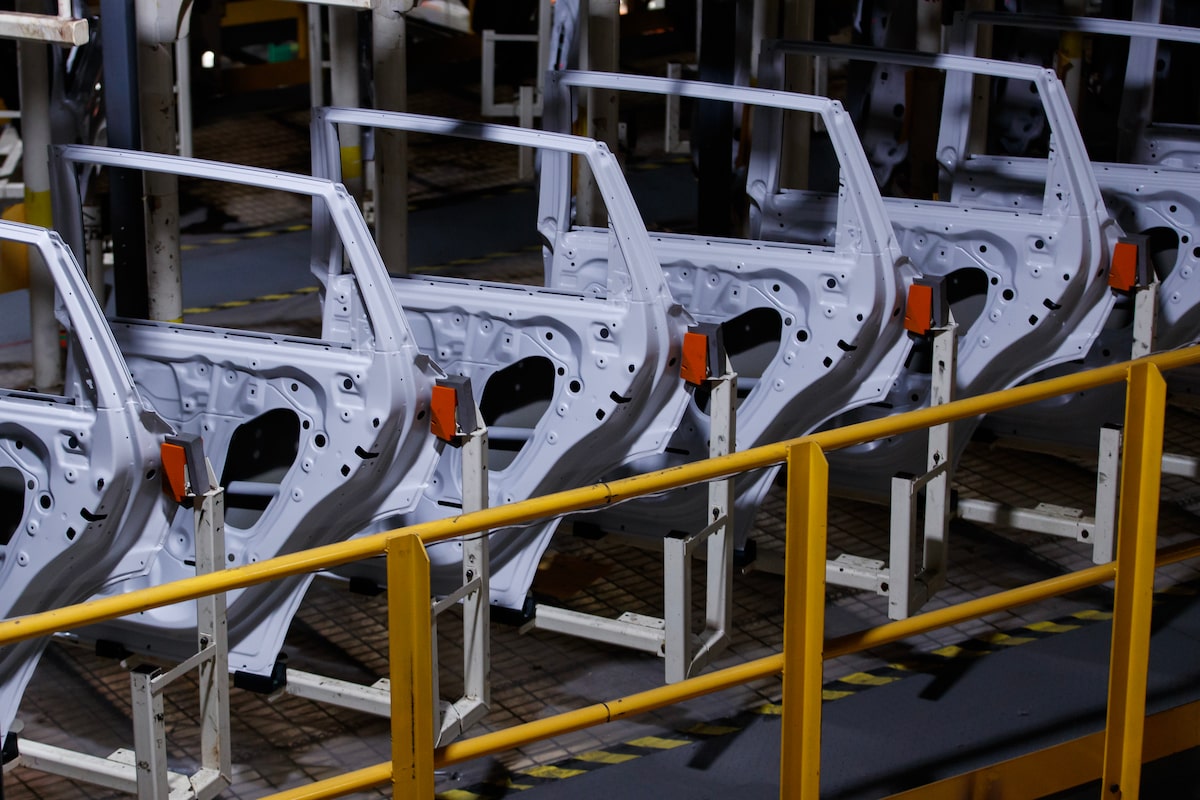
A Honda CRV production line in Alliston, Ont. Ontario hosts most of Canada’s auto industry and Premier Doug Ford wants Canada to keep tariffs on EVs from China.Cole Burston/The Canadian Press
Ontario Premier Doug Ford, whose province is home to much of the country’s auto industry, is warning Prime Minister Mark Carney against reducing Canada’s 100-per-cent tariffs on Chinese electric vehicles during Mr. Carney’s trip to Beijing next week.
He said China should instead set up EV factories in Ontario. A Chinese EV-maker opened an electric-bus assembly plant in Newmarket in 2019, for instance.
Canada triggered a trade war with China after imposing steep levies on Chinese EVs in 2024 in tandem with then-U.S. president Joe Biden’s administration.
Beijing retaliated with hefty tariffs on Canadian canola, seafood, pork and other products, levies that are hurting producers and harvesters. The tariff on Canadian canola seed, a major crop in Alberta, Saskatchewan and Manitoba, is more than 75 per cent.
Mr. Carney heads to China Jan. 13 and will meet with Chinese President Xi Jinping during the visit.
Carney heads to China next week, seeking new markets and better relations
The Prime Minister is seeking to patch up ties with Beijing after a severe diplomatic rupture as his government looks for new export markets to reduce Canada’s dependency on an increasingly protectionist United States. Ottawa’s decision to bar state-owned Chinese companies from investing or operating here over the years has also strained relations.
The Chinese embassy has tied removal of its retaliatory tariffs to Canada scrapping the EV tariff on vehicles from China.
Mr. Ford said he doesn’t want imported cars.
“We can’t back down. Simple as that. They want to come and open a big manufacturing facility and employ Unifor [union] employees, well, let’s talk. But don’t be shipping cars not manufactured by Ontarians,” the Premier said.
A foreign carmaker would be required to notify Ottawa of a planned “greenfield” investment under provisions of the Investment Canada Act, meaning the establishment of an entirely new operation as opposed to acquiring an existing business.
Opinion: Canada urgently needs a plan to protect the auto industry
The Canadian government has not traditionally rejected greenfield manufacturing proposals that are unrelated to sensitive areas, such as critical minerals or defence or national security.
While Canada and the United States have placed 100-per-cent tariffs on Chinese EVs, other trading partners have imposed smaller levies. The European Union’s tariffs vary by automaker, but in some cases, exceed 45 per cent including a 10-per-cent baseline levy set by the economic bloc.
On Jan. 1, Mexico imposed tariffs on auto-industry imports from all countries with which it does not have a free-trade agreement, including China. The rates on Chinese EVs range from 20 per cent to as high as 50 per cent depending on the vehicle.
One option for Mr. Carney is to simply cut the EV tariff to a lower rate that matches other countries.’ Mr. Ford, however, was not in the mood for compromise.
“The only compromise I would have is if they open up here, they hire Unifor employees, and they produce vehicles here,” the Premier said. “We have the best auto workers in the entire world. That’s the compromise.”
Prime Minister Mark Carney and Ontario Premier Doug Ford in December.DAVE CHAN/AFP/Getty Images
The lobby group representing the Detroit Three – Canadian subsidiaries of U.S. automakers – is also warning Mr. Carney against scrapping tariffs on Chinese EVs when the future of the Canada-U.S. trading relationship is under review.
The United States, Canada and Mexico are conducting a review of the trilateral USMCA in which U.S. President Donald Trump is expected to seek revisions that benefit American business.
Mr. Trump wants allies to support his tough-on-China agenda and his ambassador in Canada has thanked Ottawa for imposing the EV tariffs on China. In recent days, the U.S. President has revived talk of acquiring Greenland in order to prevent it from coming under the control of Russia or China.
“There is no world in which Canada can eliminate or lower our tariff on Chinese EVs,” said Brian Kingston, president of the Canadian Vehicle Manufacturers’ Association. His members include Ford Canada, General Motors Canada and Stellantis Canada.
“We are at a very sensitive point in the discussions with the Americans,” he said.
“The overwhelming majority of trade in our economy depends on access to the U.S. Trying to secure more trade with China, which is a fraction of our overall economy, would be extremely dangerous if it puts our relationship with the Americans at risk.”
Opinion: Is more trade with China really a good idea?
Separately, the Prime Minister’s Office said Mr. Carney’s trip next week will include a Jan. 18 stop in the Qatari capital of Doha in the Persian Gulf region, where he is seeking to coax wealthy investors to deploy their capital in Canada. The Globe and Mail had reported this Wednesday, but it was not confirmed until Thursday.
The Gulf, with its trillions of dollars in investment capital, is one of several priority regions for Canada, along with Europe and Asia, as Mr. Carney seeks to diversify trade away from the United States.
This will be the first visit to Qatar by a sitting prime minister, Mr. Carney’s office said.
In Doha, Mr. Carney will meet with Qatar’s Emir, Sheik Tamim bin Hamad Al-Thani, as well as business leaders and investors to promote trade, expand market access for Canadian exporters to Qatar, attract investment in Canada and “forge new partnerships in artificial intelligence, infrastructure, energy and security,” the PMO said.
A big delegation of cabinet ministers will accompany Mr. Carney to China including Foreign Affairs Minister Anita Anand, Industry Minister Mélanie Joly, Energy and Natural Resources Minister Tim Hodgson, Agriculture Minister Heath MacDonald and International Trade Minister Maninder Sidhu. Kody Blois, parliamentary secretary to the Prime Minister and Liberal MP Michael Ma, who defected from the Conservatives in December, are also attending.
A smaller subset of these ministers, as well as Finance Minister François-Philippe Champagne, will join the Prime Minister in Qatar and Davos.