
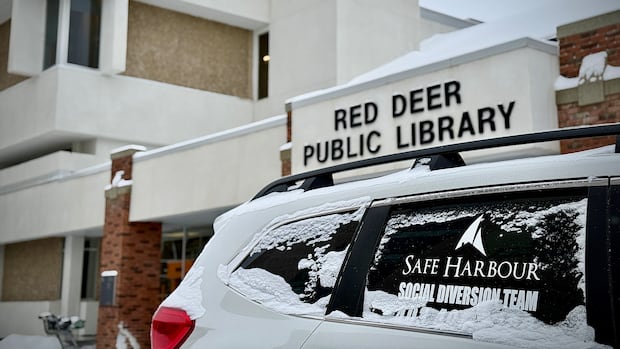
Between central Alberta’s freezing winter temperatures and the recent closure of a drop-in centre run by a local harm-reduction group, Red Deer Public Library CEO Shelley Ross has seen an uptick in the number of homeless people spending time at the branches.
As a result, she has needed to make some changes in the way she runs the library.
“When we’re hiring … for the library, we make it clear that the first and biggest challenge in a public library is the public,” Ross said.
“We’ve really changed who we’re looking for when we’re hiring, and we’re making the ability to work with the public a much greater concern of ours because we can teach the materials-handling skills without too much trouble.”
But some who work in the sector say they worry about the sustainability of such an approach, and how much it aligns with the mandates of libraries.
The skill gap
Libraries taking on challenges that come with members of the public facing homelessness, or issues related to substance abuse and mental health, isn’t a new reality across Canada.
“It’s not just urban, it’s rural, it’s public libraries across the country seeing the same thing,” said Mary Chevreau, the executive director of the Canadian Urban Libraries Council.
But she believes library studies students haven’t necessarily been prepared for what was to come after they graduate.
“You need different skills than what one would have acquired through library school,” Chevreau said.
And though she believes some schools are starting to shift to teaching students about “supporting an entire community, not just people who love books,” it means much of that training is falling onto CEOs like Ross.
“We do … first aid training,” Ross said. “We also do a training program called homeless academy.”
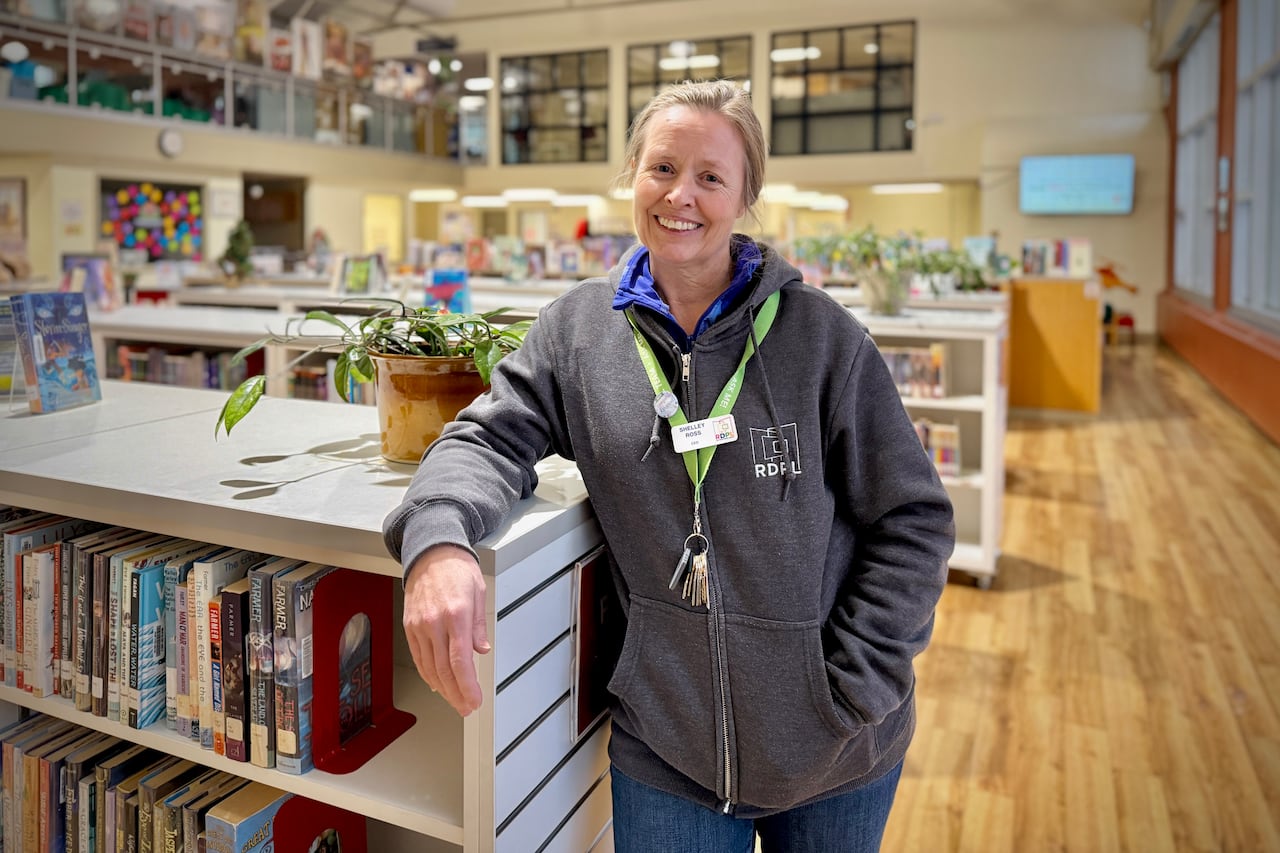 Shelley Ross has been the CEO of the Red Deer Public Library for eight years. She said when the doors close for the day, “putting people out into the cold that you suspect are unhoused is a [difficult] feeling.” (Lina Elsaadi/CBC)
Chevreau said she is seeing something similar being implemented countrywide.
“Library leaders have spent a lot of time … trying to train staff in an empathy approach to service models, so that they have better tools in their toolkit to support individuals who may be in crisis.”
But the issue? They’re not paid to do so.
“It takes away from our mandate,” Chevreau said. “But we feel a moral [and] ethical responsibility to ensure that people are given a chance in this space.”
‘Something will have to give’
Beyond training, Chevreau worries many talented librarians are having opportunities taken away.
“We don’t get funding to hire a social worker,” she said. “So we take our funding for staff, and now we’ve carved off something to hire a social worker that would have been a librarian or somebody who had those skills to provide literacy.”
That concerns her.
“We’re open 12 hours a day. We have to have staffing 12 hours a day. … At some point, something will have to give if this funding continues to be funnelled into supporting another community.”
Chevreau said spending that way takes away from their mandate.
“We don’t want funding to support unhoused [people or] those experiencing mental health or addiction,” she said. “We want funding to go to the social services organizations who are the experts.
“It’s a role that we’ve taken out of necessity because there isn’t anything else or any other places left.”
Ross highlighted that the Red Deer Public Library is already pressed for space and resources.
“We do our best to give people the welcoming public library experience that they may wish. But it’s just not in our abilities, really, to provide shelter services.”
Amber Edgerton, press secretary for Alberta’s ministry of assisted living and social services, said in a statement that the government’s 2025 budget included $220 million of funding to support shelter spaces across the province. The statement noted all provincially funded shelters offer 24/7 access.
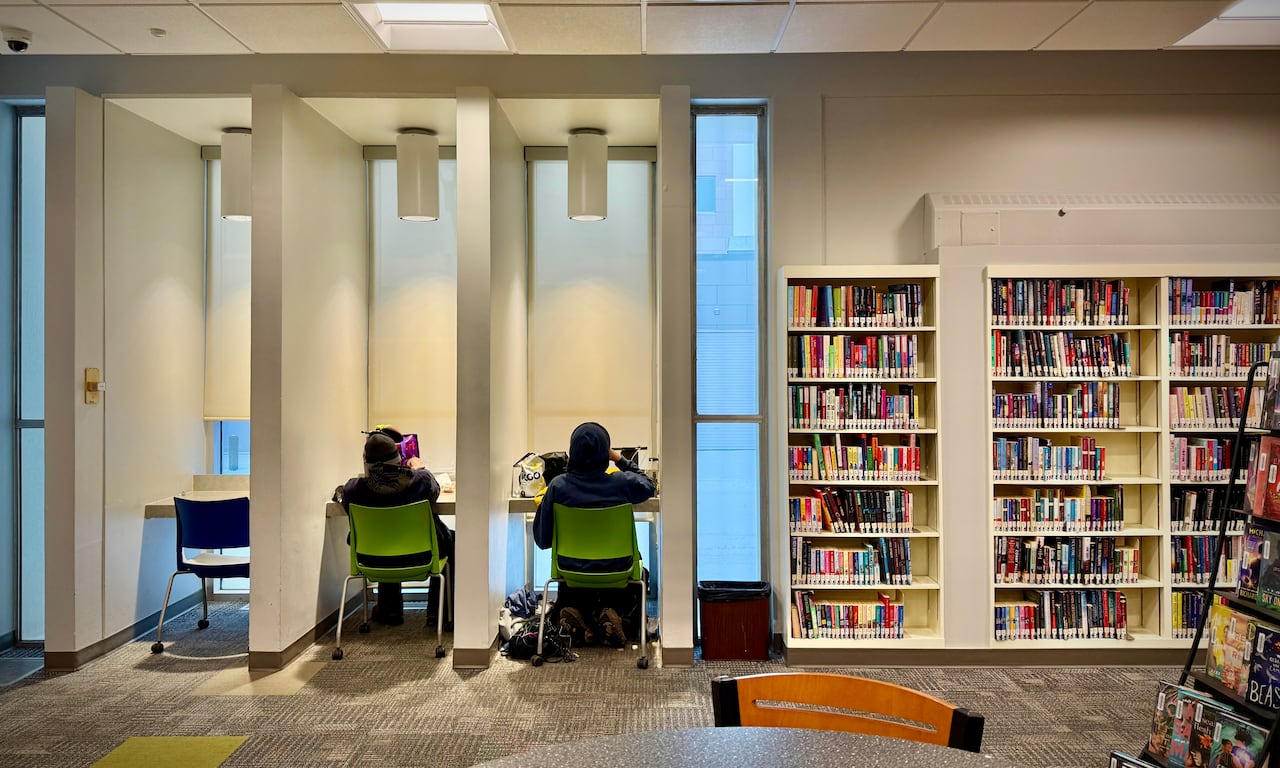 Red Deer Public Library CEO Shelley Ross says libraries importantly act as liaisons of information, which is why she feels it’s appropriate her staff keep a four-page handout with resources for anyone in crisis. (Lina Elsaadi/CBC)A place to ‘not feel homeless’
The City of Red Deer said it is seeing similar increased usage at its recreational centres across the city too.
Last month, the city announced $150,000 in funding to expand three winter warming initiatives, two of which will see more daytime shelter availability. The city said it is in the early stages of helping to establish a permanent shelter space, and that it has issued a request for proposals to find an operator.
Bobby-Jo Stannard, safe and healthy communities manager at the City of Red Deer, doesn’t foresee an end to libraries being used as warming spaces as a result of the new funding.
“Often people are not only looking for a warm place to be, but a place where there’s community,” she said. “And the library … is a great place for that.”
Ross said library staff aren’t equipped to address the needs of people facing significant issues.
“[But] we do our best to make referrals and to share information about who might have the resources that you need.”
Ross said the library is open to everyone who respects the space, and can even be of help in other ways.
“You can come into the library and not feel homeless,” she said. “There is value in people being able to just have a normal day … not feel in any way different, just to be normalized, just to be welcome.”