
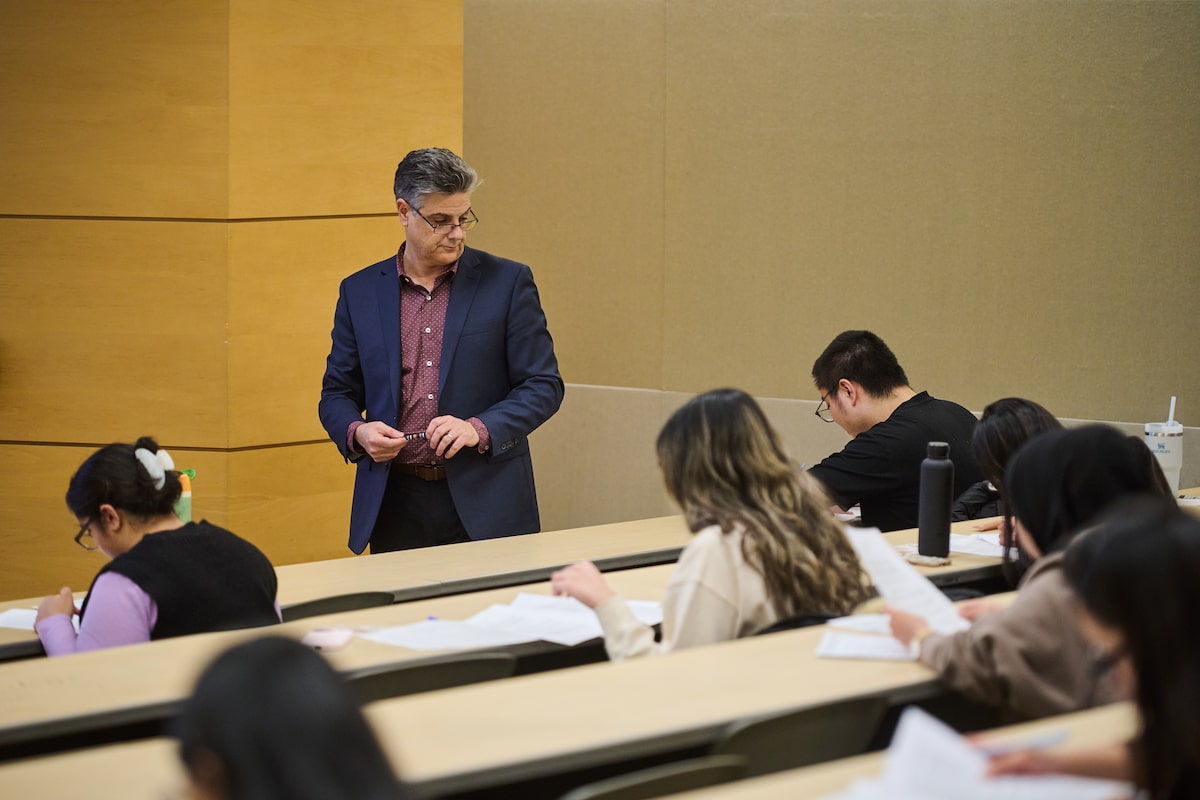
Professor James Elwick looks on as students take an exam at York University in Toronto on Dec. 16, 2025. Prof. Elwick is compiling and archiving records about exam cheating in Canada.Sammy Kogan/The Globe and Mail
Less than a decade after Confederation, the newly created province of Ontario was hit by several academic scandals in the mid-1870s, with revelations that exam papers for the certification of schoolteachers were stolen or illicitly unsealed, copied, then sold on the black market.
Fast-forward to our time, when the Law Society of Ontario found out that copies of its licensing exam had been leaked to a tutoring agency. The legal regulator suspected that 150 wannabe lawyers had “engaged in prohibited actions” when they were tested in the fall of 2021.
These two episodes are cited in research by York University professor James Elwick to illustrate the breadth of the project he has initiated – compiling and archiving records about exam cheating in Canada.
Prof. Elwick received a $75,000 federal grant for his project on exam cheating.Sammy Kogan/The Globe and Mail
Ultimately, he aims to create an online repository of documents dealing with all manners of plagiarism, note-smuggling, cribbing and other examples of exam dishonesty. This digital archive would be a resource for historians, teachers or students who want to research academic integrity.
“By looking at cheating, we can start to think about what it is to be recognized as an expert. Then we can ask larger questions like, how can we develop better ways to trust experts, especially in the face of everybody’s panicking about artificial intelligence,” Prof. Elwick said in a recent interview. “But of course, cheating has gone on ever since there have been exams going.”
Prof. Elwick is an associate professor at York’s Department of Science, Technology and Society. His previous work looked at the emergence in society of standard tests and assessments, which he says are the formalization of a system where credentials are evaluated, recognized and awarded in a consistent manner.
Now, he is turning his gaze to what happens when people try to swindle that credentials system. Last summer, he was awarded a $75,000 federal grant to study exam cheating.
“Schools don’t just educate – they also certify,” he noted in his grant application. In a world where no one can master all knowledge, exams and diplomas are a way to confirm the credentials of people who possess expertise in some area.
Hired exam-takers, blackmail and the rise of contract cheating at Canadian universities
In Canada, the use of standardized testing to accredit competence emerged in the mid-19th century, with the shift from oral exams to written tests, Prof. Elwick said.
His research shows that, as the use of written tests spread, so did cheating. He found in the archives of the Ontario Department of Education five major cheating cases that occurred in the 1870s after standardized exams were introduced to evaluate aspiring teachers.
In 1877, for example, a probe found that students in Toronto paid for early access to exam questions after the proofs had been leaked from the official printer by a junior staffer.
In Simcoe County between 1875 and 1882, a ring called the “Owl Club” sold advance copies of exam questions. The ring members communicated in code and obtained documents stolen from local school officials by steaming open the envelopes containing the test papers.
Prof. Elwick shows a historical example of a code letter used in academic cheating.Sammy Kogan/The Globe and Mail
Sometimes it was educators who undermined the process. In Ottawa and in Dundas County, examiners opened the test packages in advance and disclosed the questions to candidates.
In another case from the 1870s, a member of the central committee overseeing the certification exams, James A. McLellan, co-wrote a textbook featuring questions nearly similar to the ones in the tests, leading to accusations of collusion.
At the time, the concept of exams was still new in Canada, Prof. Elwick noted. “All of a sudden, you’ve now got to sit at a table and pour out all your knowledge in three hours on a particular subject. This is a new thing. People were becoming socialized into this new ritual.”
One more recent case, which Prof. Elwick dug up from York’s records, unfolded like a courtroom drama because it led to a university tribunal hearing. In the spring of 1993, physics professor Charles Dugan was overseeing 30 students taking their final exam. His suspicions grew when he noticed that a student hadn’t returned promptly from a visit to the toilets. Prof. Dugan went to check and saw someone in a stall with a book bag.
“His upbringing prevented him from either knocking on the door of the stall or speaking to the person,” the hearing minutes said. Instead, Prof. Dugan noted that the student who had left for a toilet break wore shoes and pants matching those he observed in the bathroom stall.
A lawyer for the student then cross-examined the professor, asking him to identify the washroom from a floor plan of the building, in an attempt to prove that he had identified the wrong man.
Opinion: In the AI revolution, universities are up against the wall
The emergence of the exam system and the parallel growth of cheating have led to an entire field of academic integrity. Universities now have committees, tribunal hearings and appeals processes to deal with plagiarism and exam fraud.
“It’s become like a microcosm of society and has created its own judiciary, its own social dynamics,” Prof. Elwick said.
Along with administrative records, he wants to document evidence of cheating from the student perspective. One example he mentioned was articles in student papers. An article from 1987, for instance, looked at the proliferation of ads for pre-written essay papers.
The day after Prof. Elwick’s interview with The Globe and Mail, another cheating story made the news. The Montreal newspaper La Presse reported that anti-corruption police investigated a driving school that was alleged to have outfitted students with hidden earbuds to supply them with answers during their licence tests.
The technology might evolve but, Prof. Elwick said, the mechanics of cheating still retain a familiar ring.
“The way to understand a complex system that everybody takes for granted is to study when it breaks down,” he said.