
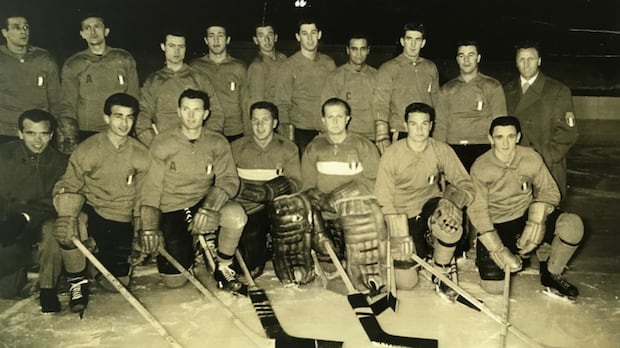
In just over a month, millions of Canadians will be gathering to watch ice hockey at the Milano-Cortina Winter Games.
Hockey enthusiasts may know Italy is among 12 nations on the men’s side that’ll be vying for gold, while the host country’s women’s team is among eight in competition.
But what fans may not know is Italy’s hockey program has deep and historic ties to Canada, particularly northern Ontario.
Aldo Maniacco, who passed away last year, was from Sault Ste. Marie and among several players from the region to compete on Italy’s men’s Olympic team in 1956. It was the first time the country ever hosted a Games, which 70 years ago were also played in Cortina d’Ampezzo.
Aiming to ice as competitive a squad as possible, players of Italian heritage from Sault Ste. Marie, Sudbury, Timmins and Thunder Bay were scouted by Italy’s national team in the years leading up to the 1956 Games.
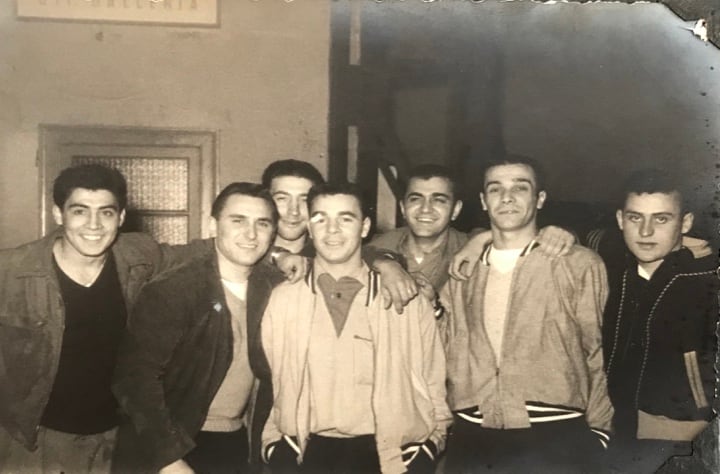 Players from northern Ontario with Italian heritage competed on Italy’s Olympic ice hockey team in Cortina d’Ampezzo in 1956. (Supplied by Bill O’Donnell)
These men applied for Italian passports and moved to the country their parents had once called home, carrying hopes of making something of themselves in professional sports and dreams of competing on the international stage.
Several of the northern Ontario players made it to that Olympic team 70 years ago — along with Maniacco, they included fellow Sault players Carmen Tucci and Bernie Tomie. Ron Furlani from Sudbury also made the squad.
Other players, including Florio Guarda of Timmins, Roy Furlani of Sudbury and the Sault’s Ron Dotter, Don Lato and Dickie Gioia all moved to Italy to play hockey but didn’t crack the Olympic roster.
Decades later, Maniacco’s family is working to ensure the legacy of these players — known as the Cortina Canadians — doesn’t get erased.
WATCH | Cortina Canadians speak decades later on 1956 Olympic run in Italy:
The late hockey player’s granddaughter, Brye-Anne Maniacco, along with their in-law, Bill O’Donnell, have been retracing the history of the team in hopes of eventually producing a full documentary.
“It seemed their contribution to hockey had been forgotten,” O’Donnell said. “I don’t think this is a story that should be lost. These men gave up Canadian citizenship, but they loved the game so much that playing hockey was what they wanted to do.”
Italy’s hockey team finished the 1956 Olympics in seventh place among 15 teams, which remains the country’s best Olympic finish in the sport.
In preliminary play, the team tied games with Austria and Germany before holding Canada to a 1-1 score entering the third period — a game Italy lost 3-1.
“Aldo Maniacco told me that he scored a goal against Martin Brodeur’s father, Denis Brodeur, who was [Canada’s] goaltender,” O’Donnell recalled. “But the referee didn’t see it go into the net. Brodeur pulled it out before the referee could call it a goal.”
Canada won the bronze medal, with the U.S.S.R. (the former Soviet Union) taking gold and the U.S. earning silver.
Despite being relegated to the consolation round, Italy finished strong and won all three of its remaining games.
“The Cortina Canadians made a major contribution to that hockey club,” O’Donnell said.
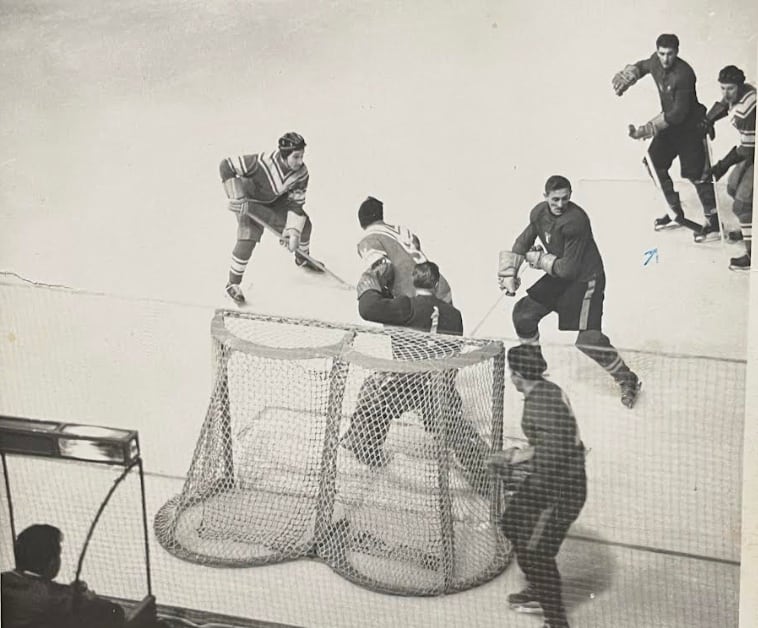 Shot of Italian team playing ice hockey at the 1956 Winter Olympics in Cortina d’Ampezzo. (Photo supplied by Brye-Anne Maniacco)
Italy later made a decision to not allow North Americans on Italy’s national team in the 1964 Olympics.
The result, according to O’Donnell?
“They didn’t do well. They finished 14th out of 15 teams that year.”
Players of Italian heritage from the Western Hemisphere were allowed back into Italy’s hockey program 20 years later, with northern Ontario maintaining strong representation.
Tom Milani and Robert De Piero from Thunder Bay played on the Italian team in the 1980s, while the Sault’s Gene Ubriacco coached the 1992 national team there.
The Sault’s John Parco also played on Italy’s 2006 Olympic hockey team in Turin, and scored on Canada’s goalie, Martin Brodeur.
“The legacy of those guys is still there today,” O’Donnell said. “They contributed so much.”
Most of the players from the 1956 team are no longer alive. Maniacco died in Sault Ste. Marie on May 10, 2025.
Disappointed that her grandfather won’t be able to watch the Olympics next month, Brye-Anne Maniacco is grateful for the memories he has left behind.
“That was something he always said — he wouldn’t live to see [the Games] come back,” she said tearfully. “But he was so proud and excited they were coming back. I was really proud of him.”
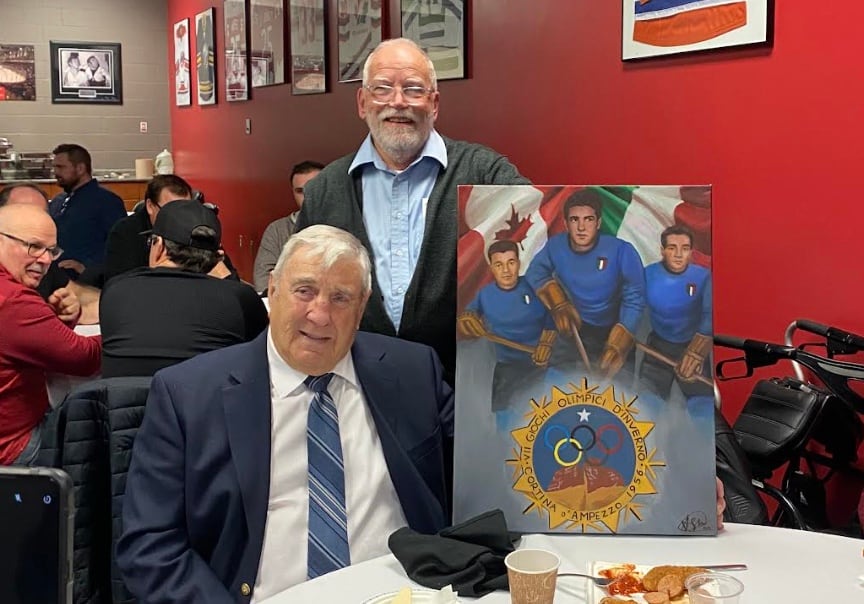 Aldo Maniacco, sitting, presented with painting from Bill O’Donnell featuring Sault Ste. Marie players who competed on Italy’s 1956 Olympic ice hockey team, including Maniacco, Carmen Tucci and Bernie Tomie. (Submitted by Brye-Anne Maniacco)
Three players from the team 70 years ago are still around today, including Tomie.
Maniacco’s family is currently trying to secure funding from the Northern Ontario Heritage Fund to produce a documentary on the Cortina Canadians.
“This isn’t just a Sault Ste. Marie story or northern Ontario story — this is a Canadian story,” O’Donnell said. “It’s something as a country we should take pride in, the legacy these fellas have left us.”