
Nathan Ingram-Cotton, brewmaster at Annex Ales in Calgary, has gone above and beyond to limit the brewery’s water-consumption, despite the city not imposing commercial restrictions.AHMED ZAKOT/The Globe and Mail
Brewmaster Nathan Ingram-Cotton feels fortunate that the second rupture of Calgary’s most important water main happened when it did: just before Dry January.
“It helps a little bit,” he said, laughing. Annex Ales, the brewery he manages in Calgary’s southeast, took a hit the last time the city’s Bearspaw South Feeder Main burst in June, 2024.
Mr. Ingram-Cotton, who spends his days keeping Annex’s water-heavy business humming, has trimmed the brewery’s water consumption in half to about 3,500 litres daily from the normal average of about 6,500 litres.
Aside from lowering its output, the brewery is collecting its sanitation water and using it to rinse fermentation tanks; it’s reusing the water that cools unfermented beer so “not a single drop is wasted”; and they’re waiting until the end of the day to clean the floors instead of periodically mopping.
All are things nobody asked him to do.
“One of our mottos is, ‘No Gods, No Masters,’ which is basically: ‘Do the right thing, even though no one is watching,’” said Mr. Ingram-Cotton.
The brewmaster’s best efforts have not stopped Calgary residents’ water consumption from remaining stubbornly high since the Bearspaw South Feeder Main burst on the evening of Dec. 30, 2025, sending a river of water gushing into the Trans-Canada Highway in the city’s northwest. The city has since asked residents to keep showers to three minutes, flush toilets only when needed and run washing machines sparingly. But businesses have not been forced to close or reduce their water use.
“It seems like people aren’t really heeding the message this time,” said Mr. Ingram-Cotton.
City of Calgary ignored two decades of warning signs about water system, report finds
The ruptured pipe has left the approximately 1.6-million-person city with a fraction of its normal clean-water supply. Thursday marked the fifth consecutive day Calgary residents’ water consumption was considered “unsustainable” by city metrics. Daily water consumption this week hovered around 510 million litres; the city’s target for sustainability is 485 million litres.
A third-party investigation published this week found that the city of Calgary ignored two decades of warnings about the pipe’s vulnerabilities. It has led to finger-pointing at current and past city administrators and elected officials, while Calgary Mayor Jeromy Farkas, elected in October, has warned the deteriorating feeder main will plague Calgary for years while the city upgrades its water infrastructure.
City officials said on Thursday that construction crews have made good progress on fixing the feeder main and that service could be restored soon.
Mr. Farkas warned early in the week the city would be in “life-threatening” territory if too much water was pulled from the city’s reservoirs, as firefighting responses could be hamstrung by low reserves.
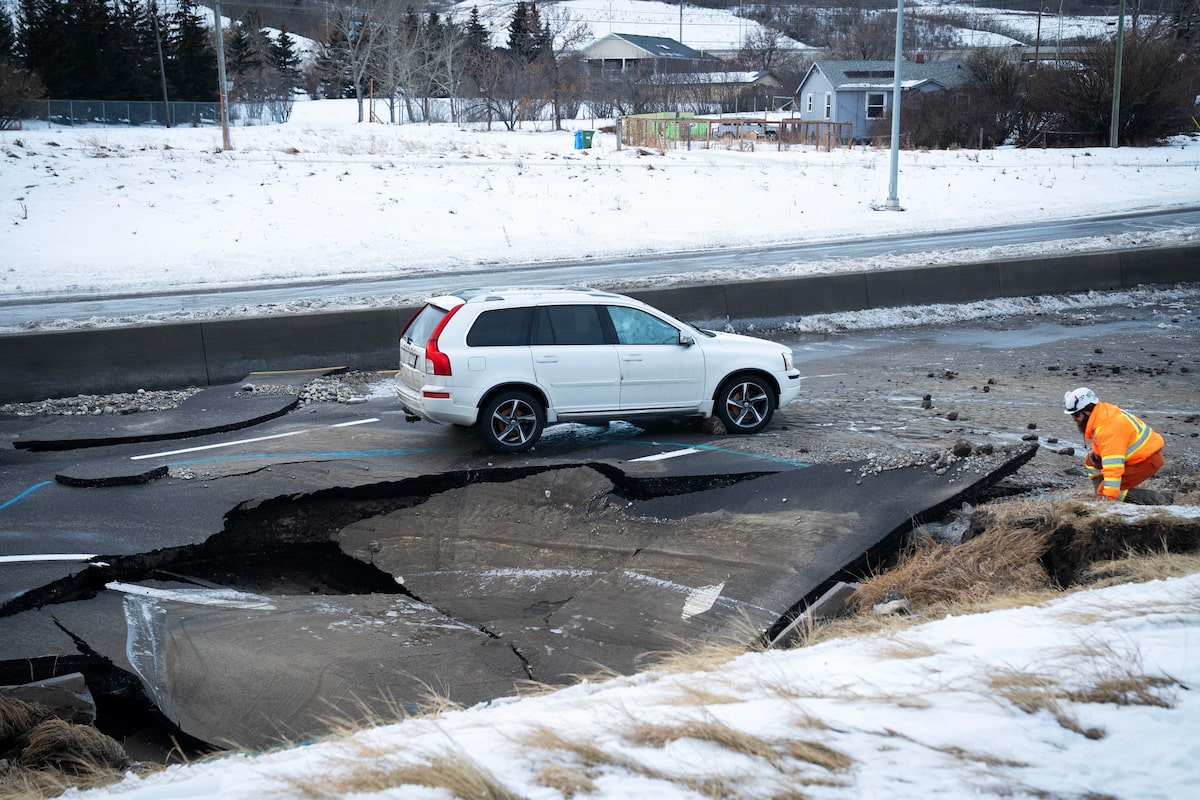
City crews check the damage on the Trans-Canada Highway the day after a water main break.Todd Korol/The Globe and Mail
He has not gone so far as to echo former mayor Jyoti Gondek’s warning in June, 2024, that taps may run dry – a sentiment she expressed on a day in which the city used 472 million litres of water and summer temperatures hit 23 C.
Calgary’s current water use reflects the heightened demand that occurred during the second round of restrictions imposed during late summer, 2024, when the city turned off the feeder main to repair 21 sections of the pipe.
Compared to this time last year, Calgary residents’ water consumption levels have not changed. On Jan. 8, 2025, the city pulled 502 million litres. On the same date this week, it used 508 million litres.
Sue Henry, head of the city’s Emergency Management Agency, said this week that Calgary’s only functioning water-treatment plant is delivering three times more water than it normally does, and the reservoir it pulls from is emptying.
“There is no wiggle room to meet the kind of demand we’ve been seeing. We are operating at full tilt,” said Ms. Henry.
A “non-intrusive” emergency alert for Calgary was sent on Wednesday, but the city hasn’t initiated a public state of emergency, which would give officials a wider range of powers and will only be triggered if the city was in “dire need,” Ms. Henry said.
“We only get one shot at that through an event like this, and we need to save that shot for when we absolutely need citizens to take action.”
Opinion: Calgary’s water-use restrictions are a symptom of a much larger problem in Canada
Calgary will be forced to enter a state of emergency if residents don’t adjust their usage, warned Kerry Black, associate professor at the University of Calgary’s Schulich School of Engineering.
If it happens, Prof. Black said hospitals would be prioritized and residential access may be cut off, and the city would likely shift to bottled water delivery.
“If we have to prioritize public health over being able to have a shower or you being able to wash your clothes, we will do that,” said Prof. Black. “That is sort of the crux of a public-health approach, is to protect all rather than one.”
Prof. Black said residents aren’t as conscious of their water consumption habits in the winter.
She said people also appear to be less willing to co-operate during this round of water restrictions – the third in about 18 months.
“It’s no different than that second phase [in late-summer 2024] because people care less,” Prof. Black said.
“It sounds harsh to say that, but it’s the reality. If you’re not impacted by it, you don’t care.”