

Listen to this article
Estimated 3 minutes
The audio version of this article is generated by AI-based technology. Mispronunciations can occur. We are working with our partners to continually review and improve the results.
A deer that was hunted in B.C.’s Kootenay region has tested positive for chronic wasting disease, bringing the total number of cases reported in the province up to nine.
The province said on Friday that the case was confirmed in a management zone set up to stop the spread of the disease.
It came after testing of a white-tailed deer that was hunted near Jaffray, B.C., according to province.
Chronic wasting disease (CWD) is an infectious and fatal illness affecting species such as deer, elk, moose and caribou.
The condition, which is always fatal and has no known cure, has been spreading throughout the Kootenay region after being detected for the first time ever in the province last year.
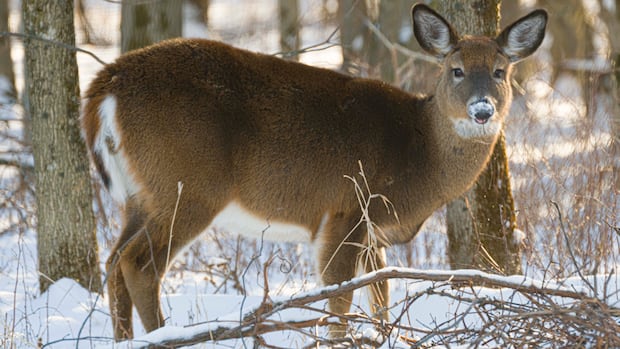
 Cervidae is a family of hoofed ruminant mammals that includes moose, deer and elk. If a cervid gets chronic wasting disease, there is a 100 per cent fatality rate. (Marcella Bernardo/CBC)
Late last month, the province announced it would be setting up a special hunt to encourage more surveillance of the disease within the existing management zone.
Typically, hunters in B.C. are only permitted to kill two deer per season.
But, from Jan. 5 to Jan. 31, hunters are now allowed to participate in a special hunt within the Kootenay chronic wasting disease management zone and harvest a third deer.
Within the management zone, the B.C. government requires hunters to submit samples for free testing, and to report sick animals.
There are also restrictions on transporting carcasses in the Kootenay region due to the disease.
All of the nine confirmed cases of “zombie deer disease” in B.C. are located within the Kootenays in the southeast corner of the province.
WATCH | Hundreds of urban deer to be culled to manage CWD: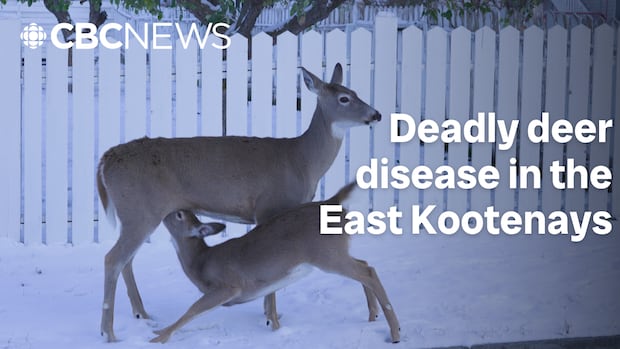
B.C. set to cull hundreds of deer to curb deadly deer disease in the East Kootenays
A fifth case of a deadly deer disease has been found near Cranbrook. The first case was identified last January in the East Kootenay region and more continue to pop up. The province says it’s working to manage the spread. As CBC’s Corey Bullock reports, B.C. says it’s set to cull 200 deer in Cranbrook and Kimberley to test for the disease.
The province is encouraging hunters outside the Kootenays, especially in the Peace region adjacent to Alberta, to voluntarily submit samples from harvested deer, elk and moose.
In Alberta, more than 26 per cent of all mule deer tested positive for chronic wasting disease in 2024-25.
The B.C. government said it is focused on preventing transmission of the disease from the Kootenays to other parts of the province, and is specifically concentrating its efforts on deer that live along the B.C.-Alberta border.
WATCH | Chronic wasting disease explodes through Alberta:
Chronic wasting disease has exploded through Alberta’s deer population
It attacks the brain, has a 100 per cent fatality rate, and is spreading quickly through Alberta’s deer population. Researchers across western Canada, including Sabine Gilch in Alberta, are working on a potential vaccine for this deadly wasting disease. She joined Edmonton AM to talk about her work.
Prion diseases like chronic wasting disease are a family of rare neurodegenerative disorders that can be found in both humans and animals, impairing brain function.
While there is no direct evidence the disease can be transmitted to humans and there have been no cases in humans, the ministry says Health Canada and the World Health Organization recommend people not eat the meat of an infected animal.
Perhaps the best known example of a prion disease is bovine spongiform encephalopathy, commonly referred to as mad cow disease.