
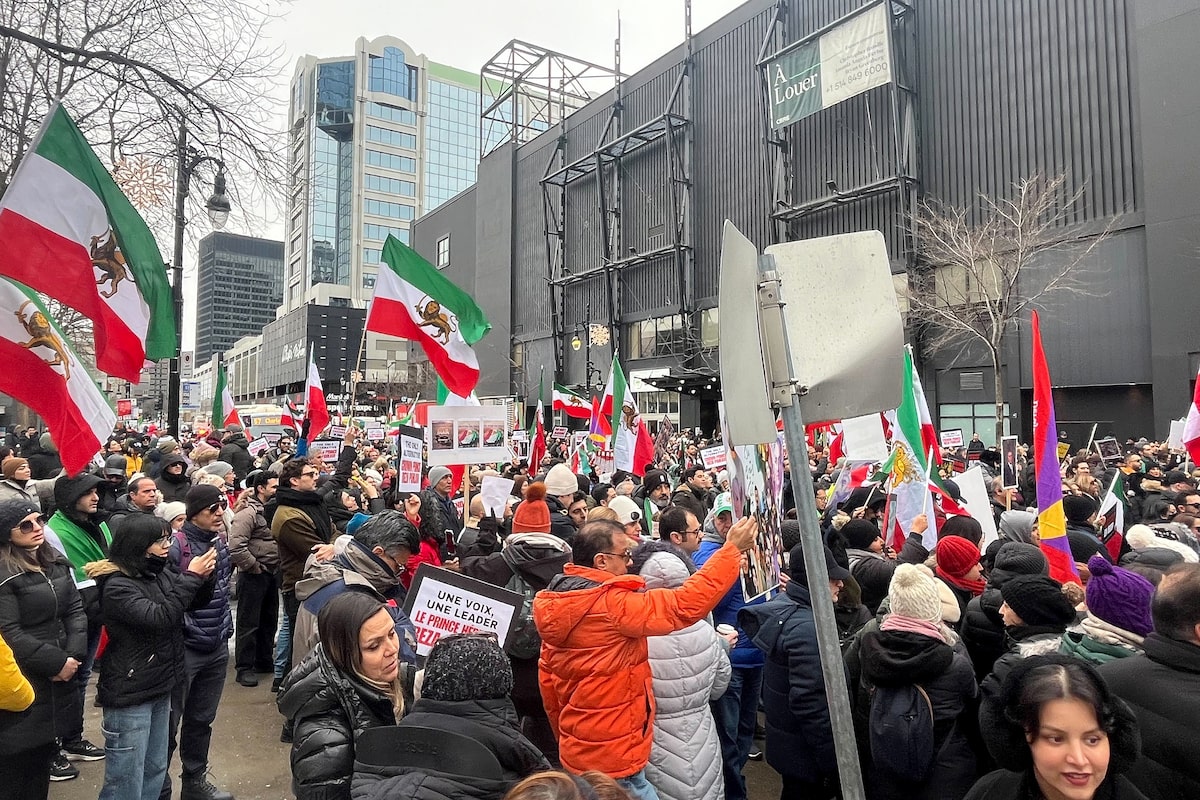
A rally to voice support for the Iranian people, in Montreal, on Saturday.Quentin Dufranne/The Canadian Press
As a procession of semi-trucks rumbled down Yonge Street in Toronto flying Iran’s prerevolution flag and blasting their air horns on Sunday, Rafat Mirlohi looked on with a mix of hope and distress.
For four days, she has been unable to reach family in Iran while a crackdown on countrywide anti-government protests has killed at least 500 people, according to reports, and shut down phone and internet contact with the outside world.
“We don’t know what’s going on there any more,” Ms. Mirlohi said, waving her own Iranian flag − the sun-and-lion version that flew before the 1978-79 revolution – as the rally to support Iranian protesters thundered past. “It’s complete darkness in Iran now. I have lots of family there. When I call, the line just goes silent.”
The communications blackout has heightened anxieties among Canada’s Iranian community as people try to check on the well-being of friends and relatives in the embattled country. The U.S.-based Human Rights Activists News Agency said on Sunday that at least 10,681 people have been detained over the two weeks of protests and another 544 are dead. The Iranian government has not issued casualty figures.
“We’ve had other blackouts, but this is the worst ever,” said Nagol Momeni, another Toronto-area resident with family in Iran. “We’ve always been able to establish a weak land-line connection. This time, it’s zero. I’m stressed and frustrated and can’t sleep.”
Iran warns U.S. not to launch strikes as activists say protest deaths reach 544
Others have had better luck. Kei Esmaeilpour, president of the Civic Association of Iranian Canadians, a non-partisan advocacy group, said he had been in regular contact with people in the country, including a leader of the protest movement.
“Part of what I’m doing these days is transferring messages,” said Mr. Esmaeilpour, who is based in British Columbia but has most of his family back in Iran. “The message from them is: ‘Let the international community know. Ask them to help us.’”
The precarious state of the Iranian economy has fuelled the protests, he said.
“My brothers, both of them are educated engineers, and they cannot find a job for themselves.” Families, he said, aren’t able to afford meat, fruit or bread. “This is the situation over there. But this is the main question right now: What are people looking for?”
“They’re looking for life.”
Images emerging from Iran in recent days show violent attacks on demonstrators, stirring memories of the revolution.
Iran said on Sunday it would strike back against U.S. military bases and Israel if U.S. President Donald Trump followed through on his threat to attack Iran to protect protesters.
Reuters
“I observed the demonstrations, the shootings, everything, 47 years ago and this reminds me so much of those days,” said Fakhreddin Jamali, co-founder of the Iranian Heritage Society of Edmonton.
He has a weekly Thursday Zoom chat with his sisters. Last week, they were all no-shows because of the internet outage. “The situation is pretty grave and worrisome,” he said. “We don’t know where it’s going to go.”
Despite the graphic images coming out of Iran – of bodies piled high, and of pools of blood in the streets – Nazanin Afshin-Jam, a human-rights and democracy advocate based in Nova Scotia’s Pictou County, strikes a cautiously optimistic tone.
“It’s horrific,” she said. “My stomach turns, and of course I’m afraid for our brothers and sisters back home in Iran, but my heart’s energy overtakes that, and I have a feeling of hope and excitement for what’s to come – that the Iranian people will finally get what they’ve been demanding for the last 46 years, which is freedom, democracy, secularism and hopefully a constitution based on human rights and the rule of law.”
A timeline of the protests in Iran and how they grew
While Iran has seen many popular movements since the regime assumed control in the late 1970s, the number of protesters this time is “unprecedented,” Ms. Afshin-Jam said.
The demonstrations, which began as a response to the economic situation in the country, have grown as they’ve picked up on past grievances. “Some of my father’s relatives, who normally would never come out on the streets, have this time. So that, for me, was very interesting,” she said, adding that she’s been waiting for this day for many years.
If the regime were to fall, Ms. Afshin-Jam, who left Iran with her family when she was 1, said she’d want to visit the country of her birth. “My mom passed away a couple of years ago, and I’ve been holding her ashes, and I refuse to bury them,” she said.
“I want to bury her next to her family.”