
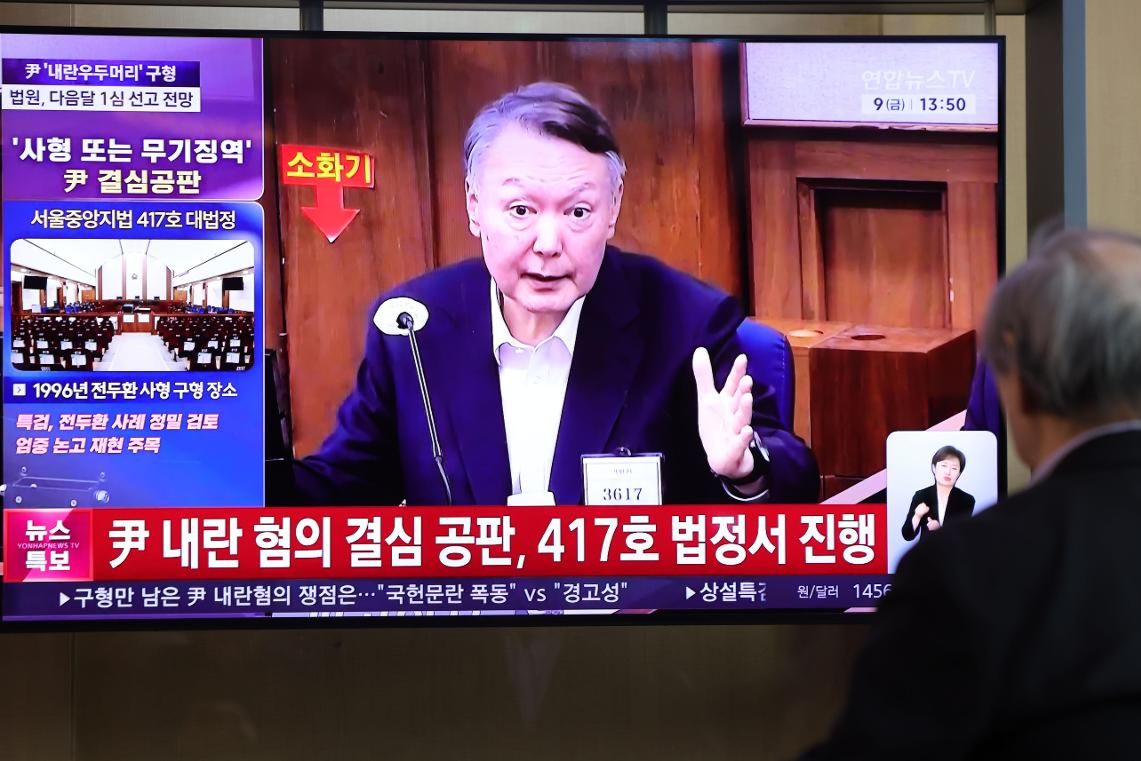
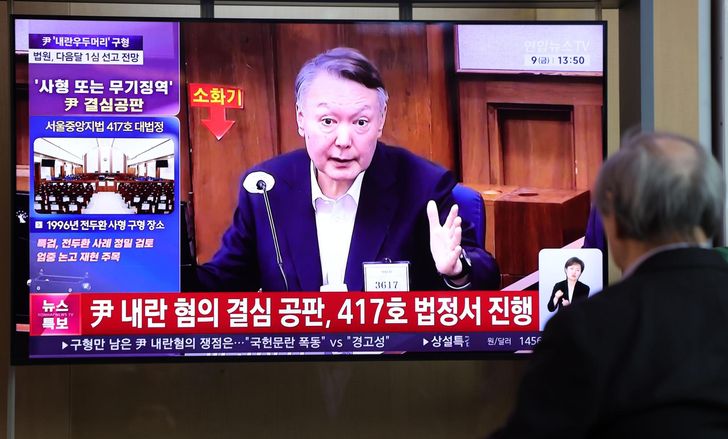
Commuters at Seoul Station watch news coverage Friday about former President Yoon Suk Yeol facing a possible maximum sentence in his sedition trial over the martial law crisis. Newsis
As Korea awaits a landmark sentencing against former President Yoon Suk Yeol, expected within months, prosecutors find themselves legally constrained by the country’s narrow range of possible punishments.
Yoon faces charges of insurrection over his Dec. 3, 2024, martial law declaration, making him the first president in Korea’s democratic history to be indicted on such counts for actions taken while in office.
Under the Criminal Act’s strict provisions governing insurrection ringleaders, sentencing options are limited to three: death, life imprisonment with labor, or life imprisonment without labor. The special counsel investigating the case will seek one of the three during the final hearing slated for Tuesday.
Although South Korea has not carried out an execution in more than a quarter-century, the unprecedented nature of the case — compounded by Yoon’s steadfast denial of responsibility — has reignited a national debate over whether the ultimate penalty should be considered, nearly 30 years after it was last sought against a former head of state.
Prosecutors and lawyers closely observing the situation say that because Yoon has flatly denied all charges, shown no remorse and continued to shift responsibility to subordinates, the prosecuters’ case for seeking the death penalty is strong. At the same time, some within the special counsel team are said to favor life imprisonment, arguing that the social shock of requesting a death penalty must be weighed.
Prosecutors accuse Yoon of conspiring with former Defense Minister Kim Yong-hyun and others to proclaim an unconstitutional state of emergency despite no signs of war, armed rebellion or a comparable national crisis. Yoon is alleged to have deployed troops and police to block the National Assembly from voting to lift martial law and to have attempted to arrest or detain key political figures, including then-National Assembly Speaker Woo Won-sik, then-Democratic Party of Korea (DPK) leader Lee Jae Myung, former People Power Party leader Han Dong-hoon and senior election officials.
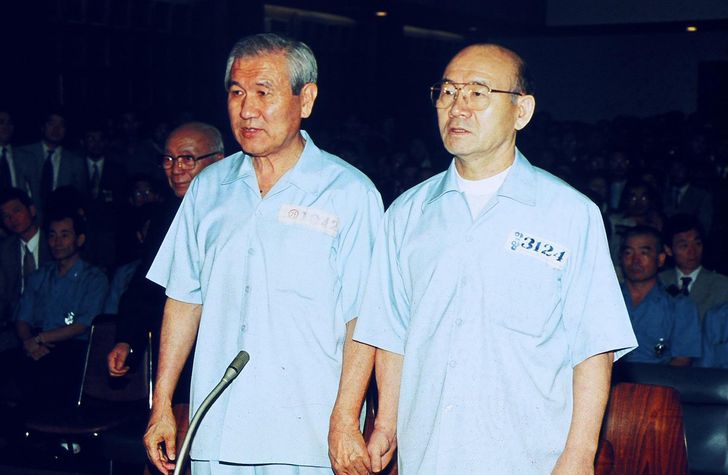
Former Presidents Chun Doo-hwan, right, and Roh Tae-woo stand during their sentencing hearing in Courtroom 417 of the Seoul District Court in this Aug. 26, 1996, photo. Yonhap
The atmosphere in Courtroom 417 of the Seoul Central District Court on Friday was heavy with historical resonance.
Three decades ago, the same courtroom hosted the landmark trials of former Presidents Chun Doo-hwan and Roh Tae-woo, who were prosecuted for their roles in the 1979 military coup and the bloody suppression of the 1980 Gwangju pro-democracy uprising.
In 1996, prosecutors sought the death penalty for Chun on multiple charges including treason, mutiny and massive bribery under the Act on the Aggravated Punishment of Specific Crimes.
The court initially sentenced Chun to death, but an appellate court later commuted the punishment to life imprisonment, a term that was finalized by the Supreme Court and eventually cut short by a presidential pardon. Roh, indicted on nine counts including key roles in the coup and insurrection, was given a 22-year, six-month prison term at first instance, later reduced to 17 years and also ended early by clemency.
For Yoon, the historical parallels are difficult to ignore. He now stands in the same courtroom as Chun and Roh once did, accused of wielding state power to suppress political opponents and entrench his rule.
As a law student, Yoon once sentenced Chun to life imprisonment in a mock trial; now he appears again in Courtroom 417, wearing a prison badge numbered 3617.
During a marathon 15-hour trial session on Friday that stretched past midnight, he was seen nodding off — a physical toll of what critics have slammed as deliberate stalling tactics and referred to locally as a “bed trial” — as his fate was debated in the very halls wehre he once sought to uphold the law.
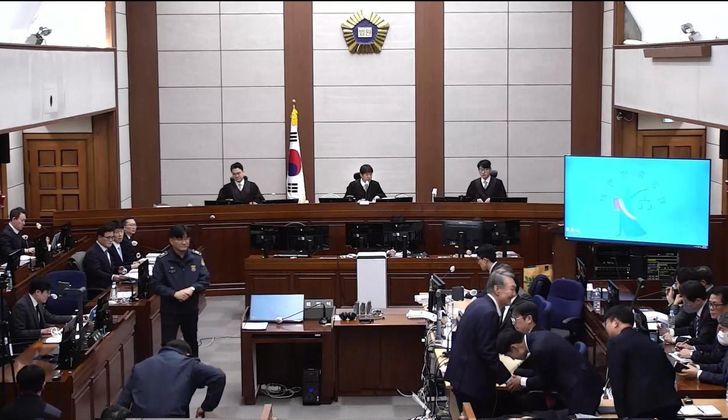
Former President Yoon Suk Yeol shakes hands with members of his legal counsel following a marathon 15-hour insurrection trial session at the Seoul Central District Court on Friday. Newsis
Any move to seek the death penalty for Yoon would reverberate far beyond his individual case.
Korea retains capital punishment in law but has not carried out an execution since December 1997, and is widely regarded as a de facto abolitionist state. Over the past quarter-century, multiple death sentences have been confirmed by the Supreme Court, but none has been enforced, keeping the issue in legal and moral limbo.
Meanwhile, calls are mounting from political opposition and parts of civil society for the court to impose the maximum penalty on Yoon for its symbolic significance.
Baek Seung-ah, a floor spokesperson for the ruling DPK, said during a National Assembly briefing Saturday, “There can be no leniency for insurrection forces who insulted the people and destroyed constitutional order.” She urged the judiciary to take action, insisting that “only the maximum penalty under the law is the answer” — a pointed call for a death sentence for Yoon and his accomplices.