
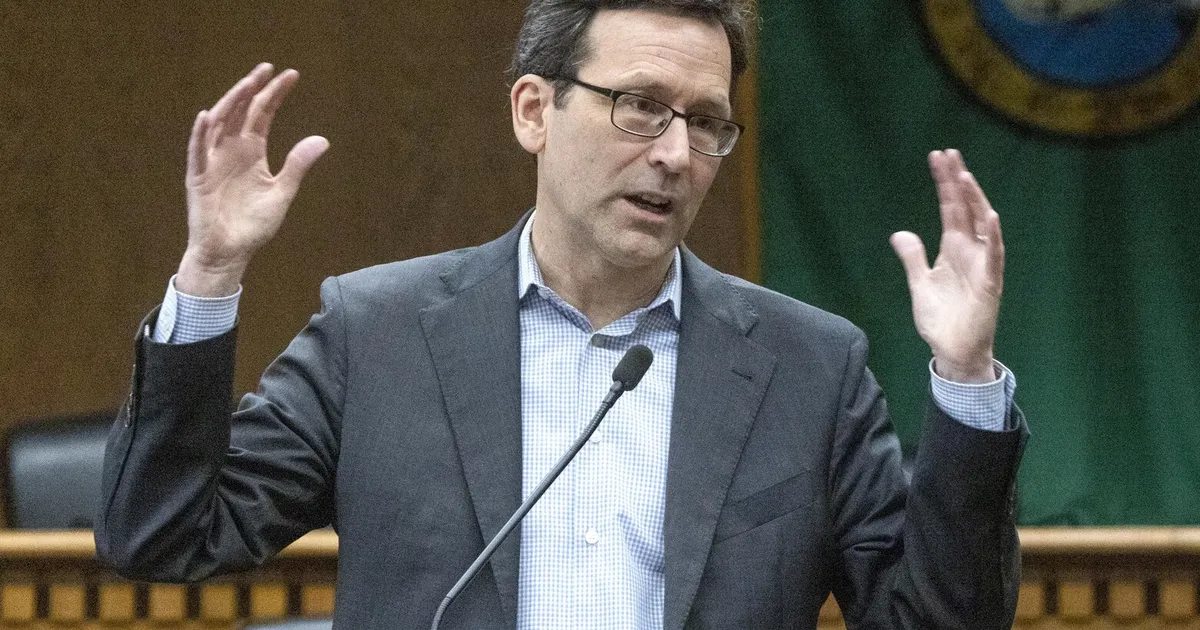
OLYMPIA — Gov. Bob Ferguson’s first year in office has been shaped by a state budget crisis that was years in the making, and yet somehow arrived abruptly.
He and majority Democrats last year grappled with an estimated $16 billion gap between state tax collections and planned spending. In response, they made cuts but raised taxes to the tune of roughly $9 billion over four years.
As they prepare for the 2026 legislative session, which starts Monday, Ferguson and lawmakers are already staring at another shortfall, estimated at $2 billion.
The seeds of the state’s financial woes were planted over years of increased spending and rosy tax assumptions. But the full scope of the problem was only made public in late 2024, just after Ferguson was elected governor.
“That wasn’t just a surprise — that was a shock,” Ferguson said Friday, speaking with reporters at a legislative preview in Olympia.
In addition to the state’s self-inflicted problems, lawmakers are facing a frequently hostile Trump administration that has tried — often illegally, according to court rulings — to slash federal funding to states led by Democrats.
It all adds up to a tall order for the short legislative session, scheduled to run 60 days.
Ferguson and key state lawmakers laid out their policy and spending agendas for the 2026 session Friday, acknowledging difficult choices ahead.
They’re mulling additional cuts throughout state government and universities, delaying implementation of some big programs and seriously debating a new state income tax on earnings of more than $1 million a year.
Ferguson has endorsed what he labels the “millionaires tax” and said he’s confident it will likely pass this year and survive legal challenges.
He also put conditions on his support for any such tax. In an interview with The Seattle Times and at Friday’s legislative preview, he made it clear he won’t sign such a tax unless it is offset with tax cuts for individuals and small businesses.
While specifics have not been fleshed out, Ferguson said he wants a portion of the tax devoted to funding and expanding the state’s Working Families Tax Credit, which currently gives annual rebates of up to $1,330 to lower-income people.
He also said his staff is eyeing cuts or exemptions in the state sales tax for certain essential household purchases, such as clothing that costs less than $100.
The high-earners income tax proposal is estimated to bring in at least $3 billion annually, supporters say, though the text of the bill has not been released.
Top Democrats acknowledged the new tax, even if passed, would not solve the state’s immediate budget shortfall since it would go into effect a few years later and would likely face legal challenges. A long-standing legal precedent from a 1933 state Supreme Court decision found a graduated income tax unconstitutional.
Senate Majority Leader Jamie Pedersen, D-Seattle, said he agrees with Ferguson that a “significant portion of the proceeds” should be used to provide a permanent funding source for the state’s Working Families Tax Credit. He also said he would like to see a small portion of the funding go toward reducing the aggregate state property tax, and that there are other discussions around targeted sales tax relief.
“We have a wide variety of options, and I think there will be robust discussion about it,” Pedersen said. “The big picture, though, is that I absolutely believe that a significant portion of the proceeds, if that idea moves forward, will need to be dedicated to reductions of regressive taxes.”
Republican budget leaders criticized the Democrats’ reach for an income tax, pointing to other taxes the majority party has raised in recent years that have increased costs for businesses and people.
“If you want to be serious about fixing regressivity in our state, you need to talk about reducing the tax burden on the poor and the middle class,” said Sen. Chris Gildon, R-Puyallup, ranking member on the Senate Ways and Means Committee. “You just can’t complain about a regressive tax system, while making it more regressive.”
Republicans and some business leaders have also raised the specter of the new income tax driving away wealthy residents and their businesses to other states.
Ferguson dismissed those concerns Friday. “I don’t think that is going to happen,” he said at the legislative preview, noting that 41 states have an income tax.
While Republicans agreed the state is facing more challenges heading into the session due to budget constraints, the road to fixing the issue looks much different from Democrats’ approach and instead focuses on reductions in spending and eliminating lower-priority programs rather than new taxes. But the GOP is solidly in the minority in the Legislature and has little power to enact its ideas without support from Democrats.
Lawmakers will not only spend the legislative session with a big focus on shoring up the budget, but also want to tackle issues such as affordability and housing, legislative leaders said.
Although Democratic and Republican caucus leaders did not agree on how to solve most issues facing Washington, both parties did agree the state needs to do more to fix its ballooning tort liability payouts and chronic challenges to the state’s public defense system.
Democratic leaders also pointed to challenges at the federal level causing uncertainty in the state, but Republicans said they want to focus on state issues and pushed back on the notion that actions by the Trump administration have impacted Washingtonians as much as Democrats say.
“Federal policies don’t target Washington,” said House Minority Leader Drew Stokesbary, R-Auburn. “Washington state’s policies target Washington.”
One big looming decision from the Trump administration will squarely affect the state though, as Ferguson is expected to submit a request for a major disaster declaration that would unlock tens or hundreds of millions in emergency aid to help with recovery from recent historic flooding.
Ferguson said Friday the state has not yet finished its estimate on the total damage from the floods, but said it’s working on a persuasive case to convince the Trump administration that Washington should receive disaster relief — including a video pitch.
“That’s going be expensive. And we’re going to need the federal government to step up on that,” he said.
Seattle Times reporter Sophia Sostrin contributed to this report.
Jim Brunner: jbrunner@seattletimes.com: Jim Brunner is a political reporter for The Seattle Times, where he covers how the state’s elected leaders are serving the public with an eye for watchdog and high-impact explanatory stories.Shauna Sowersby: 206-652-7619 or ssowersby@seattletimes.com: Shauna Sowersby is the state politics reporter for The Seattle Times. She covers the state Legislature, government agencies and the inner workings of state government from Olympia.