
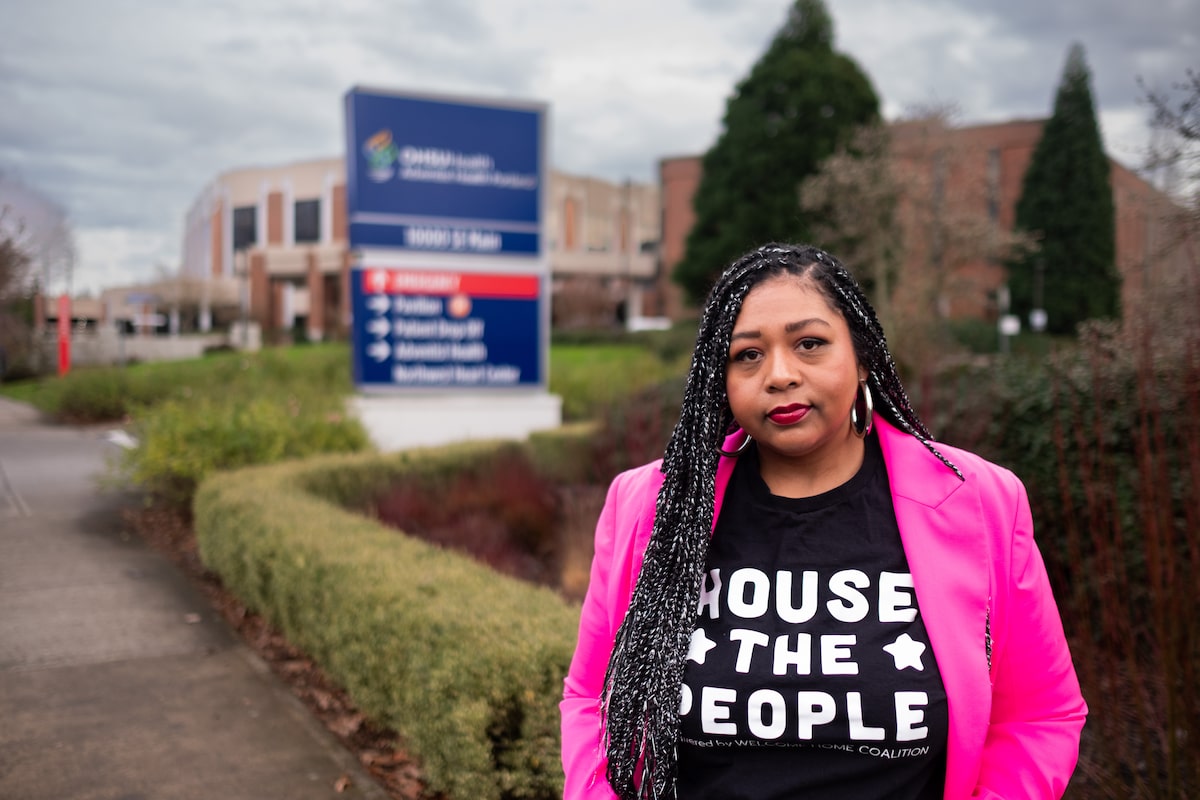
Candace Avalos, a municipal councilor who represents east Portland, said her government must marshal its energy and resources to try to impede ICE.Christena Dowsett/The Globe and Mail
Portland, long a hub of progressive protests, saw a spike in demonstrations this weekend in response to federal immigration agents shooting and wounding two people in the city late last week, a day after killing a woman in Minneapolis.
On Saturday morning, hundreds marched around downtown’s riverfront park, demanding Immigration and Customs Enforcement stop operating in their sanctuary city. In Portland and across Oregon, policies limit local police forces from helping with federal immigration enforcement.
Shortly afterward, two hundred doctors, nurses and others rallied outside a local hospital that they accuse of co-operating with ICE by allowing the federal agency to dictate the treatment of its detainees.
As dusk fell, hundreds more gathered in a plaza across from City Hall to memorialize Renee Good, the 37-year-old Minnesotan killed by an ICE agent last week. They heard from politicians and shared testimony of immigrants targeted by that same federal agency. Protesters decried ICE operations that Oregon-based activists and politicians say have ramped up considerably since last fall.
And, throughout the weekend, another protest remained constant: a group of people screamed at vehicles entering and exiting the boarded-up office building ICE leases in Portland’s south end.
The two who were wounded in Portland, Yorlenys Betzabeth Zambrano-Contreras and Luis David Nino-Moncada, were said by Police Chief Bob Day to “have some nexus to involvement with” Tren de Aragua, a violent Venezuelan gang. This corroborated an earlier statement from the U.S. Department of Homeland Security that was made without evidence and received with skepticism.
Chief Day, speaking at a Friday news conference, acknowledged that he was hesitant to share this information so quickly because he is aware such associations have been thrown around too loosely by law-enforcement agencies, including his own, to blame victims. He also linked Ms. Zambrano-Contreras and Mr. Nino-Moncada to an open investigation into a non-fatal shooting from last summer.
He added that Ms. Zambrano-Contreras had been arrested for prostitution and involved in a human-trafficking case in a nearby county. (Mr. Nino-Moncada’s public defender told Oregon Public Radio Friday that ICE is casting aspersions on his client and has not provided any evidence of his involvement in the gang.)
This weekend, volunteers with one of the dozens of grassroots ICE-monitoring groups across the United States have also continued their periodic practice of using their own cars to tail ICE employees, posting to social media surveillance that sometimes results in the federal agents pulling into a local police station to seek help.
While protesters took to the streets, Portland’s elected state and municipal politicians urged them to remain calm. The officials pledged to use whatever powers they have at their disposal to put “sand in the gears” of ICE’s local operations.
Portland police officers dawning riot gear monitor an anti-ICE protest at the U.S. Immigration and Customs Enforcement building on Saturday.Mathieu Lewis-Rolland/Getty Images
Elected officials are proposing legislation and throwing up bureaucratic hurdles in an effort to make work difficult for federal agents.
They say they are trying to answer the question facing lawmakers in charge of the many Democratic-run cities seeing increased immigration enforcement: How do you stop an ostensible partner with much more power and resources from imposing its will upon your electorate?
U.S. President Donald Trump’s administration has retaliated by cutting crucial funding from Oregon’s state social services, which lawmakers say makes governing even more difficult.
Candace Avalos, a Portland municipal councillor who represents east Portland, the district where the shooting occurred and home to roughly half of the city’s people of colour, said her government must marshal its energy and resources to try to impede ICE.
“With all of that going on … we have 7,000 homeless people on our streets, we have 14,000 unhoused people living through shelters and other means. We have an affordability crisis that is absolutely crushing the people of our city, and so it makes me incredibly angry that I’m having to fight my own government,” she said.
Flowers are laid outside Adventist Health Clinic in East Portland after two people were shot by U.S. Border Patrol agents on Jan. 8.Christena Dowsett/The Globe and Mail
State Attorney-General Dan Rayfield announced hours after the shooting that his Department of Justice was opening a formal investigation into whether the ICE agents used excessive force.
Ricki Ruiz, a Democratic state representative for the Gresham district, bordering Portland’s eastern edge, said his party plans to use its supermajority in the Oregon House of Representatives to bring a raft of legislation aimed at slowing ICE’s actions once the legislative session begins next month.
That includes regulating face-mask use so law-enforcement officials have to clearly identify themselves, as well as allowing people to sue federal agents who enter their homes without warrants, he said.
Mr. Ruiz said he’s also taking other action. He noted that his constituents complained last month that ICE agents had posed as utility workers to gain entry to their homes without warrants. He said he complained to the local natural-gas and electrical utilities and they issued public alerts in multiple languages to help people determine whether the person at their home is an actual employee.
Tricia McLaughlin, the U.S. Department of Homeland Security’s Assistant Secretary for Public Affairs, told local news outlets that those allegations are “garbage.”
A protester sits near a vigil for Renee Nicole Good during an anti-ICE protest at the U.S. Immigration and Customs Enforcement building on Saturday in Portland.Mathieu Lewis-Rolland/Getty Images
Homeland Security did not respond Sunday to questions from The Globe and Mail about the scale of its operations in Oregon and widespread local opposition.
Brenda Alvarado, one of three organizers with the non-profit Portland Immigrant Rights Coalition, said ICE detained more than a thousand people from last June to December, according to her organization’s statewide data. The coalition accompanies immigrants to hearings to observe ICE’s actions and immediately summon legal counsel if they are arrested.
She said the arrests ramped up in October, with her organization’s emergency hotline receiving 2,000 calls a week, up from its baseline of about 100 a month.
Jamie Dunphy, a city councillor who represents the eastern part of Portland, lamented that the city is trying to go up against the “most well-funded police force in the world right now.”
“I’m going to make it annoying and complicated and expensive and time consuming and sometimes that may be the only tool we have,” he said.
The city council passed a municipal levy on any detention facility last month, which would penalize the agency’s private landlord for allowing ICE to detain people within city limits if it renews its lease on the property when it expires in 2033.
The city also created “nuisance” fees for the use of chemicals such as tear gas on the nearby protesters, which he says happened so much last summer, a neighbouring charter school had to move.
Even though the two people shot by ICE in the city allegedly have some gang affiliation, Ms. Avalos, the east Portland councillor, said she and many of her colleagues will not take anything at face value coming from the Trump administration. She added that many detainees have been shown to have no criminal records.
“Regardless of any kind of suspicion, any kind of documented record, our standard for law enforcement needs to be much higher,” she said. “This idea that we can shoot first and ask questions later is despicable.”