
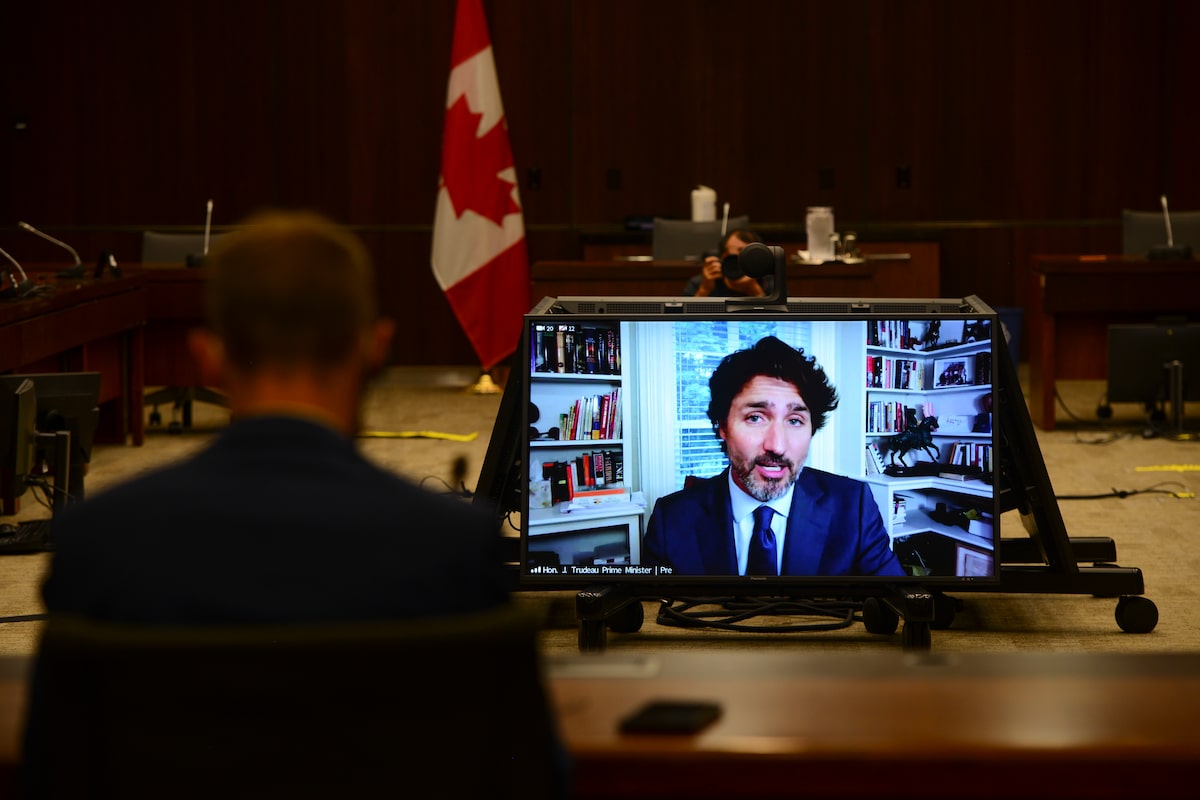
Then-prime minister Justin Trudeau appears as a witness via videoconference during a House of Commons finance committee in the Wellington Building in July, 2020. The committee was looking into government spending, WE Charity and the Canada Student Service Grant.Sean Kilpatrick/The Canadian Press
The remnants of an early-pandemic political scandal land at the Supreme Court of Canada this week in a case that could have widespread ramifications, as the top court considers the limits of citizens’ ability to challenge some government decisions.
In June, 2020, then-prime minister Justin Trudeau said WE Charity, the international development group founded by the Kielburger brothers, would run a youth summer jobs program worth about $900-million. Conflict-of-interest accusations flared, and the plan was scrapped soon thereafter.
In May, 2021, the federal Ethics Commissioner concluded that Mr. Trudeau was in an apparent conflict of interest but that he did not violate the law.
According to the federal Conflict of Interest Act, that was supposed to be the end of the story. The law stipulates that orders and decisions made by the commissioner in most cases are final and “shall not be questioned or reviewed in any court.”
2021 Editorial: The WE Charity scandal was about a lot more than conflict of interest
Democracy Watch, an advocacy group founded in 1993 by young lawyer Duff Conacher, believes that Mr. Trudeau was in a real, not apparent, conflict of interest, and fought to challenge the Ethics Commissioner’s decision at the Federal Court of Appeal. The group lost in 2024. The Supreme Court agreed to hear the case last May.
“If you can’t challenge their rulings, they’re all unaccountable czars that are handpicked by the government they watch over,” said Mr. Conacher of officials such as the Ethics Commissioner, in an interview ahead of a two-day hearing at the top court Jan. 14 and 15.
The stakes at the Supreme Court are high. According to lawyers at Dentons, in a review of the Democracy Watch case last July, a successful challenge could fundamentally change administrative law.
Mark Mancini, an assistant law professor at B.C.s Thompson Rivers University who specializes in administrative law and judicial review, said the Democracy Watch hearing is part of a series of cases in recent years that have revolved around when and how courts can review decisions of government actors.
“Fundamental accountability of government to the law is more important than ever,” Prof. Mancini said.
2021 Opinion: The WE Charity scandal was 25 years in the making
This week’s hearing at the Supreme Court is particularly meaningful for Mr. Conacher, who has worked for years to push governments to be more transparent and accountable. This is the first time that his activist group has been a main party in a Supreme Court case.
“It’s been a slog,” he said of many years battling governments. But he always recalls the advice of an early mentor, the American political activist Ralph Nader: “You’re up against a machine. You chip away – and try to win where you can.”
In Democracy Watch’s loss at the Federal Court of Appeal in October, 2024, Chief Justice Yves de Montigny said the courts should exercise restraint and adhere to the limits to legal challenges prescribed in the Conflict of Interest Act.
The law currently allows only narrow grounds such as jurisdictional overreach; questions of law and fact are not to be challenged.
Yet Chief Justice de Montigny noted an unresolved legal puzzle – the issue of how such limits jibe with the concept of the rule of law. Can governments truly limit such legal challenges?
There have been contradictory rulings in recent years at the Federal Court of Appeal. In his Democracy Watch ruling, the Chief Justice said the answer to this “complex and vexed question will ultimately have to come from the Supreme Court itself.”
Ten-year timeline forecast for Supreme Court renovation
The federal government, which won at the Federal Court of Appeal, said in its legal arguments ahead of the Supreme Court hearing that decisions of the Ethics Commissioner are “a matter of political accountability,” not for the courts. Lawyers for Ottawa warned that the courts’ jurisdiction should not be expanded at the expense of Parliament’s powers.
“The Constitution does not require or permit Parliament’s authority to be curtailed in that way,” Ottawa argued in a legal filing.
Several provinces agreed. Ontario in a legal filing said laws that prevent legal challenges so that matters are decided by administrators, not the courts, represent “legitimate legislative objectives.”
The legal term for the government tool to limit court challenges in such situations is what are called partial privative clauses. These declare, like in the Conflict of Interest Act, that a decision is final, save for narrow grounds.
This stretches back to a Supreme Court precedent in 1981 called Crevier, where the ability to challenge some government administrative decisions was slightly loosened.
Opinion: Why do we not know about our Supreme Court justices?
But a Supreme Court precedent in 2019 called Vavilov, one of the signature decisions under Chief Justice Richard Wagner, is now in play. Vavilov is a landmark ruling in administrative law and at its heart prescribes a legal standard of “reasonableness.”
That means when there are court challenges, judges focus on whether the administrator’s conclusion has an underlying rationale that is transparent, intelligible and justified.
Many administrative decisions can be contested in the courts. Democracy Watch in its arguments at the Supreme Court said this right needs to be expanded to cases such as rulings from the Ethics Commissioner.
Lawyer Sujit Choudhry and University of Ottawa law professor Paul Daly are arguing Democracy Watch’s case at the top court.
Mr. Choudhry in an interview spoke of essential oversight of the country’s top officials and pointed to elsewhere in the world where “self-dealing is one of the greatest threats to democracy.”
“The principle,” said Mr. Choudhry, “could not be more important.”