
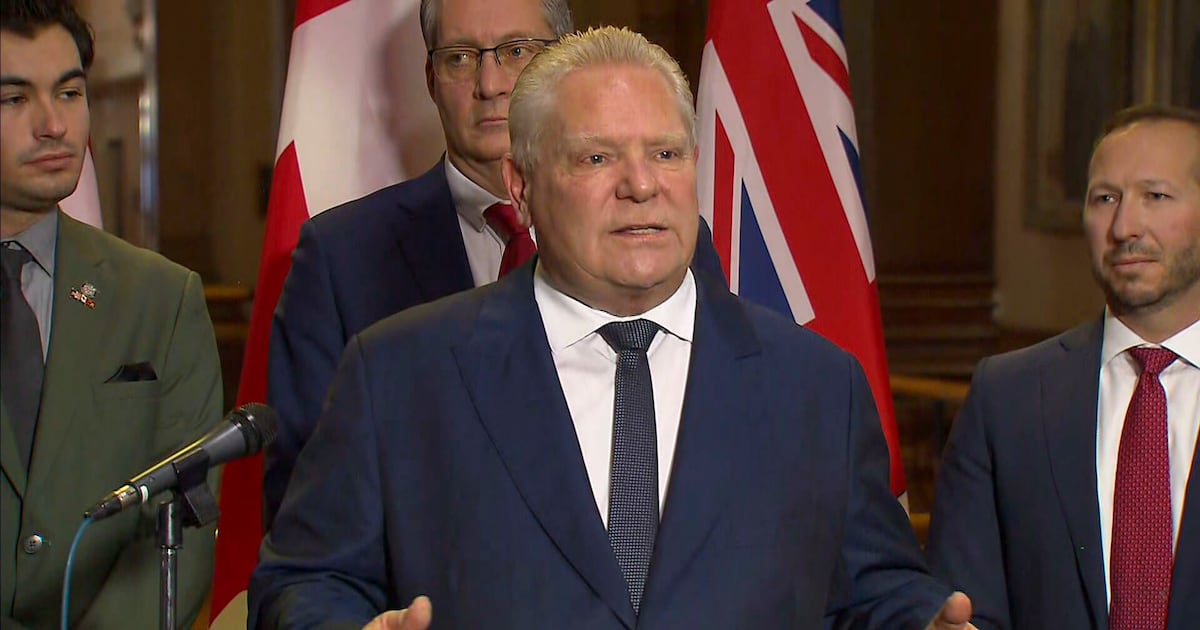
Ontario Premier Doug Ford weighed in on Toronto’s proposed 2026 budget, saying the province does more than its share for the city.
Ontario Premier Doug Ford says he has no plans to provide Toronto with new revenue tools through discussions on the next phase of the new deal between the city and the province.
“Revenue tools are called taxes. They want to tax the pants off you. They’ve taxed us to death in Toronto. Enough, enough of these taxes,” Ford told reporters at Queen’s Park on Tuesday.
“As I say, government doesn’t have an income problem. They have a revenue problem. Stop spending money. Start focusing on areas that you can drive efficiencies.”
Ford’s office later confirmed the province is not exploring the possibility of providing the city with new revenue tools.
Last week the city unveiled its proposed $18.9 billion operating budget for 2026, including a small 2.2 per cent tax hike for residential property owners, the smallest proposed increase of Mayor Olivia Chow’s term.
In part, that smaller increase was possible thanks to the 2023 new deal agreement between the province and the city, which included the upload of the Gardiner Expressway and Don Valley parkway.
Asked last week about discussions around the next phase of the deal, City Manager Paul Johnson said they would focus on revenue tools that grow with the economy.
“This constant churn of having to go back and have this discussion (about funding) is in no one’s interest, including the province’s,” Johnson said last week. “It’d just be better to solve it. The straightest path is to figure out ways that we can have predictable revenue streams that we can model as they grow with the economy.
“That said, you know, there are many ways to get to where we need to. It could be dedicated funding that has a cost-of-living increase included in it, or some way of making sure that it grows.”
During his budget presentation, Toronto CFO Stephen Conforti cited the example of Taylor Swift’s hugely successful concert series in Toronto, saying that despite the boost to the economy, Toronto saw very little of that revenue as it doesn’t have access to revenue streams like sales tax.
Budget Chief Shelley Carroll also suggested in an interview with Newstalk 1010 that the city needs to look at revenue options that grow with the economy so that the city is not constantly short on change, and that could include new taxation powers.
“It is about that conversation that’s been going on for 25 years now, which is that we did amalgamation, but now we have this large beast, the megacity of Toronto, and it needs a sustainability factor,” Carroll said.
“If it had small access to the economy, like other orders of government, then we would be able to rebuild reserves in good times and not have to come cap in hand whenever there are hard times.”
She said that would be the focus of the next phase of discussions with the province as the initial three-year new deal comes to an end.
We can build off the success of the New Deal by working together with the province to bolster Toronto’s ability to deliver services people need.
No one is interested in new taxes. That’s not on the table. Not for us or the Premier. Not even discussing it.
We’re just looking for… https://t.co/DOm4j2PZkk
— Mayor Olivia Chow 🇨🇦 (@MayorOliviaChow) January 8, 2026
Chow’s office pointed out that the mayor herself ruled out new taxes in a response to Carroll’s interview on X.
“We can build off the success of the New Deal by working together with the province to bolster Toronto’s ability to deliver services people need,” Chow wrote. “No one is interested in new taxes. That’s not on the table. Not for us or the Premier. Not even discussing it. We’re just looking for Toronto’s fair share.”
Chow’s office did not immediately respond to a request to clarify whether she also sees revenue tools and taxes as being the same thing.
Ford pointed out Tuesday that when he was a city councillor and his brother, Rob Ford was mayor, the city passed ultra-low property tax increases with far less provincial support than the city has now.
“So they have to start driving efficiencies and standardization across the city,” Ford said.
Despite railing against city spending, he was complimentary about the lower proposed property tax increase.
“I got to give the mayor credit. She kept the taxes low this year. So thank you, mayor,” Ford said.
Both Chow’s office and Ford said the two officials continue to have a good working relationship.