
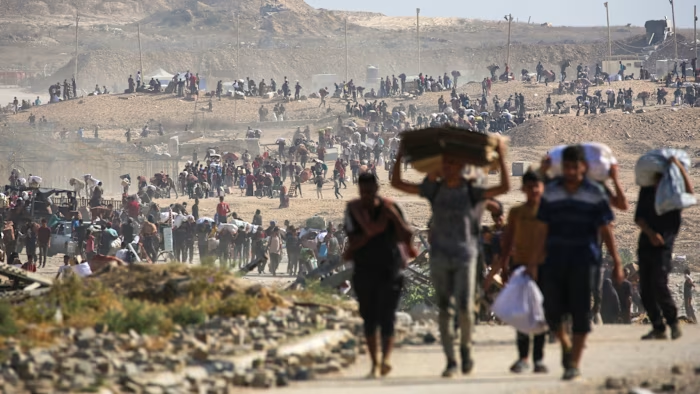
Washington is set to announce a new governance structure for Gaza as soon as Wednesday, as the Trump administration seeks to proceed with the next phase of a ceasefire deal despite allies’ scepticism and a lack so far of international support and funding.
US and Israeli officials tasked with shepherding the fragile ceasefire insist they can make progress, despite the same officials’ past record with the Gaza Humanitarian Foundation, a failed aid distribution scheme whose access routes became the scene of several shootings by Israeli troops.
They aim to follow the senior announcements with “quick wins” enabled by Israel, said four people with knowledge of the plans, including the full reopening of the Rafah crossing to Egypt; more medical support for Palestinians; and the loosening of import restrictions to Gaza.
Nickolay Mladenov, a former Bulgarian defence minister and UN envoy, is set to be announced as “high representative” for the shattered strip, said people familiar with the situation. Mladenov, a highly regarded diplomat who was not involved with GHF, will oversee the work of a 14-member Palestinian technocratic committee on day-to-day governance.
 Former Bulgarian defence minister Nickolay Mladenov will oversee a committee on day-to-day governance © Hassan Ammar/AP
The unveiling of a “board of peace” led by US President Donald Trump and other world leaders is likely to be delayed for now, said the people.
But the US expects to announce an executive committee for the overall “board” of major international players, including US envoy Steve Witkoff and Jared Kushner, Trump’s son-in-law and the key architect of his Gaza policy.
Timings of the announcements could be affected by Trump’s decision on whether to launch military action against Iran, which he has threatened.
Next steps in the ceasefire’s “phase two” include deploying the Palestinian technocrats into Gaza to take over civil affairs from Hamas, as specified in the US-brokered truce last October that ended two years of war.
Hiring is due to begin within Gaza and for Mladenov’s office.
“We need to show they can deliver,” said a regional diplomat, referring to the Palestinian technocratic committee.
Yet larger problems persist, said several people with knowledge of the plans.
Western and Muslim states remain reluctant to provide peacekeeping troops or funds for Gaza, as Israeli forces still occupy half the enclave and Hamas tightens its grip on the other half. Only $1bn has been raised, said the regional diplomat, when an estimated tens of billions are needed.
US officials aim to use the Davos economic forum this month to rally financial and political support for their Gaza plans, said one of the people.
Key barriers to progress are the planned disarmament of Hamas, prospects for which remain unclear, and the Israeli government’s refusal to countenance large-scale reconstruction or further troop pullbacks without it.
 General Roman Gofman, who is set to head the Mossad spy agency, has taken part in talks about Gaza’s postwar transition © IDF/Wikimedia
Mladenov travelled to Israel last week for meetings with senior US and Israeli officials including Benjamin Netanyahu. At the prime minister’s office last Thursday were many of those now responsible for Gaza’s postwar transition, including Miroslav Zafirov, Mladenov’s chief lieutenant and a former Bulgarian and UN diplomat with long experience in the Middle East.
Sitting alongside both Bulgarians on the “American” side of the table were Aryeh Lightstone, a senior US envoy who leads the Gaza team based in Israel, and Liran Tancman, an Israeli tech entrepreneur and former reservist advising the US team on a volunteer basis.
Opposite them on the “Israeli” side were Michael Eisenberg, an Israeli-American venture capitalist advising Netanyahu on Gaza and US policy, and General Roman Gofman, the premier’s military secretary who has been nominated to head the Mossad foreign spy agency from later this year.
Several people with knowledge of the situation said all four US and Israeli officials were instrumental in planning and promoting the Gaza Humanitarian Foundation, which operated for several months last year with US military contractors guarding food distribution sites inside Israeli-held areas of Gaza.
According to people within GHF and others who dealt with the group, Lightstone worked to raise funds and international support. Eisenberg, Tancman and Gofman created and drove forward the idea within the Israeli system.
The private aid distribution scheme was tied to Israel’s attempts to weaken Hamas’s governance and economic hold over Gaza, a goal that has largely failed.
 Aid has flowed into the strip since the truce but a promised surge in assistance has not happened © Mohammed Saber/EPA/Shutterstock
The GHF hubs were often scenes of chaos. Hundreds of Palestinians were killed by Israeli fire on access routes, according to health officials in the Hamas-controlled territory. The Israeli military has denied its troops deliberately fired on civilians and claimed the toll was far lower than that issued by Gazan officials.
GHF officials now blame the Israeli government for creating acute food insecurity by wholly shutting down aid flows into Gaza just as the foundation began operating last May. Yet until it shuttered in November, GHF maintained its work was a success. It said it distributed 187mn free meals to Palestinians, a figure even some Israeli officials disputed.
Aid flows into the strip have increased since the truce came into effect, but promises from Israel of a surge to 4,200 trucks per week have not been fully met, said international humanitarian officials. The Israeli government this month said it would bar over three dozen non-profits from working in the strip, posing another risk to distribution.
Critics of the US-led “phase two” ceasefire push, including Israeli and western officials and analysts, say the latest plans are disconnected from political and security realities in Gaza.
Those people argue that the small team of US and Israeli officials responsible — made up of diplomats, businesspeople and unofficial advisers — are highly ambitious yet uninformed, and are overly close to Netanyahu’s right-wing administration.
This group developed an aspirational 32-page plan, dubbed “Project Sunrise”, a $112bn scheme to redevelop Gaza over a decade as a futuristic AI-powered luxury enclave. The plan was first reported by the Wall Street Journal.
“They’re focused on ‘Sunrise’ and work backwards, but there is nothing in the middle to go from the current situation [in Gaza] to that,” said a person involved in Gaza affairs.
“Execution matters, details matter,” they added, citing the lack of a wider structure for increasing capacity in Gaza; lukewarm support from Arab states; and the lack of a role for the western-backed Palestinian Authority.
The regional diplomat said the group behind the “Sunrise” plan “think the sun rises because they’ve woken up”.
But they added: “It’s the only game in town . . . You can say it’s a bad plan or an insufficient plan, but unless someone has better ideas this is what is going to happen.”
Two Israeli officials said the latest Gaza planning showed the unorthodox style adopted by Trump in his second term, in which policy is led by private businessmen deploying tech industry methods and “unofficially official” envoys.
The group of US and Israeli civilian officials has also superseded in influence the US-led military headquarters in southern Israel, called the Civil-Military Coordination Center, set up after last October’s truce.
The CMCC — intended to monitor the truce and co-ordinate among Israel, the US, other nations and NGOs — has descended into endless meetings on minute policy matters and fruitless battles with Israeli government bureaucracy, said four people familiar with the matter.
A final member of the close-knit Israeli team who was also involved in the GHF, Yotam HaCohen, an Israeli reservist, is stationed at the CMCC as the prime minister’s representative.
“The CMCC is a diversion,” said an Israeli official. “It’s easy to write things on a blackboard, but nothing ever comes out of it. The actual work is being done at the Kempinski,” they said, referring to the luxury David Kempinski Hotel on Tel Aviv’s Mediterranean shore, where the US Gaza team has been staying and working.
The roughly 12-person US team answers directly to Kushner, now the main driver of the postwar transition, said five people briefed on the matter.
The US team insists its Gaza plans are realistic and points to the Trump administration’s achievement in reaching the ceasefire and release of Israeli hostages.
“No one thought it was possible,” said a person with knowledge of US government thinking. “I wouldn’t bet against Jared in the Middle East.”
Aside from Hamas’s weapons, a key question for many analysts and diplomats remains whether — given the proximity of the US and Israeli teams — the Trump administration will force progress on Netanyahu if needed. Some suggested it was in the interests of both warring parties for “phase two” to stall, alleviating pressure for genuine concessions.
“Both Israel and Hamas want to buy time and keep things as they are,” said one of the people with knowledge of Gaza planning. “The most likely scenario . . . is that the Americans muddle through.”