
Toplines
North Korea is likely to reinforce the justification for its “self-defensive” nuclear development following the US military operation against Venezuelan President Nicolás Maduro on January 3, reducing the likelihood of renewed United States–North Korea dialogue. The North Korean Ministry of Foreign Affairs on January 4 condemned the US military operation to arrest and extradite Maduro, calling it a “violent violation of Venezuela’s sovereignty” and evidence of the United States’ “gangster-like nature.”[1] Workers’ Party of Korea (WPK) General Secretary Kim Jong Un oversaw a missile launch the same day and called for expanding a “strong and reliable nuclear deterrent,” citing “recent geopolitical crises,” likely referencing the January 3 US operation in Venezuela.[2] The South Korean Ministry of Unification (MOU) assessed on January 5 that North Korea’s response reflects its ongoing “anti-US solidarity,” similar to messaging following the US strikes on Iranian nuclear facilities in June 2025.[3]
North Korea and Venezuela have maintained a symbolic partnership, grounded in anti-US rhetoric, since establishing diplomatic ties in 1974.[4] Kim has continued diplomatic exchanges with Venezuela, though there is no evidence of meaningful North Korean-Venezuelan trade or economic cooperation.[5] The UN Panel of Experts (PoE) investigation into possible bilateral cooperation, following a 2018 meeting between Maduro and a senior WPK official, was not concluded prior to the panel’s dissolution due to opposition from Russia and the People’s Republic of China (PRC).[6] Venezuela remains primarily a North Korean political ally within the socialist and anti-Western bloc, with limited strategic relevance in defense or industry.
North Korean state media has consistently framed US actions in Venezuela — often citing PRC and Russian condemnations — as proof of an external threat from “Western aggressors.”[7] This narrative supports Pyongyang’s portrayal of its nuclear weapons as “self-defensive.”[8] North Korea is likely to further strengthen this justification and assess that states without nuclear capability or great-power backing are vulnerable, making prospects for complete, verifiable, and irreversible denuclearization on the peninsula more difficult.
North Korea alleged that South Korean drones violated its airspace, which Pyongyang may use to further justify its anti-South narratives and sustain pressure against inter-Korean engagement. Seoul’s denial is consistent with the Lee Jae Myung administration’s de-escalatory posture. North Korea on January 10 claimed that South Korean drones violated its airspace in September 2025 and on January 4.[9] It released the images of the drone’s fuselage and flight records, arguing that the drone launched from a civilian-restricted area and therefore must have been operated by South Korean authorities.[10] South Korea’s Ministry of National Defense (MND) on January 10th rejected the allegation, stating that the military did not “operate drones on the dates North Korea claims.”[11] South Korean National Defense Minister Ahn Gyu-back added that “the drone North Korea disclosed is not a model possessed by our military.”[12] WPK Propaganda and Agitation Department Deputy Director Kim Yo Jong on January 11 demanded that South Korea provide an explanation of the drone’s identity.[13] North Korea characterized the drone as a surveillance and reconnaissance asset and claimed it collected imagery using a high-resolution optical camera.
The Lee administration has criticized former President Yoon Suk-yeol for alleged drone infiltration into Pyongyang as a “military attack,” and claimed that, if the current military conducted a similar operation, it would conflict with its policy stance.[14] South Korea’s ruling Democratic Party has recently pursued de-escalatory measures, including legislation restricting civilian launches of propaganda leaflets toward North Korea.[15] South Korea can already monitor areas, such as Pyeongsan and Kaesong, through current satellite assets.[16] The operator of the drone has yet to be identified.
The Lee administration may view this incident as an opportunity for dialogue. National Defense Minister Ahn raised the possibility of a “joint inter-Korean investigation,” and President Lee has directed the government to establish a large-scale investigation team.[17] North Korea, however, is more likely to leverage the incident to reinforce its anti-South Korea position ahead of the 9th Party Congress in 2026. It may use the claim to justify strengthened domestic security and counter-reconnaissance measures against its perceived external threats. North Korea has remained silent on South Korea’s proposal for inter-Korean military talks in November 2025. It is unlikely to accept a joint investigation and could instead use the issue to sustain pressure on Seoul.
[The following text appeared in the China & Taiwan Update, January 9, 2026.]
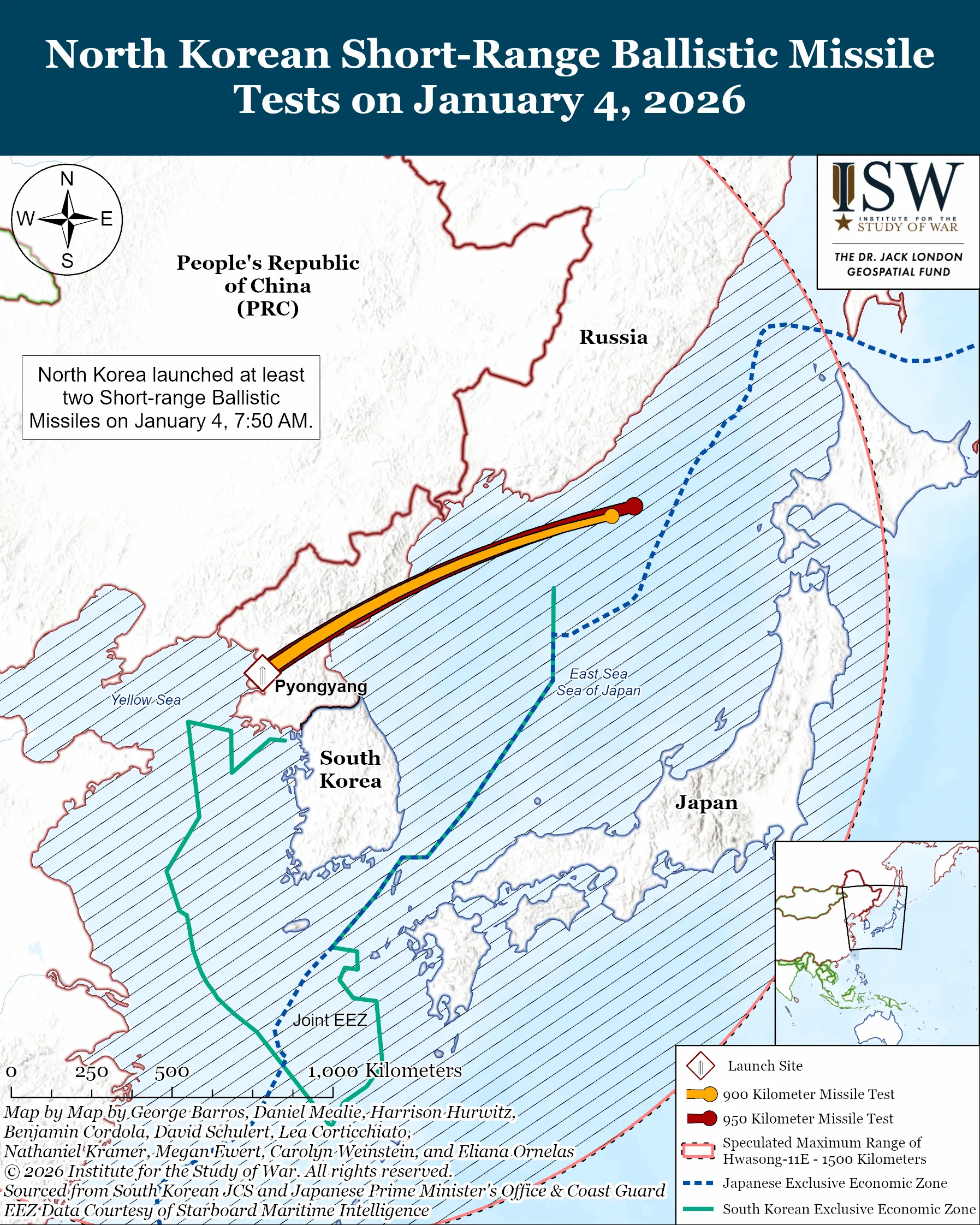
North Korea launched at least two “supersonic” ballistic missiles on January 4.[18] The timing of the launch may signal Pyongyang’s intention to further accelerate military development in the face of recent events, including the United States’ capture of Venezuelan President Nicolás Maduro and the PRC–South Korea Summit.[19] The South Korean Joint Chiefs of Staff and the Japanese Prime Minister’s Office reported that two missiles, speculated as Hwasong 11-E, flew around 900km (559 miles) towards the East Sea (Sea of Japan).[20] South Korean national defense scholars speculated that the launch was intended to verify the missiles’ low-altitude gliding flight capability and operational range.[21] The launch was the first since November 7 and the third launch of South Korean President Lee Jae Myung’s term.[22] North Korea has conducted tests of various types of missiles every month since October 2025.[23] WPK General Secretary Kim Jong Un also inspected tactical guided weapons and ordered an increase in their production on the day before the missile launch.[24] Hwasong-11E, a low-altitude ballistic missile, has a maximum range of 1,500km, which would allow it to strike targets anywhere in the Korean Peninsula and the main islands of Japan.[25] This type of missile also employs anomalous maneuverability similar to cruise missiles, which evade missile defense networks more effectively.[26]
Kim Jong Un’s visit to a missile factory occurred just after the United States’ capture of Venezuelan President Nicolás Maduro on January 3 and just before President Lee’s visit to Beijing on January 5.[27] Kim Jong Un stated the need to enhance North Korea’s nuclear deterrence and development of missiles to respond to recent unspecified “geopolitical crises” and “complicated international events.”[28] The US capture of Maduro, essentially a “decapitation” operation against an anti-US regime, likely reinforced his belief that highly advanced asymmetric weapons and nuclear weapons are necessary to deter the United States and other advanced military powers. The launch also likely serves as an expression of North Korea discontent regarding the possibility of discussion of denuclearization during the summit between President Lee and Chinese Communist Party (CCP) General Secretary Xi Jinping. North Korea may justify this belief of the necessity of its self-defense through missile tests and other military developments. North Korean officials have stated repeatedly that Pyongyang will no longer negotiate with the United States until it drops its demand for denuclearization.
Key Takeaways
US-North Korean Relations Worsen: North Korea is likely to continue its “self-defensive” nuclear development following the US military operation against Venezuelan President Nicolás Maduro on January 3. North Korea’s fears of “Western aggression” will likely reduce the likelihood of renewed US-North Korea dialogue.
Inter-Korean Relations Worsen: North Korea alleged that South Korean drones violated its airspace on January 10, which Pyongyang may use to further anti-South Korea narratives. South Korea denied North Korea’s accusations, which is consistent with the Lee Jae Myung administration’s de-escalatory posture.
North Korean Ballistic Missile Tests: North Korea launched at least two “supersonic” ballistic missiles on January 4. The timing of the launch may signal Pyongyang’s intention to continue its military development amid US actions in Venezuela and PRC-South Korean dialogue.
North Korean Domestic Politics
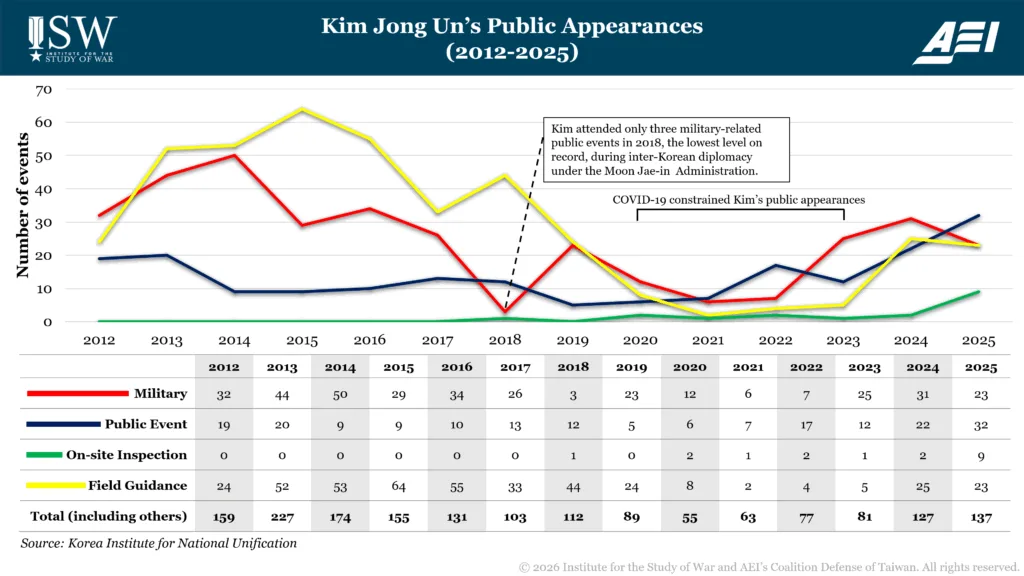
WPK General Secretary Kim Jong Un’s 2025 public schedule was his most extensive since 2015.[29] Kim conducted 118 public activities in 2025, the most since his 155 appearances in 2015.[30] Kim’s public appearances previously peaked at 227 in 2013, after he succeeded his father, Kim Jong Il, in December 2011.[31] These numbers followed a steady downward trend until they reversed after recording 55 appearances in 2020 during the COVID-19 period.[32] Kim Jong Un’s public appearances remain relatively uncommon, and his appearance at particular events and locations communicates Kim’s governing priorities. Kim’s 2025 activity placed a greater emphasis on public events and military developments, likely to preview the WPK’s announcement of significant achievements in those sectors prior to the 9th Party Congress.
Kim will likely participate extensively in more domestic activities in alignment with the new agenda of the 9th Party Congress. Kim’s daughter, Kim Ju Ae, will likely serve an even more prominent role in North Korean affairs in 2026, given the rapid increase in her public appearances in the last few years. 2025 marked the final year of the five-year plans for “National Economic Development” and “Defense Science and Weapon System,” which were enacted during the 8th Party Congress in 2021.[33] Pyongyang will unveil new economic and defense strategies at the 9th Congress.[34] Kim is likely signaling the “successful” conclusion of these plans to internal audiences by appearing at more domestic events. Kim Jong Un placed a particular emphasis on self-reliance for the North Korean population and regional self-sufficiency by attending events related to North Korean industry and manufacturing, such as the December 18 completion ceremony for an industrial factory.[35] Kim may intend to solidify his authority by demonstrating that the regime has achieved a degree of “self-reliance,” the core pillar of the five-year plans.[36] Kim is also likely seeking to manage domestic discontent, as indicated by his attendance at welfare events in flood-stricken areas.[37]
Kim will likely attend more domestic events in 2026 to promote “self-reliance” under his new economic and defense plans. Kim will likely simultaneously seek to strengthen North Korea’s close cooperation with Russia and the PRC, likely as a way to signal North Korean strength to foreign audiences. Pyongyang very likely intends to strengthen its advanced technology capabilities through exchanges with the PRC and Russia.
Kim’s daughter, Kim Ju Ae, will also serve an even more prominent public role. Kim Ju Ae has appeared in public more than 600 times as of November 2025, since her debut in November 2022.[38] Kim Jong Un seeks to enhance his image as a “father of the people” and mitigate negative public perceptions of Kim Ju Ae through showcasing his activities with his daughter. Kim Ju Ae’s public appearance also suggests Kim Jong Un intends to secure a stable power transition, unlike the troubled process he had to go through.
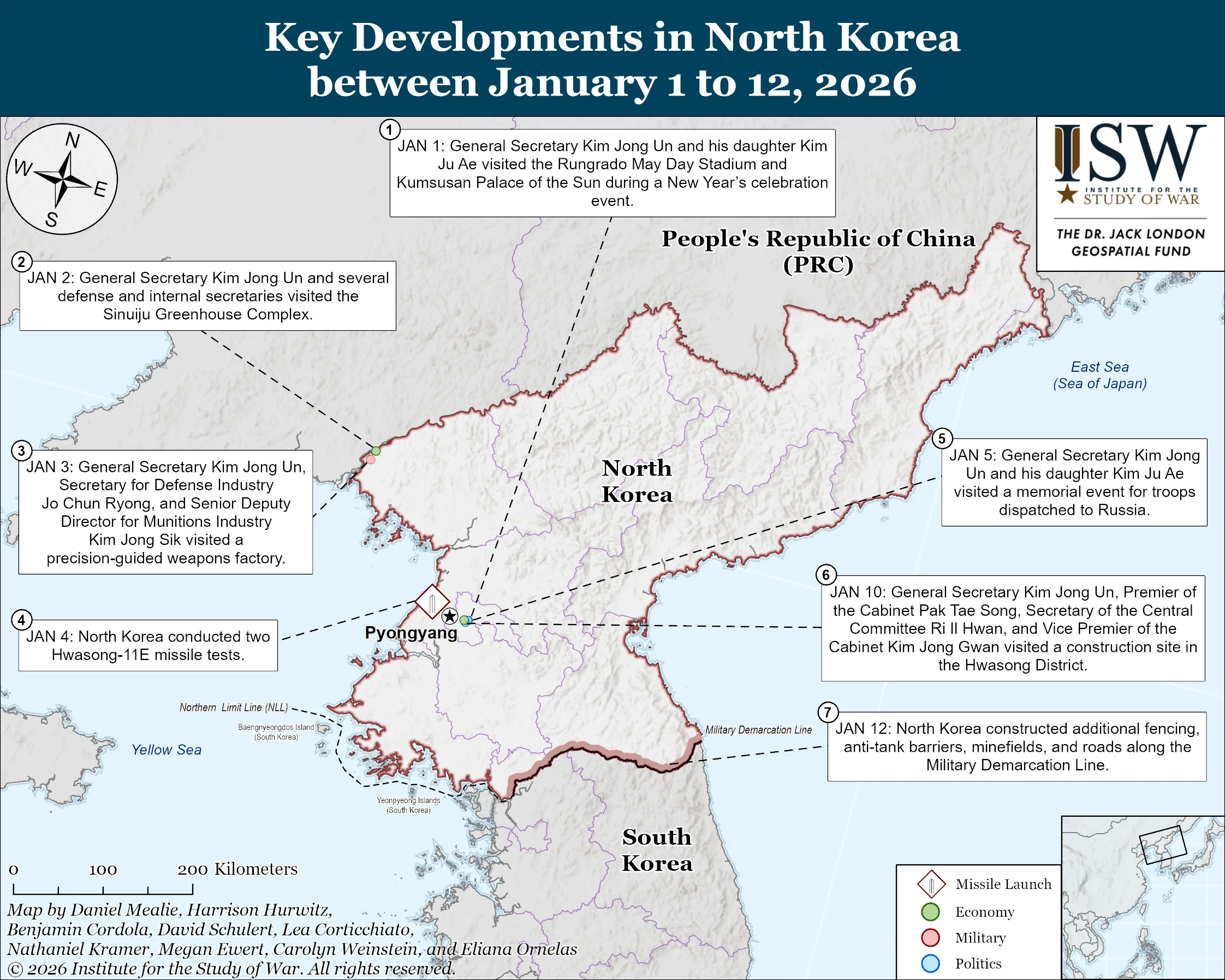
Kim Jong Un’s New Years messaging focused on the rule of law, missile modernization, regional industrial development, and gave tribute to North Korean troops dispatched to Russia. North Korea held a ceremony commemorating the 53rd anniversary of the enactment of the North Korean Socialist Constitution on December 27. WPK officials vowed to “defend the socialist ideal and system” in accordance with the Constitution, and North Korean state media credited Kim Jong Un with establishing the “people-first principle.”[39] The “people-first principle” is a North Korean political concept that prioritizes citizens’ interests in party policymaking.[40] The Kim regime exploits the concept as a key legitimizing mechanism to reinforce a supreme leader-centered authoritarian rule. North Korea replaced the Kim Jong Il-era “Songun (military-first) politics” to “people-first principle” at the 8th Party Congress in 2021 as a defining ideology of Kim Jong Un.[41] Kim also oversaw a series of military activities, including a “strategic cruise missile” and “supersonic missile” launches on December 28 and January 4, respectively, and missile production facilities on December 28 and January 3. He then inspected the construction of a memorial for North Korean troops who died fighting in Russia on January 5.[42] Other public appearances by Kim included a hospital opening ceremony in Nampo on December 29 and a large-scale greenhouse construction site in Shinuiju on January 2.
Kim’s public appearances from late December through early January conveyed a set of domestic messages spanning economic management to national defense. His New Year messaging prioritized reinforcing party loyalty and highlighting his achievements as a leader. The emphasis on adherence to the Socialist Constitution may appear to signal strengthened judicial authority, but in North Korea, the constitution and legal system function to prescribe and enforce citizen behavior rather than to act “as checks” on the leader’s power.[43] North Korean state media’s reinforcement of the “people-first principle” thus demands that citizens accept Kim’s claim that his rule serves their interests. Kim’s visit to a greenhouse construction site under the “20×10 Development Plan” similarly frames his economic initiatives as efforts to improve living conditions, further reinforcing the “people-first principle” narrative. Military-related events such as a missile launch, a weapons factory inspection, and the construction of a memorial site for troops killed in Russia likely function to showcase North Korea’s expanding military capabilities and footprint, while portraying Kim’s leadership as strengthening national power for a domestic audience.
North Korean Military Developments
See topline section.
North Korean Foreign Relations
North Korean state media accused Japan on January 6 of plotting “reinvasion” following the approval of its largest-ever defense budget.[44] North Korean concerns over Japanese “militarism” may lead to increased North Korean military activity directed at Japan. Japanese Prime Minister Sanae Takaichi announced on December 26 that Japan’s 2026 defense budget would reach a record-high nine trillion yen (58 billion US dollars), a 3.8 percent increase from the current fiscal year.[45] Japan primarily seeks to enhance its strike-back capabilities and coastal defenses amid a period of increased tensions with North Korea and the PRC. The report cited Japan’s launch of a new attack submarine, the mass production of new surface-to-ship missiles, and the recent defense buildup as the sources of their concern.[46] The report stated that these capabilities were intended for preemptive strikes, thus posing significant risks to regional security. North Korea accused Japan of reviving its “past militarism,” echoing typical rhetoric drawing parallels between Japan’s imperial past and modern-day Japanese policy. The article threatened “strong retaliation by neighboring countries” if Japan continued its defense buildup efforts.[47] North Korean protests of Japanese military expansion are typically purely rhetorical, as in this instance.[48] North Korea is increasingly seeking to enhance its own military capabilities and present itself as a military power, however. North Korea may seek to expand its military activity, unilateral and combined, around Japan to protest Japanese military advancement and project power in the Indo-Pacific region.
North Korean Influence Operations
Nothing significant to report.
Inter-Korean Relations
South Korean President Lee Jae Myung and CCP General Secretary Xi Jinping held talks in Beijing on January 5.[49] Lee urged the PRC to play an intermediary role in facilitating inter-Korean dialogue, though the PRC is unlikely to assume such a role. Lee and Xi called for joint efforts to promote peace on the Korean Peninsula. Neither side publicly referenced North Korea’s nuclear weapons program in their remarks or readouts.[50] South Korea’s National Security Council Director Wi Sung-lak stated that the two leaders reaffirmed the importance of resuming dialogue with North Korea and that the PRC expressed its intention to play a “constructive” role in supporting peace and stability on the Korean Peninsula.[51]
Lee on January 7 cited previous South Korean governments’ “military attacks” toward North Korea for heightening the regime’s hostility and emphasized the need for de-escalation.[52] Lee added that he has asked the PRC to communicate South Korea’s intention of respecting North Korea’s “regime stability” alongside short-term goals of “offering compensation” in exchange for halting further nuclear weapons production.[53] Lee clarified that his administration views follow-up reduction and complete denuclearization as the end goal and that the PRC shared “sympathy” toward this strategy.[54]
The Lee administration likely assesses that a “small deal” to freeze North Korea’s nuclear program first through a normalization of dialogue is the most feasible approach in the absence of Pyongyang’s unwillingness to abandon its nuclear program. This strategy aligns with Lee’s E.N.D. initiative (exchange, normalization, and denuclearization) that seeks to advance denuclearization of the Korean Peninsula.”[55] Lee appears to reject a maximum-pressure approach in favor of building domestic and international consensus around confidence-building measures. Lee also likely views the PRC as a key channel of communication with Pyongyang, though whether Beijing will meet these expectations remains uncertain.
Beijing has at times assumed a mediating role in inter-Korean relations, serving as chair of the Six-Party Talks from 2003 to 2008, and has since expressed general support for denuclearization of the Korean Peninsula.[56] The PRC’s interests appear to have diverged following the deepening Russia–North Korea alignment after Moscow’s 2022 invasion of Ukraine, however.[57] The PRC also stopped explicitly referencing denuclearization following the September 3 Xi–Kim summit. Such a trend signals that the PRC is less likely to act as a committed mediator and convey Seoul’s intentions or encourage Pyongyang to engage in inter-Korean dialogue.[58]
South Korean Domestic Politics
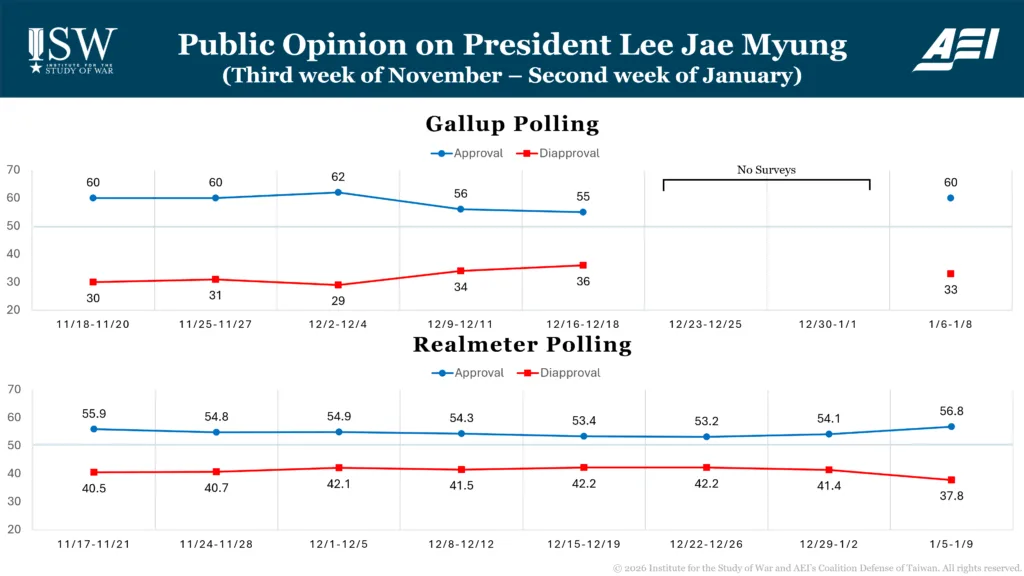
South Korean President Lee Jae Myung saw his approval rating increase nearly three percentage points during the second week of January. South Korean polling agency Realmeter reported that Lee’s approval rating surged to 56.8 percent, a 2.7 percent increase from the previous week.[59] Lee’s disapproval rating simultaneously dropped 3.6 percentage points to 37.8 percent.[60] Realmeter attributed the increase primarily to the Lee administration’s diplomatic efforts, including the summit between Lee and the CCP General Secretary Xi Jinping as a primary driver for this positive shift.[61] Realmeter also noted that economic developments, and achievements such as the KOSPI (Korea Composite Stock Price Index) reaching an all-time high, further bolstered Lee’s approval ratings. Gallup polling also stated that the administration’s diplomatic efforts positively influenced public opinion.[62] Gallup did not conduct surveys during the fifth week of December and the first week of January due to holidays.
Counter-North Korean Coalition Building Efforts
The United States signaled stricter sanctions enforcement on North Korea on January 7. The United States and South Korea appear to be pursuing divergent approaches to North Korea. The United States on January 7 seized a Russian-flagged oil tanker that departed Iran and was en route to Venezuela.[63] US Secretary of Energy Chris Wright said Iran, Russia, and North Korea should take note that Washington now has “a president who actually enforces sanctions.”[64] This signaling is consistent with previous US efforts to seek UN sanctions designations in November 2025 against vessels transporting North Korean coal and iron ore and requests for additional UN sanctions on Pyongyang in December 2025.[65] The PRC and Russia blocked US efforts at the UN Security Council, however.
South Korea’s Lee Jae Myung administration has pursued a more conciliatory and engagement-oriented approach toward North Korea. Lee has encouraged Trump to act as a “peacemaker” by leveraging his personal relationship with Kim Jong Un, including ideas such as a “Trump world” tower at the Wonsan-Kalma resort during their June 2025 summit.[66] Lee appears to view US involvement in reducing hostility as a critical component of diplomatic confidence building aimed at drawing North Korea into dialogue. South Korea’s Ministry of Unification (MOU) Chung Dong-young on December 19 suggested partial sanctions relief on North Korea, though the proposal has faced resistance from security-focused Cabinet members.[67]
Acting US Ambassador to South Korea Kevin Kim stepped down in January 2026, causing further gaps in US diplomatic representation. Deputy Chief of Mission James R. Heller will serve as charge d’affaires ad interim.[68] The Trump administration has yet to nominate ambassadors to South Korea and several other key US allies. The precedent from Trump’s first term — when the Seoul envoy post remained vacant for 17 months — suggests that a prolonged gap in diplomatic representation is possible. These developments may complicate allied coordination on North Korea policy.[69] United States-South Korea policy signals toward Pyongyang risk losing coherence amid an absence in diplomatic channels and coordinated strategy.

Endnotes
[1] https://www.yna.co dot kr/view/AKR20260104041551504?section=nk/news/all
[2] https://nk.news1 dot kr/news/articles/6028655
[3] https://nk.news1 dot kr/news/articles/6028540
[4] https://www.koreadaily dot com/article/20260104021846192
[5] https://www.upi dot com/Top_News/World-News/2019/01/28/North-Korea-throws-support-behind-Venezuelas-Maduro-regime/3891548692065/
[6] https://www.upi dot com/North-Korea-media-Kim-Yong-Nam-signs-agreements-in-Venezuela/2831543594067/; https://www.yna.co dot kr/view/AKR20200729008100072?input=1195m
[7] http://www.rodong.rep dot kp/ko/index.php?MTJAMjAyNS0xMi0yOS0wMzRAMTVAMkBAMEAyM0A==; http://www.rodong.rep dot kp/ko/index.php?MTJAMjAyNS0xMi0yNy0wMzJAMTVAMkBAMEAyMEA==
[8] https://www.yna.co dot kr/view/AKR20170822171851109
[9] https://www.yna.co dot kr/view/AKR20260110010052504?section=nk/news/all
[10] https://www.yna.co dot kr/view/AKR20260110010052504?section=nk/news/all
[11] https://www.yna.co dot kr/view/AKR20260110041551504?section=nk/news/all
[12] https://nk.news1 dot kr/news/articles/6034685
[13] https://www.nknews dot org/2026/01/north-korea-demands-explanation-from-seoul-on-drone-incursions-rejects-rebuke/; https://www.yna.co dot kr/view/AKR20260111006600504?section=nk/news/all
[14] https://www.youtube dot com/watch?v=MD898wDxAyU; https://www.news1 dot kr/politics/assembly/5566544; https://www.hani.co dot kr/arti/politics/diplomacy/1238592.html
[15] https://www.chosun dot com/politics/politics_general/2025/12/15/AX2KWYH2VVFDTOVSYTE4IKD3LE/
[16] https://nk.news1 dot kr/news/articles/6035104
[17] https://www.youtube dot com/watch?v=MD898wD
xAyU; https://www.news1 dot kr/politics/assembly/5566544; https://www.hani.co dot kr/arti/politics/diplom
acy/1238592.html
[19] h
ttps://www.chosun dot com/politics/politics_general/2025/12/15/AX2KWYH2VVFDTOVSYTE4IKD3
LE/
[21] https://nk.news1 dot kr/news/articles/6035104
FV2OG5MU/
[22] https://www.joongang.co dot kr/article/25394903; https://www.yna.co dot kr/view/AKR20260104012051504
[23] https://understandingwar.org/research/china-taiwan/china-taiwan-update-january-2-2026/
[24] https://www.yna.co dot kr/view/AKR20260104005600504
[25] https://www.munhwa dot com/article/11558370
[26] https://www.joongang.co dot kr/article/25394995
[27] https://www.yna.co dot kr/view/AKR20260104012051504
[28] https://kcnawatch.org/newstream/1767560997-348064374/hypersonic-missile-launching-drill-conducted-in-dprk/
[29] https://www.yna.co dot kr/view/AKR20251227032000504?input=1195m
[30] https://www.kinu.or dot kr/nksdb/?page=2&startDate=&endDate=&category=&keyword=%EC%A4%91%EA%B5%AD&orderKey=date&orderDirection=DESC
[31] https://www.kinu.or dot kr/nksdb/?page=2&startDate=&endDate=&category=&keyword=%EC%A4%91%EA%B5%AD&orderKey=date&orderDirection=DESC
[32] https://www.kinu.or dot kr/nksdb/?page=2&startDate=&endDate=&category=&keyword=%EC%A4%91%EA%B5%AD&orderKey=date&orderDirection=DESC;
[33] https://nkinfo.unikorea.go dot kr/nkp/knwldg/view/knwldg.do;jsessionid=d1XyZr30h4dt6YaNnqmPHK1sSLdRh7Oy8PeCrFuI.ins22?menuId=NK_KNWLDG_DICARY&knwldgNo=160; https://www.newsis dot com/view/?id=NISX20210916_0001586597&cID=10301&pID=10300
[34] https://www.dailynk dot com/9%EC%B0%A8-%EB%8B%B9%EB%8C%80%ED%9A%8C-%EA%B9%80%EC%A0%95%EC%9D%80-%ED%86%B5%EC%B9%98-%EC%95%88%EC%A0%95%EC%97%90-%EB%AC%B4%EA%B2%8C-%EC%B2%AD%EB%85%84%ED%86%B5%EC%A0%9C%C2%B7%EC%A1%B0/
[35] https://biz.chosun dot com/international/international_general/2025/12/19/H7UXV72SL5DPDJBU6P7CLNOAEQ/
[36] https://www.yna.co dot kr/view/AKR20250908066200504
[37] https://www.news1 dot kr/nk/politics-diplomacy/5867083; https://www.hani.co dot kr/arti/politics/defense/1174319.html
[38] https://asia.nikkei.com/politics/visual-investigation-is-north-korea-s-princess-walking-a-path-toward-succession; https://www.chosun dot com/english/north-korea-en/2025/11/26/LQXN4QYQZ5FUBGSFZDYDPJSAHY/
[39] http://www.rodong.rep dot kp/ko/index.php?MTJAMjAyNS0xMi0yOC0wMTVAMUAyQEAwQDE2QA
[40] https://nkinfo.unikorea.go dot kr/nkp/knwldg/view/knwldg.do;jsessionid=dxH9xrTtamPEZUlusRMNJHmjsA_3alD2p1rAYXWm.ins22
[41] https://unikorea.go dot kr/ebook/whitepaper/white_2025/index.html#p=1
[42] https://nk.news1 dot kr/news/articles/6029999
[43] https://www.nknews dot org/2025/12/north-korea-celebrates-constitution-day-removes-socialist-from-holiday-name/
[44] https://www.yna.co dot kr/view/AKR20260106029200504?section=nk/news/all
[45] https://apnews.com/article/japan-defense-spending-china-missile-221b2cb5da0760d6e07f63ac01deba93
[46] https://www.yna.co dot kr/view/AKR20260106029200504?section=nk/news/all
[47] https://www.koreaherald dot com/article/10601736
[48] https://www.koreaherald dot com/article/10536297
[49] https://www.yna.co dot kr/view/AKR20260105157600001?section=politics/all&site=topnews01
[50] https://www.segye dot com/newsView/20260106515551?OutUrl=naver
[51] https://www.yna.co dot kr/view/AKR20260105157600001?section=politics/all&site=topnews01
[52] https://www.hani.co dot kr/arti/politics/diplomacy/1238592.html
[53] https://www.hani.co dot kr/arti/politics/diplomacy/1238592.html
[54] https://www.hani.co dot kr/arti/politics/diplomacy/1238592.html
[55] https://www.mofa.go dot kr/eng/wpge/m_5477/contents.do
[56] https://www.archives.go dot kr/next/newsearch/listSubjectDescription.do?id=010094&sitePage=
[57] https://www.yna.co dot kr/view/AKR20260105158000504?section=nk/news/all
[58] https://www.yna.co dot kr/view/AKR20251002004000072
[59] http://www.realmeter dot net/%ec%97%90%eb%84%88%ec%a7%80%ea%b2%bd%ec%a0%9c%ec%8b%a0%eb%ac%b8-%eb%a6%ac%ec%96%bc%eb%af%b8%ed%84%b0-1%ec%9b%94-2%ec%a3%bc-%ec%b0%a8-%ec%a3%bc%ea%b0%84-%eb%8f%99%ed%96%a5-%e6%9d%8e-%eb%8c%80/?ckattempt=1
[60] http://www.realmeter dot net/%ec%97%90%eb%84%88%ec%a7%80%ea%b2%bd%ec%a0%9c%ec%8b%a0%eb%ac%b8-%eb%a6%ac%ec%96%bc%eb%af%b8%ed%84%b0-1%ec%9b%94-2%ec%a3%bc-%ec%b0%a8-%ec%a3%bc%ea%b0%84-%eb%8f%99%ed%96%a5-%e6%9d%8e-%eb%8c%80/?ckattempt=1
[61] http://www.realmeter dot net/%ec%97%90%eb%84%88%ec%a7%80%ea%b2%bd%ec%a0%9c%ec%8b%a0%eb%ac%b8-%eb%a6%ac%ec%96%bc%eb%af%b8%ed%84%b0-1%ec%9b%94-2%ec%a3%bc-%ec%b0%a8-%ec%a3%bc%ea%b0%84-%eb%8f%99%ed%96%a5-%e6%9d%8e-%eb%8c%80/?ckattempt=1
[62] https://www.gallup.co dot kr/gallupdb/reportContent.asp?seqNo=1612
[63] https://www.yna.co dot kr/view/AKR20260109000251071
[64] https://www.yna.co dot kr/view/AKR20260109000251071
[65] https://www.yna.co dot kr/view/AKR20251214012600073
[66] https://www.sedaily dot com/NewsView/2GWRWXTNNL
[67] https://www.hani.co dot kr/arti/politics/politics_general/1235562.html; https://www.koreaherald dot com/article/10650777
[68] https://www.koreaherald dot com/article/10650777
[69] https://www.koreaherald dot com/article/10650777