
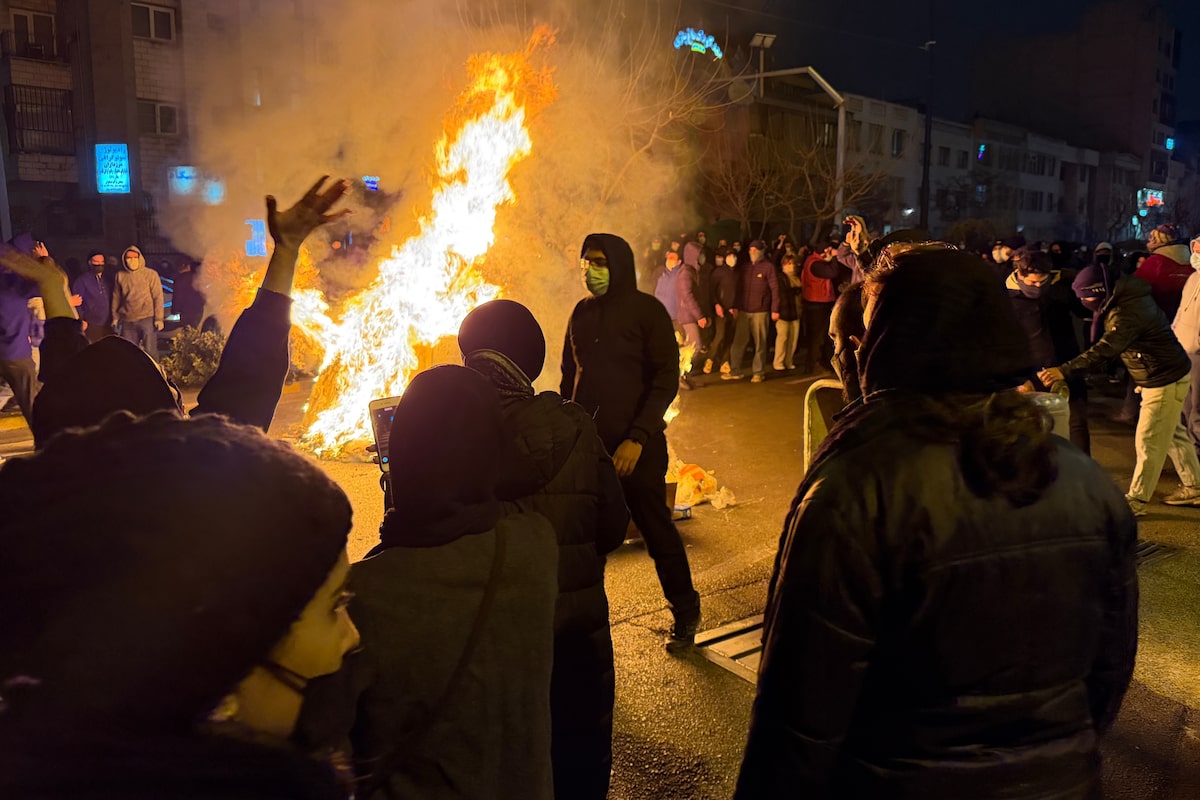
Iranians attend an anti-government protest in Tehran on Jan. 9. Demonstrations in Iran began in late December.The Associated Press
Oil prices barely budged when the U.S. attacked Venezuela, abducted its President, Nicolás Maduro, and announced it would commandeer the country’s oil reserves, the world’s largest. Iran is another story. In the past week, prices have taken off as Iran descends into chaos. U.S. President Donald Trump could make them go higher − much higher – if he makes good on his threat to bomb the place.
Mr. Trump hates high oil prices with a spiritual passion. During his campaign rallies in 2024, he vowed to cut energy prices by half. He urged OPEC to boost production to help drive gasoline prices down; his “drill, baby, drill” strategy on the home front is aimed at the same outcome. He knows that cheaper oil would make it easier for the U.S. Federal Reserve to cut interest rates, which it did three times in 2025, though he threatened to fire Fed chair Jerome Powell for not having cut faster.
The President largely got his wish. Brent crude, the international benchmark, fell to US$60 by the end of 2025 from a year-high of US$82.
But on Tuesday, the price climbed almost 3 per cent, to US$66, as the protests across Iran intensified and the body count rose. A week ago, the price was US$60. An Iranian official told Reuters that 2,000 Iranians, including government security personnel, have been killed since the protests began in late December. The true figure could be much higher; the internet blackout has severely restricted the news flow from the bloodied streets of Tehran and other cities.
Iran’s descent into near economic collapse spawned the upheaval. Store owners in Tehran’s Grand Bazaar closed their shops last month to protest runaway inflation and the devaluation of the Iranian currency, now essentially worthless – the rial trades at about 1.5-million to the U.S. dollar. Lack of inward investment and U.S. sanctions, which included Mr. Trump cutting Iran out of the Swift global payments system last year, propelled the decline, as did the U.S. and Israeli attacks on nuclear and military sites.
The environmental crisis took a bad situation and made it worse. Severe water shortages, the result of drought and water-network mismanagement, have driven up food prices. Bread prices alone have more than doubled in recent months. Water reservoirs in and near Tehran are at historic lows. Water rationing has left some areas of the city with no running water for hours at a time. Iranian President Masoud Pezeshkian has warned that Tehran may have to be evacuated if the drought continues.
Oil was the one industry that was working in Iran’s favour. Its oil reserves are the third largest in the world. Output in 2023 was four million barrels a day, ranking it ninth among the top producers, according to the U.S. Energy Information Administration. Sweeping sanctions since then have gutted production and exports. In 2018, exports were 2.8 million barrels a day. At last count, they were at about half that level. China is the main buyer of exported Iranian oil.
Iran faces a potential oil calamity that could outright sink the economy. The protests could intensify and include the oil workers. Were that to happen, exports could vanish overnight. They certainly would if the strikes or the chaos triggered the closing of the Strait of Hormuz, through which 20 to 30 per cent of global seaborne oil passes.
Around 2,000 people including security personnel have been killed in protests in Iran, an Iranian official said on Tuesday, the first time authorities have acknowledged the high death toll from an intense crackdown on two weeks of nationwide unrest.
Reuters
Another risk to Iran in general and the oil industry in particular is a U.S. or Israeli bombing campaign. On Jan. 2, Mr. Trump warned Iran not to kill peaceful protesters. “America will come to their rescue,” he said on social media. “We are locked and loaded and ready to go.” He gave no details, leaving it unclear whether he would attack only Iran’s security forces or hit industrial targets, too.
London’s Capital Economics says the world is well supplied by oil at the moment, but that a worst-case scenario, such as a strike by Iran’s oil workers, could send prices up by US$15 to US$20, about the same as the spike seen during the 12-day Israel-Iran war last June. “In any case, the fact that Iran is a much bigger oil producer than Venezuela means that the situation in Iran poses a much bigger risk to the global oil market compared to last week’s events in Venezuela,” Capital Economics said in a report.
If the mass protests stop, and Iran signals that it’s open to a deal with the U.S. that would lift the oil sanctions in exchange for, say, nuclear inspections, Iran could avoid the crisis scenario and oil prices could fall, or at least stop climbing. But Mr. Trump is as unpredictable as war. The question is whether his fear of high oil prices outweighs his desire to punish a country that he has relished punishing in both his terms as president.
It could go either way. On Tuesday, a message directed at Iran’s protesters gave the impression that a U.S. military intervention was somewhere between possible and probable. “Help is on its way,” he said on his Truth Social platform.