
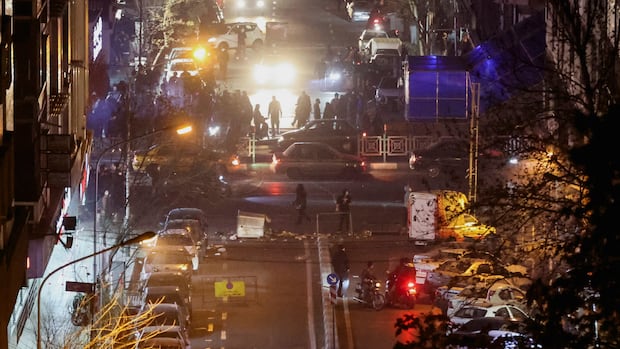
Erfan Soltani, a 26-year-old Iranian man, has been sentenced to death in Iran, according to human rights groups. It comes amid widespread protests in the country and a deadly government crackdown.
Soltani’s case is gaining visibility as potentially the first death sentence of this latest wave of protests against the Iranian regime run by Supreme Leader Ayatollah Ali Khamenei.
There have also been reports of police shooting into crowds of protesters. So far, the number of dead has climbed to at least 2,003, as reported by the U.S.-based Human Rights Activists News Agency. An Iranian state official similarly told Reuters on Tuesday that about 2,000 people had been killed.
“People fell where they stood,” one witness told BBC.
Iran Human Rights, a Norway-based non-profit, said Soltani’s family was informed on Monday that he had been arrested in Fardis, a city west of Tehran, on Jan. 8 and sentenced to death. The group cited a source close to the family.
They were told the sentence would be carried out Wednesday, the source told the group. There was no trial for his case, they said, and it isn’t clear what charges Soltani is facing.
“Iran Human Rights expresses deep concern about the escalation and continuation of the killing of protesters, and the risk of mass executions of protesters and calls for an immediate response from the international community,” the group said in a statement.
Protesters described as enemies of God
The non-profit said officials of the Islamic Republic have described protesters as mohareb (a legal term meaning “war against God”), terrorists and agitators, linking them to Israel and the United States, offences it said are punishable by death.
The demonstrations began a little over two weeks ago due to anger over Iran’s ailing economy. They soon grew to target the theocracy, particularly 86-year-old Khamenei.
Another Norway-based rights group, Hengaw, said a source close to the family told the group that Soltani’s sister is a lawyer, but has been denied access to her brother’s file.
WATCH | One author’s thoughts on the possibility of regime change: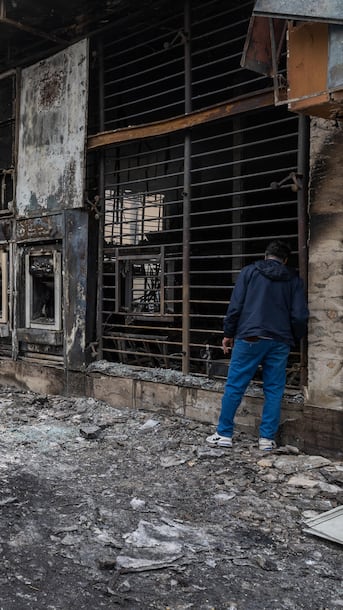
Why this author says regime change in Iran is a ‘Western fantasy’
Local activists in Iran say weeks of protests across the country have left over 2,000 people dead.The uprising of citizens against the country’s supreme leader over economic hardships is the latest in a series of revolts that follow a similar pattern that observers like John Ghazvinian have studied.
“Since his arrest, Erfan Soltani has been deprived of his most basic rights, including access to legal counsel, the right to defence, and other fundamental due process guarantees. His family has also been deliberately kept uninformed about the judicial process,” the group wrote.
It said the family has been granted just one final visit with Soltani ahead of his planned execution.
U.S. President Donald Trump posted on Truth Social Tuesday, saying he had cancelled planned meetings with Iranian government officials “until the senseless killing of protesters STOPS. HELP IS ON ITS WAY.” (Trump’s post wasn’t in specific reference to Soltani’s case.)
Top Iranian security official Ali Larijani responded by naming the U.S. president and Israeli Prime Minister Benjamin Netanyahu as “the main killers of the people of Iran.”
Trump, Netanyahu remarks haven’t helped: professor
Mohamad Tavakoli-Targhi, a professor of near and Middle Eastern civilizations at the University of Toronto, says Trump and Netanyahu’s statements against the regime have done little to help demonstrators in Iran, instead allowing the regime to accuse protesters of being foreign agents.
“If there is a strong … material support for Iranians and Iranian demonstrators, that’s great,” Tavakoli-Targhi told CBC News.
“But the sad part of it is that Trump doesn’t do that in the United States and is obliterating their very democratic foundation. And Netanyahu, who is promising to deliver democracy to Iranians, also doesn’t have a really good reputation.”
WATCH | Former U.S. deputy assistant secretary of defence weighs in: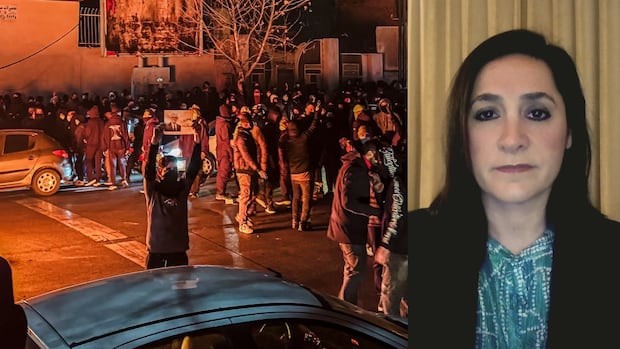
Iran’s next leadership not up to U.S., says former U.S. Defence official
As anti-government protests in Iran intensify, U.S. President Donald Trump is urging Iranians to continue demonstrating, saying ‘help is on its way.’ Dana Stroul, a former deputy assistant secretary of defence for the Middle East, weighs in as reports estimate at least 2,000 people have been killed over two weeks of protests and about 10,700 detained.
The professor noted that the importance of Iranian sovereignty has been a significant part of the political debate amid the protests — whether or not Iran should remain independent from foreign influences and powers.
In June, Trump suggested he was interested in forcing a regime change in the country after the U.S. bombed three nuclear facilities in Iran.
Iran retaliated with a strike on an American military base in Qatar soon after, escalating the tensions between the two countries.
Protest ‘rhythm’ similar to 1979: expert
While Iran and Israel agreed to a ceasefire soon after, Trump’s comments harkened back to another time the U.S. interfered in Iranian politics when a 1953 coup orchestrated by the CIA forced the country’s first democratically elected leader, Mohammad Mosaddegh, to spend the rest of his life under house arrest.
It also led, according to experts who spoke with CBC News over the summer, to the 1979 Islamic Revolution that overthrew the Pahlavi dynasty, but also eventually gave rise to the repressive government that rules the country today.
Tavakoli-Targhi said he is watching closely to see whether the current protests could, too, become a revolution.
“Revolutions have a rhythm of their own,” he said, with protests being tamped down and then returning again. He added that the current wave has a lot in common with that of the demonstration before the events of 1979.
There is a key difference, though: There doesn’t yet appear to be a fracturing within the current Iranian government or military.
“Usually, you have to have some sort of defection amongst the rank of the people who are in high positions, or seeing the military forces fractured. We haven’t seen that.”