
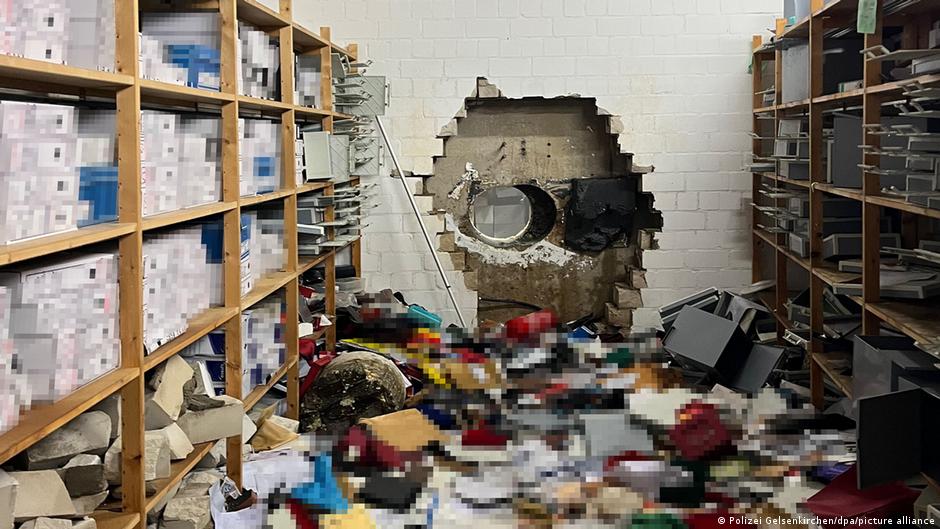
Gelsenkirchen police on Tuesday issued an update on investigations into how thieves were able to drill a massive hole into the vault of a bank in the western city, taking their pick of valuables from thousands of safety deposit boxes, without triggering the alarm and with the crime going undetected for two days over the Christmas period.
One key update seemed to hint at how they first gained entry to the bank.
“What’s now clear is that an emergency exit that it should not be possible to open from the car park was manipulated,” police said. “With this unhindered access from the parking area to the Sparkasse building was enabled.”
The theft took place during the weekend after Christmas, amid a period of multiple days where the bank was barely open, and so went unnoticed for daysImage: Christoph Reichwein/dpa/picture alliance
State interior minister briefs NRW’s parliament
The thieves managed to not only secure access to the bank and the vault, but to bypass or evade multiple alarm systems, while drilling a 40-centimeter (almost 16-inch) diamater hole directly into the vault and forcing entry to “almost all” of the 3,256 safe deposit boxes inside. How exactly they managed this is a core component of the investigation.
“A series of questions are popping up there,” the state of North Rhine-Westphalia‘s interior minister, Herbert Reul, told the regional parliament in Düsseldorf, such as whether the alarms were disactivated, or faulty, or otherwise bypassed.
A police spokeswoman said that who had manipulated the emergency exit was an issue under investigation. Speculation of inside involvement or assistance had already been rife. Reul said this was one possibility that had to be investigated, but also that there were no firm grounds for suspicion as yet.
Reul said that whatever the details, it was clear the thieves were highly organized and professional, likening some of the scenes to “a movie.”
Interior Minister Herbert Reul told reporters that if nothing else, it was already clear the heist was not the work of amateursImage: Henning Kaiser/dpa/picture alliance
Perpetrators were in the vault for at least 4 hours: police
It’s still not even clear how long the thieves were inside the Gelsenkirchen-Buer branch of the Sparkasse bank chain.
Police and Interior Minister Reul said on Tuesday that computer systems in the bank — which are supposed to log any entry into deposit boxes by fair means or foul — first recorded entry at 10:45 a.m. on December 27. The last such opening was recorded at 14:44 on the same day.
However, a police spokeswoman explicitly avoided commenting on whether all the roughly 3,100 safe deposit boxes were opened during those four hours, or whether the system stopped recording breaches for some reason as of 14:44.
The thieves’ presence in the Gelsenkirchen bank was only discovered two days later, on Monday December 29, when the fire alarm went off for a second time.
Police warn customers investigation will take months, vault remains a crime scene
Investigations are taking a long time because of the mess inside the vault, where the suspects discarded various items they did not want on the floor. Police said they believed that several hundred thousand discarded items were littered across the room and needed to be evaluated for clues or evidence.
“The place looks like a garbage tip,” Reul told reporters outside the state parliament. “There could be relevant clues on any of these items.”
A team of around 230 investigators was working 12-hour shifts on the case, police said. The suspects had also strewn “various chemical fluids” onto the floor, presumably to try to destroy any DNA evidence left by their presence.
“This work will likely take several months. The police asks all affected customers for their understanding,” investigators said of the still-sealed crime scene.
One piece of evidence, the license plates from an Audi thought to be the escape vehicle, was found in this trash can in nearby Dortmund after the crimeImage: D. Kerlekin/Snowfield Photography/picture alliance
The value of the heist and what the thieves actually elected to take is not clear, Interior Minister Reul said that nobody could really know this.
“Not even Sparkasse knows what was in there, because everyone puts what they want to secure inside their own box,” Reul said.
Sparkasse insures each individual safe deposit box for a value of up to €10,300 (roughly $12,000) but several holders have told their lawyers they were storing valuables worth considerably more than that.
German news agency dpa on Tuesday cited lawyer Daniel Kuhlmann as saying that based on the preliminary signs from the heist, such as the possibility of thieves being inside undisturbed for hours or even days, the bank could be facing “a wave of lawsuits of unprecedented proportions.”
The head of Sparkasse Gelsenkirchen, Michael Klotz, has rejected criticisms of inadequate security, saying the branch matched “recognized technological standards” and that the thieves had managed to evade “multiple independent security mechanisms.” How this was possible was a key part of the investigations, he said.
Edited by: Louis Oelofse