
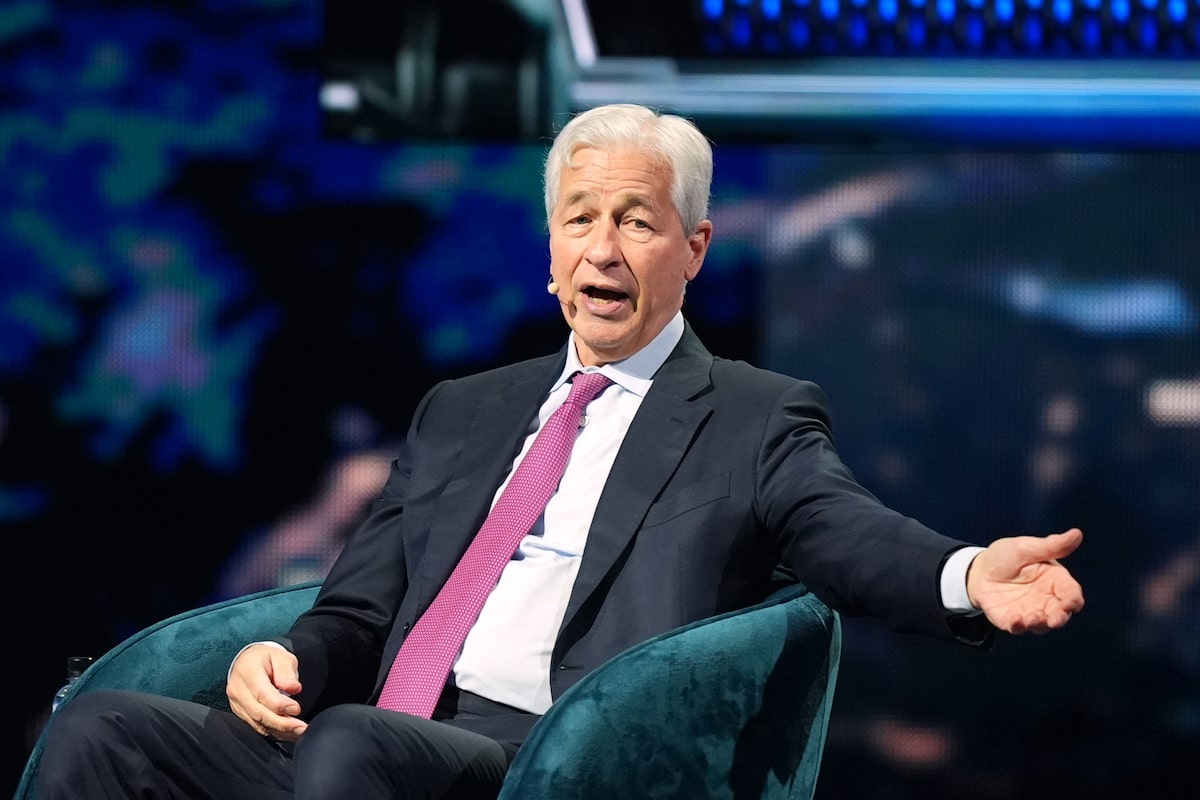
Jamie Dimon, CEO of JPMorgan Chase, speaks at the America Business Forum in Miami in November, 2025.Rebecca Blackwell/The Associated Press
Up until this week, Wall Street has generally benefited from the Trump administration’s policies and has been supportive of the President. That relationship has suddenly soured.
When U.S. President Donald Trump signed the One Big Beautiful Bill into law in July, it pushed another significant round of tax cuts and also cut the budget of the Consumer Financial Protection Bureau, at times the banking industry’s nemesis, by nearly half. Mr. Trump’s bank regulators have also been pushing a deregulatory agenda that both banks and large corporations have embraced.
But now the President has proposed a one-year, 10-per-cent cap on the interest rate on credit cards, a lucrative business for many financial institutions, and his Department of Justice has launched an investigation into Federal Reserve chair Jerome Powell that many say threatens the institution that is supposed to set interest rates free of political interference.
Bank chief executives warned the White House on Tuesday that Mr. Trump’s actions will do more harm than good to the U.S. economy.
Major central bank chiefs defend Fed’s Powell after Trump threat
Fighting the Fed, Trump tries credit easing by decree
Bank of New York CEO Robin Vince told reporters that going after the Fed’s independence “doesn’t seem, to us, to be accomplishing the administration’s primary objectives for things like affordability, reducing the cost of borrowing, reducing the cost of mortgages, reducing the cost of everyday living for Americans.”
“Let’s not shake the foundation of the bond market and potentially, do something that could cause interest rates to actually get pushed up, because somehow there’s a lack of confidence in the Fed’s independence,” Mr. Vince added.
The Federal Reserve’s independence is sacrosanct among the big banks. While banks may have wanted Mr. Powell and other Fed policy-makers to move interest rates one way or another more quickly, they have generally understood why Mr. Powell has done what he’s done.
“I don’t agree with everything the Fed has done. I do have enormous respect for Jay Powell, the man,” JPMorgan Chase CEO Jamie Dimon told reporters Tuesday.
Dimon’s message did not seem to resonate with Trump, who told journalists that Dimon is wrong in saying it’s not a great idea to chip away at the Federal Reserve’s independence by going after Chair Jerome Powell.
“Yeah, I think it’s fine what I’m doing,” Trump said Tuesday in response to a reporter’s question at Joint Base Andrews after returning from a day trip to Michigan. He called Powell “a bad Fed person” who has “done a bad job.”
Along with the attacks on the Fed, Mr. Trump is going after the credit-card industry. With “affordability” likely to be a key issue in this year’s midterm elections, Mr. Trump wants to lower costs for consumers and says he wants a 10-per-cent cap on credit-card interest rates in place by Jan. 20. Whether he hopes to accomplish this by bullying the credit-card industry into just capping interest rates voluntarily, or through some sort of executive action, is unclear.
The average interest rate on credit cards is between 19.65 per cent and 21.5 per cent, according to the Federal Reserve and other industry tracking sources. A cap of 10 per cent would likely cost banks roughly US$100-billion in lost revenue each year, researchers at Vanderbilt University found. Shares of credit-card companies like American Express, JPMorgan, Citigroup, Capital One and others fell sharply Monday as investors worried about the potential hit to profits these banks may face if an interest-rate cap were implemented.
In a call with reporters, JPMorgan’s chief financial officer Jeffrey Barnum indicated the industry was willing to fight with all resources at its disposal to stop the Trump administration from capping those rates.
“Our belief is that actions like this will have the exact opposite consequence to what the administration wants in terms of helping consumers,” Mr. Barnum said. “Instead of lowering the price of credit, it will simply reduce the supply of credit, and that will be bad for everyone: consumers, the broader economy, and yes, for us, also.”
Mr. Trump seemed to double down on his attacks on the credit-card industry overnight. In a post on his social-media platform Truth Social, he said he endorsed a bill introduced by Sen. Roger Marshall that would likely cut into the revenue banks earn from merchants whenever they accept a credit card at point-of-sale.
“Everyone should support great Republican Sen. Roger Marshall’s Credit Card Competition Act, in order to stop the out of control Swipe Fee ripoff,” Mr. Trump wrote.
The comments from Wall Street are coming as the major banks report their quarterly results. JPMorgan, the nation’s largest consumer and investment bank, and the Bank of New York Mellon Corp., one of the world’s largest custodial banks, both reported their results Tuesday with Citigroup, Bank of America, Wells Fargo and others to report later this week.