
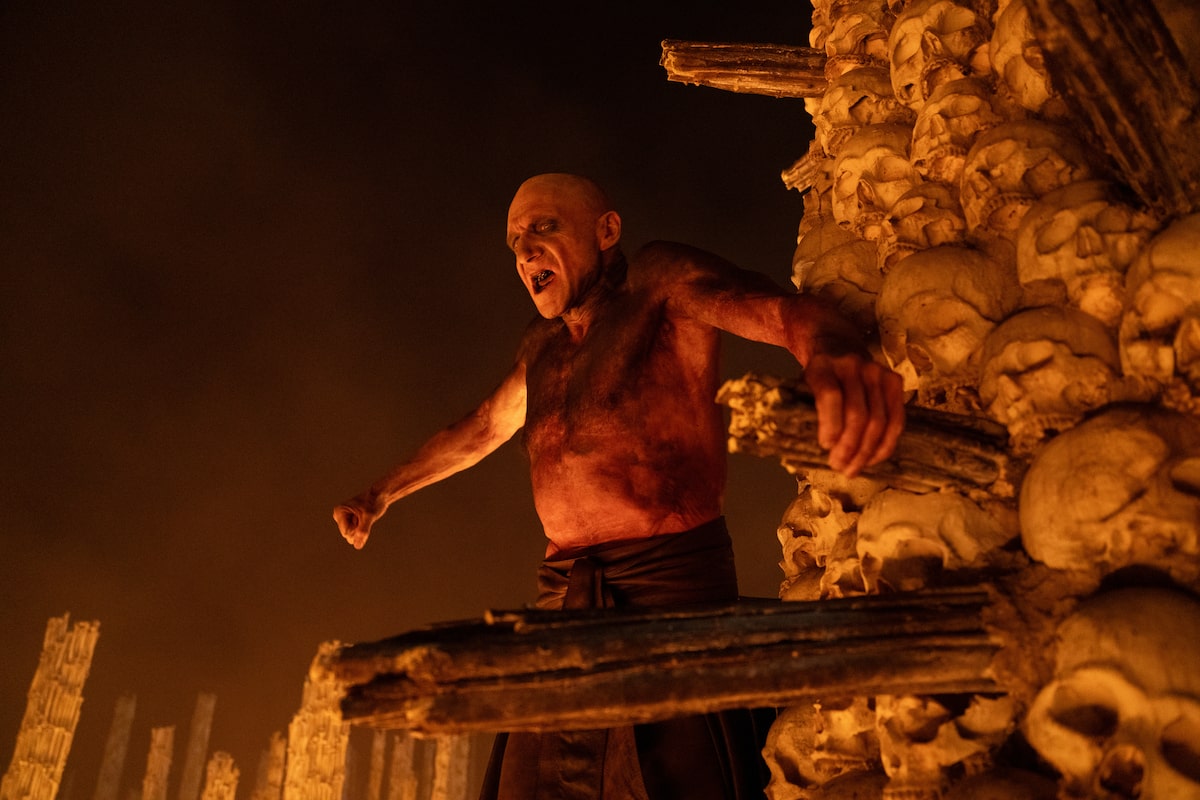
Ralph Fiennes returns as Dr. Kelson, the zen-like healer with a Colonel Kurtz aesthetic, in 28 Years Later: The Bone Temple.Miya Mizuno/Sony
28 Years Later: The Bone Temple
Directed by Nia DaCosta
Written by Alex Garland
Starring Ralph Fiennes, Jack O’Connell and Alfie Williams
Classification 18A; 110 minutes
Opens in theatres Jan. 16
Director Danny Boyle and writer Alex Garland had some surprises in store with 2025’s 28 Years Later. No, I don’t mean the acrobatic, tracksuit-clad gang led by Jack O’Connell in the movie’s hilariously silly coda; though we’ll get to that. I’m referring to how intimate and melancholic the revival of their running dead franchise turned out to be; as white-knuckle a thriller as its predecessors but also a graceful coming-of-age story about a young boy learning to grapple with grief.
28 Years Later: The Bone Temple doesn’t quite live up to the earlier film’s promise. At best, it’s an ambitious and compelling enough staging ground biding time, with cruel violence more stomach-turning than ever, as it sets up the already-in-the-works final chapter in a planned trilogy, with the original’s star Cillian Murphy due to return.
Hedda director Nia DaCosta takes the reigns for Boyle in a sequel that often lumbers along at a zombie’s pace; not the infected sprinters of the 28 franchise mind you, but the kind George A. Romero would weaponize in his allegories for race relations, Cold War paranoia and consumerism. Like those pioneering zombie movies, The Bone Temple has some big-picture ideas on its mind, more insistently using its postapocalyptic landscape to hold a cracked and corroded mirror up to our present-tense divided culture.
Gnarly and fierce zombie sequel 28 Years Later was worth the decades-long wait
Garland’s script gestures at the fear and anger that turns people against each other, and how trauma curdles into either hopelessness or cultish belief systems. But he has a hard time marrying his observations to a narrative that earns emotional investment or any sense of urgency.
This time around, Alfie Williams’s adolescent Spike, the beating heart of the last movie, is largely sidelined to being a terrified witness, after stumbling into that aforementioned gang fronted by O’Connell’s Jimmy. The latter leads a Satan-worshipping, Clockwork Orange-style wolf pack, in which his followers are also named Jimmy. Remember how Malcolm McDowell sang Singin’ In the Rain when raping and murdering in Stanley Kubrick’s ultra-violent satire. This band – products of their environment and what faint memories they hold onto from the before times – reference the Teletubbies while torturing and maiming anyone unfortunate enough to cross their path.
DaCosta lets these thoroughly unpleasant scenes, as when victims are skinned alive, linger, keeping us trapped but also beholden to O’Connell’s wily and menacing performance. He’s bringing the same energy we saw in Sinners – where he played another demonic figure – his sneakily funny, inviting and unassuming manner with words burrowing its way into your head, as if O’Connell’s making himself at home where he can rattle the nervous system.
Jack O’Connell and Director Nia DaCosta on set.Miya Mizuno/Sony
The only other actor who can make an impression in his presence is Erin Kellyman (Eleanor the Great), playing a quietly ferocious minion hanging onto doubt about the manipulative and increasingly pathetic cult leader who christens himself the son of the devil.
There’s also the soothing Ralph Fiennes, of course, returning as Dr. Kelson, the zen-like healer with a Colonel Kurtz aesthetic, his skin covered in phosphorous orange paste as he surrounds himself with skulls. He occupies a separate space for most of the movie, building a comic rapport with the Alpha, Chi Lewis-Parry’s hulking infected, who takes time away from ripping heads off to basically get high on sedatives with Kelt. They form an amusing odd couple, seeking “peace and respite” as Kelson says. That’s exactly what these scenes, where the doctor looks for signs of intelligence and humanity in the monster, offer as relief from Jimmy’s unbearable orbit.
Never mind that these scenes are mostly all exposition from Kelson, whose dialogue spells out where the plot’s headed for the audience more than it speaks to the zonked-out Alpha. But Fiennes, as monumentally talented as he is, makes that exposition warm, comforting and affecting. You know that old compliment about an actor who can sound dramatic reading grocery lists or IKEA instructions. Yeah. That.
28 Years Later: The Bone Temple Caption Samson (Chi Lewis-Parry) in Columbia Pictures’ 28 YEARS LATER: THE BONE TEMPLE.Sony
His performance is enough to keep things interesting up to a cheeky and playful finale, which includes the inevitable face-off between Kelson and Jimmy and a needle drop that had the audience I saw this with in stitches, and hold out hope for what the next 28 Years Later has to offer.
Special to The Globe and Mail