

Listen to this article
Estimated 5 minutes
The audio version of this article is generated by AI-based technology. Mispronunciations can occur. We are working with our partners to continually review and improve the results.
A Newfoundland and Labrador Supreme Court justice has dismissed an application requesting a review of a decision that cleared a former police officer of discreditable conduct.
The ruling effectively ends a long battle by a Labrador man for police accountability.
In his decision Dec. 23, Justice David Conway said his role was to determine whether or not a previous decision by Royal Newfoundland Constabulary Complaints Commission (RNCCC) chief adjudicator John Whelan was reasonable.
“In this case I find the merits decision is transparent, intelligible and justified,” Conway said.
“That is, I find the merits decision reasonable.”
Whelan found former RNC Const. Joe Smyth’s BlackBerry message to now-retired Sgt. Tim Buckle — in which he called a detained man a “loser” — was inapprorpiate, but did not amount to discreditable conduct.
“To be clear — the respondent’s commentary towards the complainant was not appropriate. The respondent admits as much,” Whelan wrote in his Jan. 16, 2025 decision.
“However, I cannot conclude that the comments were significant enough to cause a credible risk to the reputation of the RNC.”
The lawyer for the complaints commission made an application to Supreme Court five months later, seeking a judicial review of that decision.
RNCPCC lawyer James Strickland argued that Whelan used the wrong legal framework and made contradictory findings in deciding the officer’s actions were not “conduct unbecoming.”
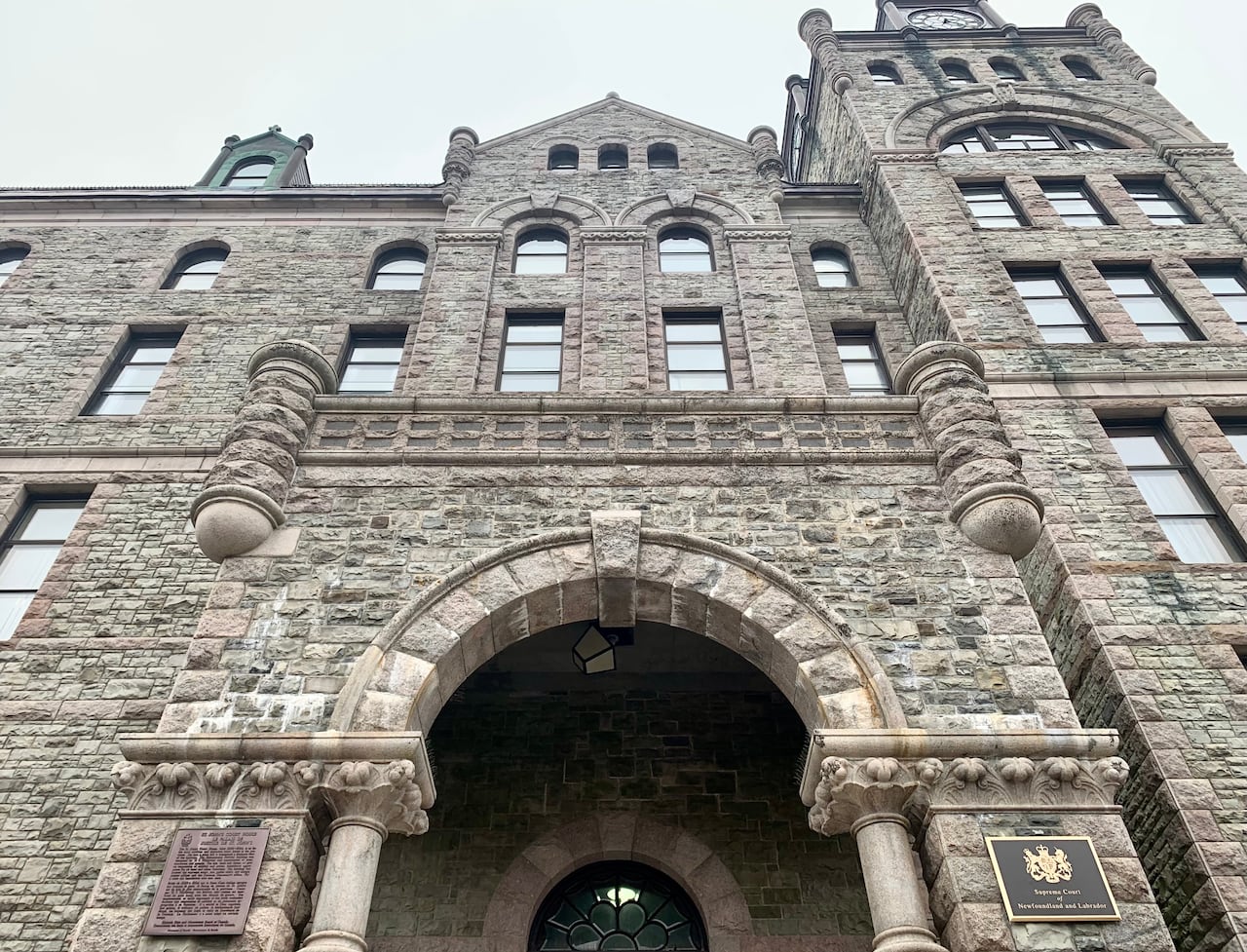 The Newfoundland and Labrador Supreme Court Building in St. John’s. (Sarah Smellie/The Canadian Press)
The decision by Conway closes the door on a protracted, complicated battle by Andrew Abbass to see accountability for two former officers he believes breached their duty.
“It’s a mess of a process. I wouldn’t recommend it to anybody. And yeah, I definitely think it needs to be amended,” Abbass said in an interview with CBC News this week.
“As an exercise in standing on principle, it’s been a frustrating, frustratingly long process.”
Abbass filed a complaint with the commission, which hears public complaints about RNC officers, in 2017.
Two years earlier, Abbass had been detained by members of the RNC while living in Corner Brook.
In April 2015, Abbass was kept for six days at the hospital, allegedly because of tweets he wrote in response to a fatal police shooting involving Smyth earlier that month.
WATCH | A near decade-long police complaints process has come to an end in N.L. Supreme Court room:
Supreme Court decision closes the door on lengthy police complaint
A N.L. Supreme Court ruling has ended a process involving complaints against police officers that has been ongoing for years. It all stems from information that came out during the Don Dunphy inquiry nearly a decade ago, and comments two RNC officers made about a detained man. Ariana Kelland reports.
“How about this Premier of N.L. I’m going to bring down Confederation and have politicians executed,” one of Abbass’s tweets said. “Ready to have me shot, coward?”
The public inquiry held two years later into the shooting death of Don Dunphy revealed that Buckle texted Smyth to report that Abbass had been arrested.
“He’s at hospital now,” Buckle wrote.
“Loser,” Smyth responded.
“Yup,” said Buckle.
Abbass was never charged with a crime. Nor was he certified as suffering from any psychiatric condition.
In a report, former RNC deputy chief Ed Oates called the detention a “serious and wrongful deprivation” of Abbass’s liberties stemming from a police officer’s abuse of authority.
Complaints against Buckle dismissed
Abbass also filed a complaint against Buckle over his detention, but Whelan ruled in August 2024 that Abbass failed to file the complaint within the six-month timeline as set out in legislation governing the police system.
Abbass only filed the complaint after learning of the messages between the two officers, two years after they were sent.
“The facts of this case are concerning,” wrote Whalen. “The detention complainant alleges that an individual was detained by the state without cause. There is certainly a public interest in determining what factors led the RNC to the complainant’s door on April 7, 2015.”
Abbass himself appealed that decision about the timeline to the Supreme Court of Newfoundland and Labrador. Justice Conway dismissed it on Oct. 30, 2025.
Abbass also filed a complaint alleging Buckle breached RNC regulations by providing inaccurate or misleading evidence at the Dunphy inquiry, and for conduct unbecoming for the messages exchanged with Symth.
Whelan rendered his decision last June.
As in the case of Smyth, Whelan concluded that Buckle’s text exchange with Smyth was inappropriate, but did not rise to the level of disreputable conduct.
Whelan determined Buckle was neither untruthful nor negligent when he testified at the inquiry.