
Unlock the Editor’s Digest for free
Roula Khalaf, Editor of the FT, selects her favourite stories in this weekly newsletter.
Former Ukrainian prime minister Yulia Tymoshenko has been accused of heading a vote-buying scheme in parliament by the country’s top anti-corruption authorities, according to people familiar with the investigation.
Tymoshenko, leader of Ukraine’s Batkivshchyna party, has been served with a notice of suspicion by the National Anti-Corruption Bureau of Ukraine (Nabu) after it searched her Kyiv office overnight into Wednesday, the people said.
Nabu, the country’s top independent anti-corruption body, confirmed the searches of an “opposition party leader” but did not name Tymoshenko in a statement and lengthy video published on social media.
Tymoshenko called the allegations “political” and said the search of her office was “nothing more than a grandiose PR stunt” that had “absolutely nothing to do with law or justice”, in a statement provided through her press secretary.
“I categorically reject all these absurd accusations,” she said.
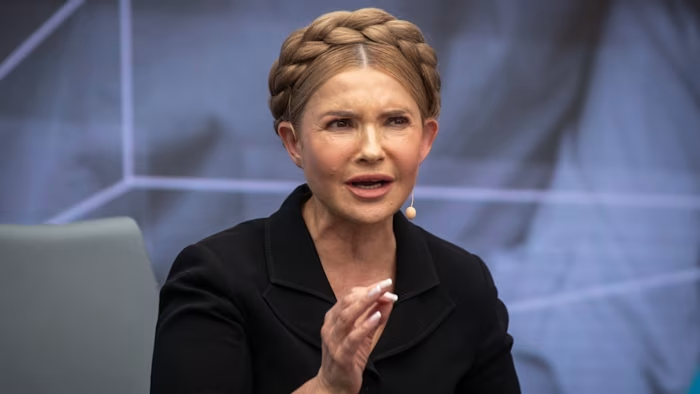
People involved in the probe confirmed to the FT that a woman with a blonde crown braid — Tymoshenko’s signature hairstyle — whose face is pixelated in the Nabu video is the former political firebrand who led the country’s 2004 pro-democracy Orange revolution to become Ukraine’s first woman prime minister in 2005.
 An image from the video released by Nabu © Nabu
Her notice of suspicion widens a political scandal roiling parliament since late last year that involves several sitting lawmakers, including some from President Volodymyr Zelenskyy’s ruling party, whom Nabu accuses of taking part in the scheme.
Tymoshenko is a staunch political opponent of Zelenskyy, although like most Ukrainian political leaders, she has largely refrained from publicly criticising the president in wartime. In the past year, she has taken a more critical stance, including against a deal signed by Kyiv and Washington in April offering the US special access to Ukraine’s critical mineral reserves.
She had supported a widely criticised law forced through parliament by Zelenskyy and his ruling party in July that reduced the powers of Nabu and its sister agency, the Specialised Anti-Corruption Prosecutor’s Office (Sapo). Public protests and western criticism forced Zelenskyy and parliament to reverse course soon after.
Nabu said in a statement that “the suspect” had “initiated discussions with certain MPs on introducing a systemic mechanism for providing unlawful benefits in exchange for loyal behaviour during votes”. The people familiar with the matter confirmed to the FT that ‘‘the suspect’’ referred to Tymoshenko.
“It was not about one-off arrangements but a regular co-operation mechanism that envisaged advance payments and was calculated to last for a long period,” Nabu added in the statement.
In the full Nabu video, a person who sounds like Tymoshenko is heard offering cash to an MP in return for support on specific votes. The woman believed to be Tymoshenko is also heard promising payment for recruited allies and describing plans to co-ordinate voting instructions via the Signal messaging app.
An image of a Signal chat shared in the Nabu video appears to show that the MPs allegedly involved in the scheme were instructed to hold up the appointment of Zelenskyy’s chosen ministers, who eventually were voted in on Tuesday.
The agency also filmed a raid on Tymoshenko’s party office, showing stacks of $100 bills laid out in front of the woman wearing a crown of braids.
Tymoshenko said investigators “found nothing, and therefore simply confiscated my work phones, parliamentary documents and personal savings”, which she said had been “fully reflected” in the official asset declaration required by sitting MPs.
“This is not the first political order against me,” she added.
A Ukrainian court in 2011 found Tymoshenko guilty of abuse of power for brokering a natural gas imports contract signed with Russia when she served as prime minister and sentenced her to seven years in prison. The case was widely viewed inside Ukraine and by the west as a politically motivated attempt by then pro-Russian president Viktor Yanukovych to sideline his chief opponent.
She was released after Yanukovych fled Ukraine at the culmination of the 2014 Euromaidan revolution.
In classic fashion for which the political leader and survivor is known, she vowed on Wednesday to bounce back from the latest moves against her: “No one can break me or stop me.”