
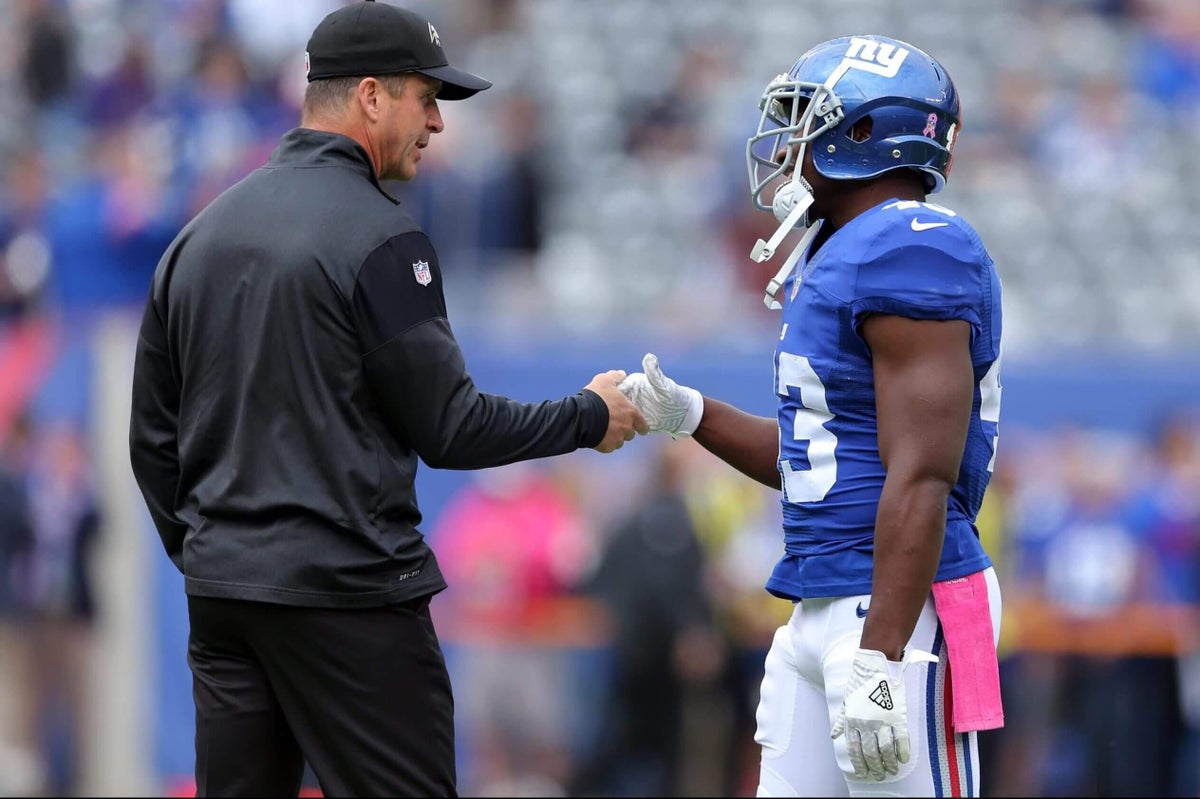
John Harbaugh is more well-known than most head-coaching candidates, having spent the past 18 seasons in the spotlight coaching the Baltimore Ravens as an annual Super Bowl contender.
As the New York Giants dig deeper on Harbaugh during an extended courtship with the coveted coach, I turned to someone who knows the 63-year-old better than most for more intel. Colleague Jeff Zrebiec has covered the past 15 seasons of Harbaugh’s career. So, here are insights into the Giants’ top coaching target from someone who had an up-close look at what makes Harbaugh such a desirable candidate.
What’s the identity of a John Harbaugh-coached team?
Zrebiec: Wait until he starts telling the Bo Schembechler stories. Harbaugh is old school in many ways, and he believes in setting the tone in the trenches and maintaining a strong running game and an attacking defense. Harbaugh’s best teams play with physicality and poise. He fosters a “nobody-believes-in-us” mentality, and his teams typically are good on the road and tough to play against.
Even when injuries have hit hard over the years, rarely do Harbaugh’s teams get blown out. Special teams will be emphasized under him. Those units play a significant role in roster decisions.
What are his strengths as a coach? What about him led to so much success over the past 18 years?
Zrebiec: Harbaugh is a culture-builder. I know that expression gets overused, but he does a nice job of fostering a team-first mindset. He gets everybody moving in the right direction and weeds out those who don’t fit with the culture he’s trying to build. He doesn’t tolerate the peripheral nonsense that impedes winning. He’s not afraid of confrontation, believing it can be good for a team. He also demands complete organizational buy-in. If something is not up to par — whether that’s infrastructure-related, the roster, scouting, etc. — he’s not afraid to challenge members of the organization to make sure it gets fixed.
He’s generally done a nice job communicating with players and evolving as a coach to the type of team that he has, and he’s annually built a quality coaching staff. Developing young assistants has been part of that. Under Harbaugh, the Ravens rarely looked unprepared to play. Just about all of his teams played with physicality and purpose.
What are his weaknesses? Could they be magnified by a younger/less talented roster?
Zrebiec: It feels like the term “CEO-type coach” has a negative connotation these days. There’s nothing wrong with letting the coordinators handle their sides of the ball, but there were times when Harbaugh should have been more involved on game days in making adjustments, imploring the coordinators to stick to the game plans and not overreact to shifts in the game. There were too many “game management” mishaps, whether it was not running the ball enough, straying from the team’s identity or not having a better feel for how the game was playing out. Ultimately, he’s responsible for that.
Over the past few years, the Ravens have blown too many double-digit leads and morphed into a mistake-prone team at the wrong times. I would think not having a two-time MVP at quarterback and a deep and talented roster will certainly put more of an onus on Harbaugh to be a better in-game manager and make sounder decisions.
Is he more of a disciplinarian or a players’ coach? What was his perception in the locker room?
Zrebiec: This was an area where he really evolved during his time in Baltimore. At first, most Ravens players would have told you he was a disciplinarian. He wasn’t very well-liked in most corners of the locker room. But from Harbaugh’s perspective, that was out of necessity. He was trying to establish a culture. He needed to dig in and push back on the veterans.
When he arrived in 2008, the Ravens’ locker room dynamic wasn’t good. There was a clear divide between the perennially underperforming offense and a star-studded defense that featured guys like Ray Lewis, Ed Reed and Terrell Suggs. Harbaugh felt like he had to adopt a “my way or the highway” approach.
Over the years, he’s become more of a players’ coach. He listens to their opinions and is not afraid to change his mind on matters like practice and travel schedules, based on input from veteran leaders. Certain things are non-negotiable in his mind, but he’s more open-minded than he used to be.
He can be corny with the locker room stuff and some of the speeches/sayings, but I think players see that for what it is. Look, I think his words and methods got a little stale here. Not everybody was his biggest fan, but in general, most players respected him and believed in him as a coach, and I never sensed players tuning him out.
How involved was he with personnel decisions? How did the power dynamic work with his general managers?
Zrebiec: Certainly, with the success he had early, leading the Ravens to five straight postseasons to start his career and winning a Super Bowl, he earned more clout in the decision-making process. He had a big say in the personnel decisions. He didn’t have the final word. That was general manager Ozzie Newsome and Newsome’s successor, Eric DeCosta.
However, the Ravens use a collaborative decision-making process. They don’t mind disagreement. They encourage everyone to share their opinions, even if they don’t align with what others are saying. It’s ultimately the GM’s call, but the GM leaned on Harbaugh and other members of the front office, personnel and coaching staff before making decisions.
Harbaugh had one of the loudest and most influential voices in that process. I cannot see him joining the Giants without a promise that he’ll have a say in personnel decisions.
How was he able to develop quarterback Lamar Jackson into a two-time MVP?
Zrebiec: I laugh when I hear Ravens fans disparaging Harbaugh’s resume by saying Jackson saved his job in 2018 when Baltimore won six of its last seven regular-season games to make the playoffs after Joe Flacco went down. Well, yeah, but that year was also one of Harbaugh’s best coaching jobs. He and his staff made adjustments week by week to help Jackson settle in. They reshaped the offense and its style on the fly.
Overall, I think Harbaugh put the correct offensive coaches around Jackson. Greg Roman was a perfect coordinator for Jackson early in his career. Harbaugh stuck with Roman a year too long, but Todd Monken was the perfect guy to help Jackson get to the next level as a passer. Harbaugh gave Jackson the freedom to develop without stifling him and trying to overhaul the way he plays.
Jackson is an incredibly unique athlete and personality. Harbaugh and Jackson’s relationship may have hit a wall this year, but Harbaugh gave Jackson a wide berth in some areas and was willing to relax some of his coaching principles to give the quarterback the best possible environment to succeed.
Building a quality staff is particularly important for a head coach who doesn’t call plays. Who are some logical coordinator candidates?
Zrebiec: Monken has other options, but he and Harbaugh have a solid relationship, so I’d think that could be in play. That would be a nice get for the Giants and the New York media. Monken is a character. Tee Martin, who has been Jackson’s quarterbacks coach and has interviewed for a few offensive coordinator openings this offseason, could get consideration.
Defensively, there are a bunch of guys with ties to Harbaugh who are available: Zach Orr, Wink Martindale, Chuck Pagano and Anthony Weaver, to name a few. Heck, maybe Harbaugh even gives Rex Ryan a call. One of Harbaugh’s closest friends in coaching is Jerry Rosburg. I’m not sure if Rosburg is looking to get back in, but if he were, he’d be an ideal fit in the assistant head coach/special teams coordinator role.
Do you think Harbaugh can still be a Super Bowl-level coach?
Zrebiec: I do. Obviously, the Giants need more talent on that roster. That’s where it starts. And Harbaugh will need to make some adjustments, as well. You’d hope he’ll learn from some of the issues the Ravens had in recent years that kept them from being more successful in the postseason. But I do think Harbaugh will raise the floor there and clean up things that are holding them back.
Ultimately, Harbaugh will probably benefit from a change of scenery. One of the things owner Steve Bisciotti so admired about Harbaugh was his willingness to look inward to improve and evolve as a coach every year. I think he’ll be plenty motivated to prove he still belongs in the conversation with the league’s top coaches.