
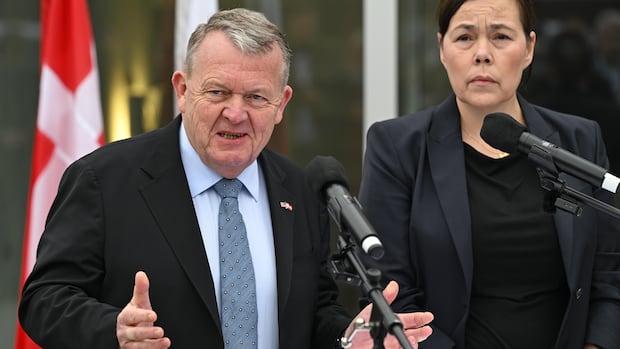
A top Danish official said Wednesday that a “fundamental disagreement” over Greenland remains with U.S. President Donald Trump after highly anticipated talks in Washington with U.S. Vice-President JD Vance and Secretary of State Marco Rubio.
“We didn’t manage to change the American position,” Danish Foreign Minister Lars Løkke Rasmussen told reporters outside the Danish Embassy in Washington after the meeting.
“It’s clear that the president has this wish of conquering over Greenland.”
The two sides, however, agreed to create a working group to discuss ways to work through differences, as Trump continues to call for a U.S. takeover of the semiautonomous territory of Denmark, a NATO ally.
“The group, in our view, should focus on how to address the American security concerns, while at the same time respecting the red lines of the Kingdom of Denmark,” Rasmussen said, joined by Greenland’s Foreign Minister Vivian Motzfeldt.
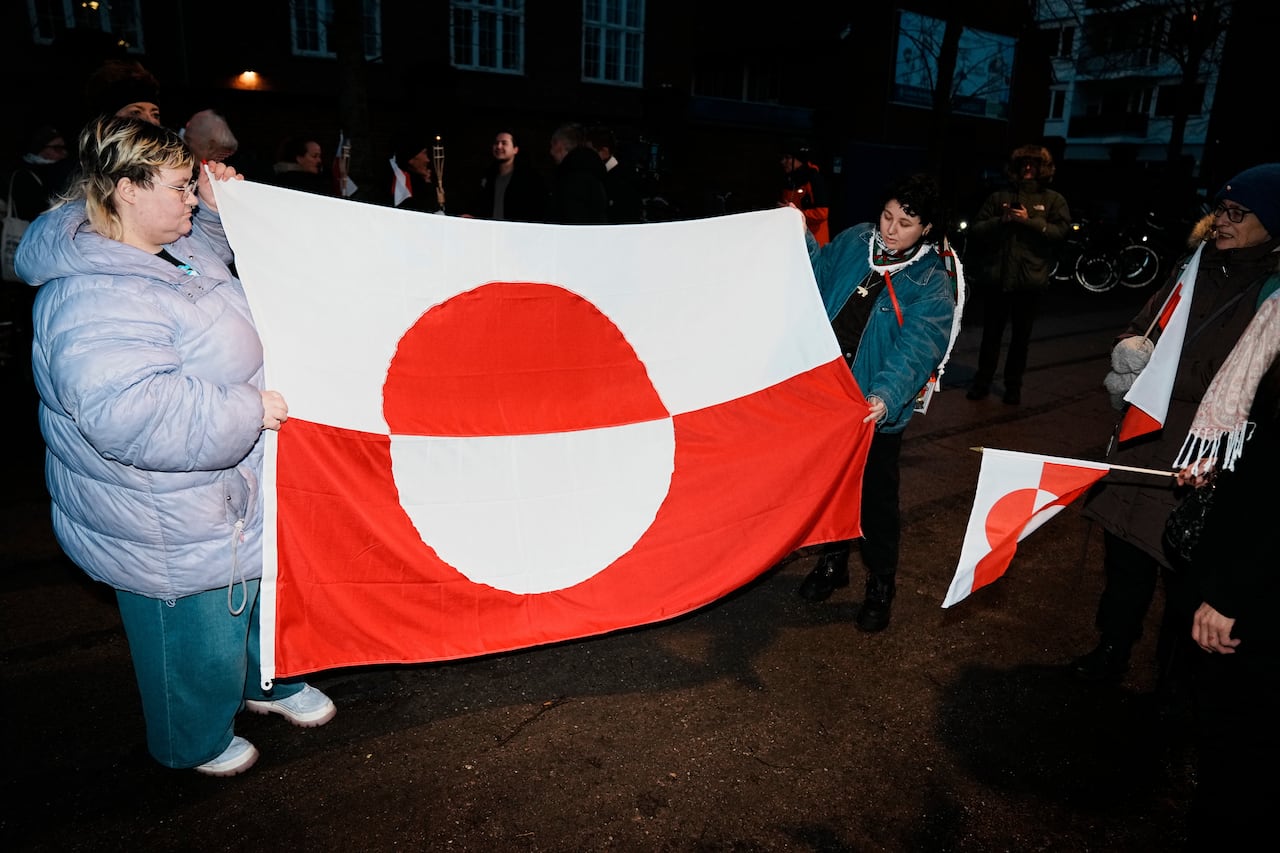 A demonstration under the slogan ‘Greenland belongs to the Greenlanders’ was held in front of the U.S. Embassy in Copenhagen on Wednesday. (Thomas Traasdahl/Ritzau Scanpix/The Associated Press )
Trump is trying to make the case that NATO should help the U.S. acquire the world’s largest island and says anything less than it being under American control is unacceptable.
Denmark has announced plans to boost the country’s military presence in the Arctic and North Atlantic, as Trump tried to justify his calls for a U.S. takeover by repeatedly claiming that China and Russia have designs on Greenland, even portraying the island as besieged by Russian and Chinese ships.
Rasmussen rejected that characterization Wednesday, saying “it is not a true narrative that we have Chinese war ships all around the place.”
A few hours before the officials sat down, Trump reiterated on his social media site that the U.S. “needs Greenland for the purpose of national security.”
Trump again cited what he says is the threat from Russian and Chinese ships as a reason for the U.S. to take control.
“NATO should be leading the way for us to get it,” he wrote, adding that otherwise Russia or China would — “AND THAT IS NOT GOING TO HAPPEN!”
“NATO becomes far more formidable and effective with Greenland in the hands of the UNITED STATES,” Trump wrote. “Anything less than that is unacceptable.”
Both Rasmussen and Motzfeldt offered measured hope that the talks were beginning a conversation that would lead to Trump dropping his demand of acquiring the territory and would create a path for tighter co-operation with the U.S.
“We have shown where our limits are, and from there, I think that it will be very good to look forward,” Motzfeldt said.
Later Wednesday, Trump said from the Oval Office that he believed “something will work out” on Greenland, though he did not change his stance.
“The problem is there’s not a thing that Denmark can do about it if Russia or China wants to occupy Greenland, but there’s everything we can do,” he said. “You found that out last week with Venezuela,” he added.
WATCH | NATO chief questioned over threats to Greenland:
NATO chief pressed on Trump’s push to control Greenland
NATO Secretary General Mark Rutte, speaking Tuesday at an event in Brussels, declined to comment on discussions between allies when asked to react to U.S. President Donald Trump’s repeated assertions that the U.S. needs to control Greenland, a semi-autonomous territory of Denmark.
In Copenhagen, Danish Defence Minister Troels Lund Poulsen announced an increase in Denmark’s “military presence and exercise activity” in the Arctic and the North Atlantic, “in close co-operation with our allies.”
Poulsen said at a news conference the stepped-up military presence was necessary in a security environment in which “no one can predict what will happen tomorrow.”
“This means that from today and in the coming time, there will be an increased military presence in and around Greenland of aircraft, ships and soldiers, including from other NATO allies,” Poulsen said.
Those allies were arriving in Greenland along with Danish personnel, he said. Poulsen declined to name the other countries contributing to increased Arctic presence, saying that it is up to the allies to announce their own participation.
Greenland’s Prime Minister Jens-Frederik Nielsen told a news conference in Copenhagen on Tuesday that, “if we have to choose between the United States and Denmark here and now, we choose Denmark. We choose NATO.”
Asked later Tuesday about Nielsen’s comments, Trump replied: “I disagree with him. I don’t know who he is. I don’t know anything about him. But that’s going to be a big problem for him.”
LISTEN | Casey Michel, Foreign Policy contributor, on the perils of annexation:
Front Burner28:25What if Greenland’s next?
Allies alarmed by U.S. statements
The second Trump administration’s aggressive statements have caused confusion and consternation, as a 1951 agreement between the U.S. and Denmark gives Washington the right to move around freely and construct military bases in Greenland, as long as Denmark and Greenland are notified.
White House press secretary Karoline Leavitt added fuel to the fire last week, stating “utilizing the U.S. military is always an option at the commander-in-chief’s disposal” in response to questions about Greenland.
Leavitt later pointed out that an aggressive military operation in Venezuela followed what she characterized as a failure of diplomacy, even as Washington has long considered that South American country an adversary, while Denmark and the U.S. are part of the NATO alliance.
Ahead of the meeting, France’s foreign minister denounced what he described as U.S. “blackmail” over Greenland in the latest sign of irritation among U.S. allies.
In comments to RTL radio, French Foreign Minister Jean-Noël Barrot on Wednesday said France plans to open a consulate in Greenland on Feb. 6, a decision he said had been taken after President Emmanuel Macron visited the outpost last summer.
“Attacking another NATO member would make no sense; it would even be contrary to the interests of the United States. And I’m hearing more and more voices in the United States saying this,” Barrot said. “So this blackmail must obviously stop.”
Canada has previously announced its own plans to open a Greenland consulate. Last week, Denmark’s major allies joined Danish Prime Minister Mette Frederiksen in issuing a statement declaring that Greenland belongs to its people and that “it is for Denmark and Greenland, and them only, to decide on matters concerning Denmark and Greenland.”
‘Security is just a cover’
Greenland is strategically important because as climate change causes the ice to melt, it opens up the possibility of shorter trade routes to Asia. That also could make it easier to extract and transport untapped deposits of critical minerals, which are needed for computers and phones.
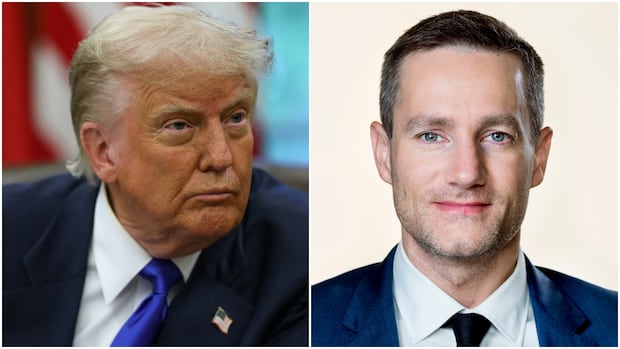
U.S. has nothing to gain acquiring Greenland as it already has access: Danish MP
U.S. Secretary of State Marco Rubio is set to meet with Danish officials next week to discuss the future of Greenland. Danish Parliament member Rasmus Jarlov says he hopes to hear more on what the U.S. president wants.
Both experts and Greenlanders question its perceived importance in terms of security.
Lars Vintner, a heating engineer, told The Associated Press he frequently goes sailing and hunting and has never seen Russian or Chinese ships.
“Security is just a cover,” Vintner said, suggesting Trump actually wants to own the island to make money from its untapped natural resources.
His friend, Hans Nørgaard, agreed, adding “what has come out of the mouth of Donald Trump about all these ships is just fantasy.”
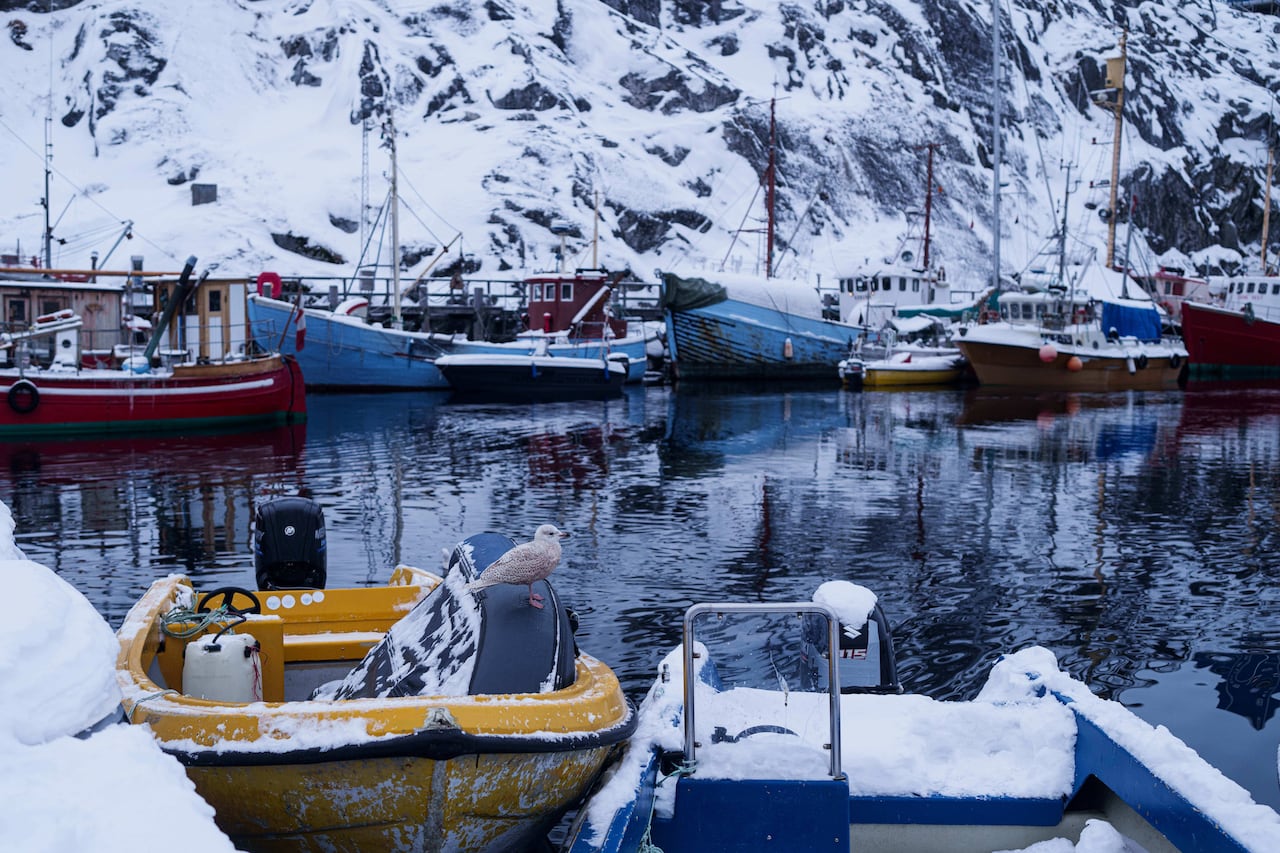 A bird stands on a boat at the harbour of Nuuk, Greenland, on Tuesday. Last week, Denmark’s major allies joined Danish Prime Minister Mette Frederiksen in issuing a statement declaring that Greenland belongs to its people. (Evgeniy Maloletka/The Associated Press)
Tuuta Mikaelsen, a 22-year-old student in Nuuk, said that Greenlanders benefit from being part of Denmark, which provides free health care, education and payments during study.
“I don’t want the U.S. to take that away from us,” she said.
A bipartisan delegation of lawmakers is also heading to Copenhagen at the end of the week to meet with Danish and Greenlandic officials.