
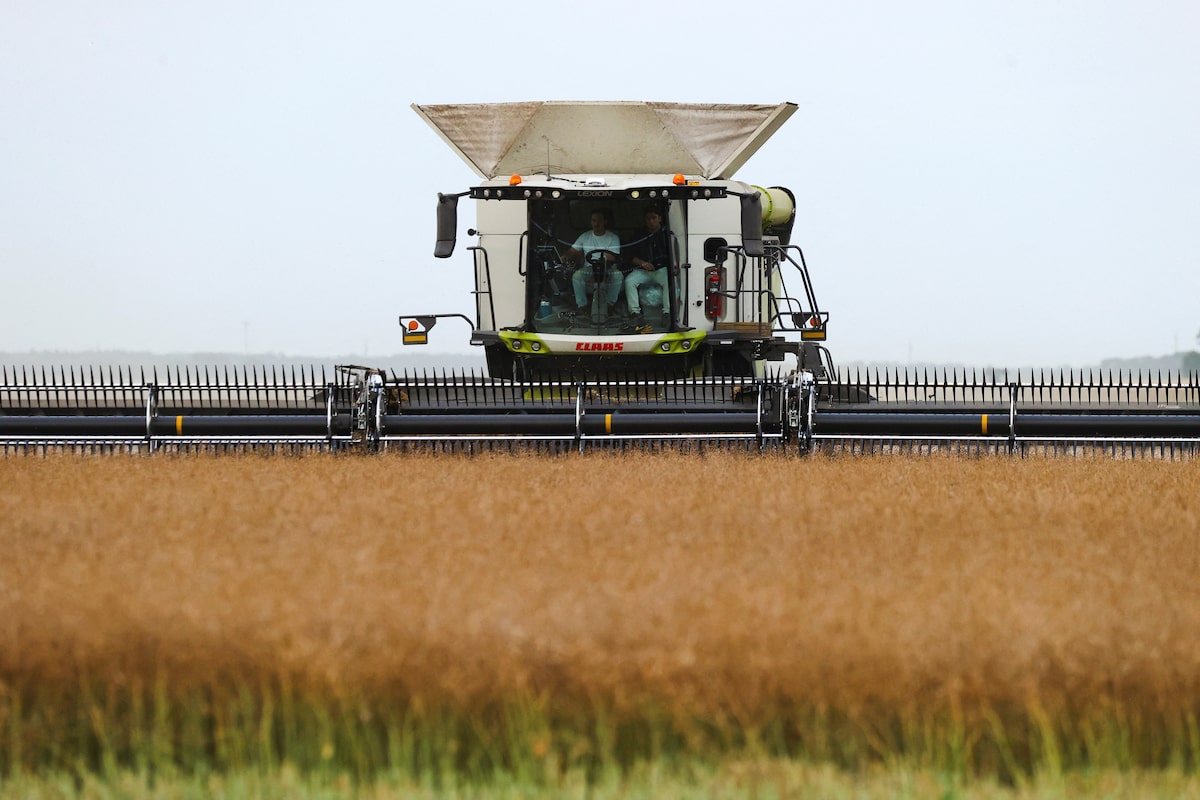
A combine harvester works as canola is harvested on a farm near Clandeboye, Man.Shannon Vanraes/Reuters
Talks on reducing Chinese tariffs on Canadian canola are productive and continuing, Foreign Affairs Minister Anita Anand said Wednesday, the first day of Prime Minister Mark Carney’s official visit to Beijing.
Mr. Carney, the first Canadian prime minister to visit China in eight years, arrived in Beijing Wednesday evening along with a delegation that includes Ms. Anand and four other cabinet ministers.
He is trying to repair ruptured relations with Beijing as he seeks to offset damage to the Canadian economy caused by U.S. President Donald Trump. Over the past decade, Western governments increasingly began treating Beijing as a rival rather than a partner, blocking investments from China in the name of national security.
Trump says USMCA ‘irrelevant’ as Canada attempts reset with China
A major irritant between Canada and China is the 100-per-cent tariffs Ottawa imposed on Chinese-made electric vehicles in 2024 and the retaliatory levies Beijing placed on Canadian canola, seafood and other agricultural products.
Asked whether she is optimistic about a deal that would reduce Chinese tariffs on canola, Ms. Anand said talks have been fruitful. “The conversation has been productive. The negotiations are still continuing,” the Foreign Affairs Minister told reporters. “We are here to represent all sectors of the Canadian economy, and the work continues over the next number of days.”
There are already signs the Canadian government under Mr. Carney is adjusting its behaviour to avoid upsetting Beijing.
Foreign Affairs Minister Anita Anand says Prime Minister Mark Carney’s trip to Beijing is about boosting trade and refreshing Canada’s relationship with China.
The Canadian Press
Ottawa’s official Indo-Pacific policy still calls China an “increasingly disruptive global power,” but in Beijing Wednesday, Ms. Anand appeared to back away from the statement when asked if it still stands.
“This is a new government with a new prime minister, a new foreign policy and a new geopolitical environment,” Ms. Anand told reporters. “In this moment of economic stress for our country, it is necessary for us to diversify our trading partners and to grow non-U.S. trade by at least 50 per cent over the next 10 years.”
The Foreign Minister stressed the need to shift trade away from the United States, which has grown more protectionist under Mr. Trump. Mr. Carney has set a 10-year goal for Canada to double non-U.S. trade, which would generate $300-billion more in annual exports.
Campbell Clark: Carney needs to be wary of the same old China ‘reset’ mirage
In another controversial development in Canada-China relations, two Liberal MPs this week, citing advice from the government, cut short a trip to Taiwan to avoid what they called “confusion with Canada’s foreign policy” as Mr. Carney visits Beijing.
China, which views Taiwan as a breakaway province, dislikes it when foreign politicians or government officials meet with Taiwanese officials, viewing it as interference in their domestic affairs. That includes the twice-yearly trips by Canadian parliamentarians, which are funded by Taiwan.
By cancelling the remainder of their Taiwan trip, the two Liberal MPs missed the part of the itinerary that involves meeting Taiwanese government officials, including President William Lai from the China-skeptical Democratic Progressive Party.
Mr. Carney is set to meet Chinese Premier Li Qiang on Thursday and Chinese President Xi Jinping Friday.
Opinion: Canada needs less confrontation with China and more trade
Canada faces pressure to keep speaking up for Taiwan, on Beijing’s quashing of civil liberties in Hong Kong and its mistreatment of the Uyghur minority.
“We will continue to have difficult conversations, to discuss human-rights issues. We will be at the table to have those conversations. At the same time, we must continue to build the Canadian economy,” Ms. Anand said.
As The Globe and Mail reported Tuesday, government officials have told the beleaguered canola industry that it should not expect the Prime Minister’s trip to China to result in the elimination of tariffs, and to prepare for reduced rates at best.
Over the past few weeks, federal officials have asked grain traders to identify acceptable tariff rates for canola products facing restrictions from Beijing.
The Prime Minister’s big ambition is not only boosting exports to China but attracting new capital to Canada, where foreign direct investment has slowed since Mr. Trump began talking of restricting Canadian access to the U.S. market.
Mr. Carney, who has vowed to build “resilience by diversifying abroad,” in November spoke of welcoming Chinese investment in the energy sector, including renewable energy and battery storage.