
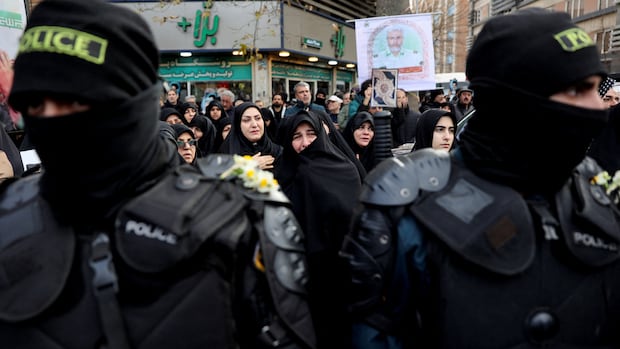
While airing video on Wednesday of large funeral processions for some of the people killed during the protests that have recently gripped the country, Iran’s state broadcaster blamed the U.S. for whipping up and leading the “terrorist actions.”
That’s the clerical regime’s official narrative, which it has been amplifying while ruthlessly trying to silence all other accounts of what’s happening.
This wave of demonstrations began on Dec. 28, when merchants at Tehran’s Grand Bazaar protested the country’s deepening economic crisis and the further drop of the currency, the rial, to a record low.
The unrest quickly spread across the country, as people fed up with years of repression and restrictions took to the streets.
WATCH | Iranians call for international support amid protest crackdowns: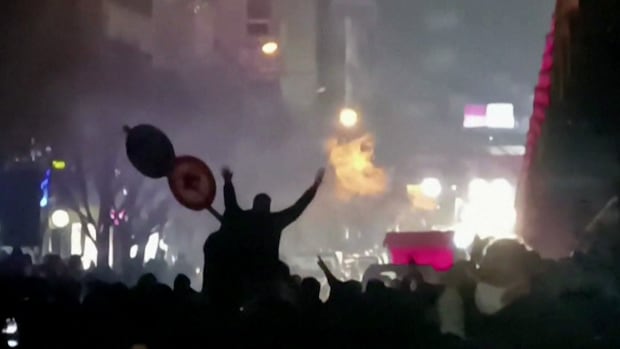
Iranians plead for international help as deaths climb above 2,000
The U.S. and Canada are urging their citizens to leave Iran immediately as Iranians send urgent pleas for help and describe the violence inflicted by security forces. Meanwhile, the number of those killed during ongoing protests has surpassed 2,000, according to human rights groups.
For nearly a week, most of Iran’s 90 million citizens have been cut off from the internet and prevented in many cases from connecting with family and friends both inside and outside Iran.
“The signals were cut as the protests began and citizens were suddenly paralyzed,” wrote a 22-year-old man in a message to CBC News. “Communication is still extremely difficult. SMS (messaging) is down.”
CBC is not identifying the man because, like others, he is concerned about potentially severe repercussions from the Iranian regime.
Over the past two days, with the help of an Iranian journalist living in Europe, CBC has been able to connect with three individuals in Iran on the social messaging platform Telegram.
All three answered questions about the protests and the level of violence, as well as U.S. President Donald Trump’s threats to intervene because of the brutal crackdown on protesters.
The U.S.-based human rights group HRANA says it has verified more than 2,500 deaths.
“I personally witnessed gunfire and attacks … tear gas, sound bombs or flares, live ammunition and pellet guns,” said the 22-year-old, who is in the southern Iranian city of Bandar Abbas, which lies on the Strait of Hormuz.
“I witnessed the confirmed death of at least one person right next to me. The body was taken away by the repression forces.”
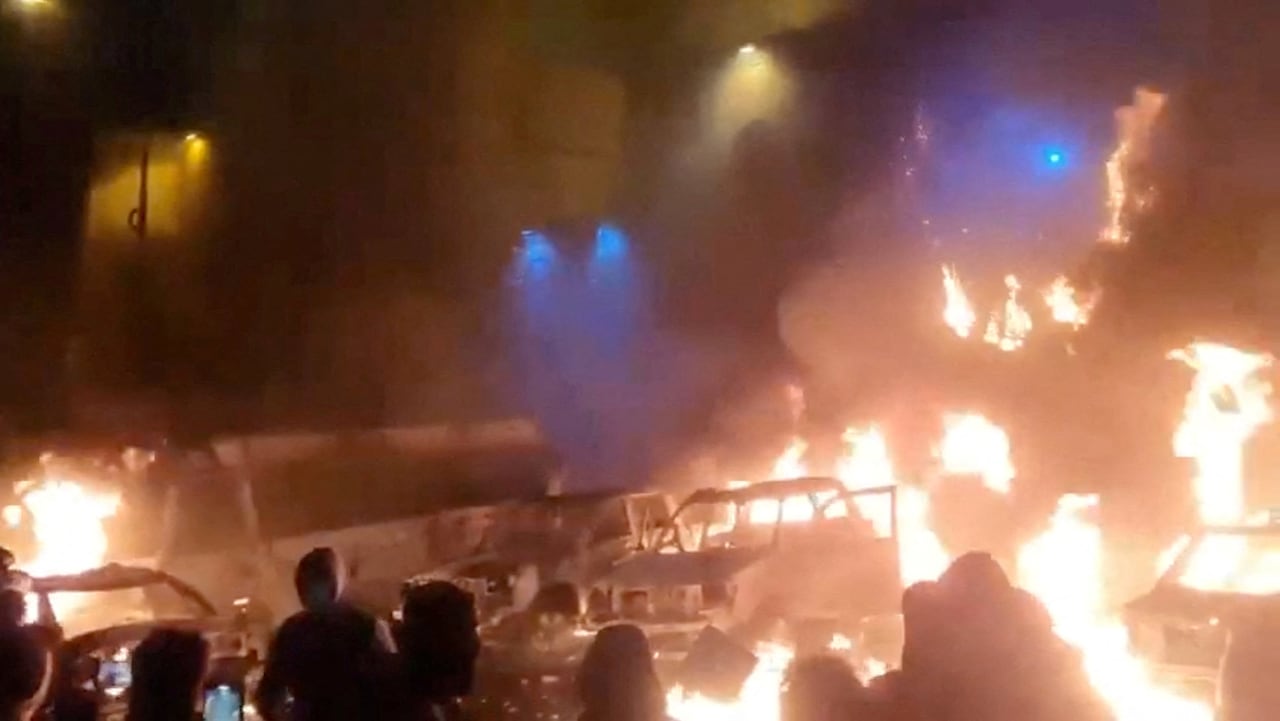 In this screen grab obtained from a social media video released on Jan. 9, protesters gather as vehicles burn in the Iranian capital, Tehran. (Reuters)Thousands killed, even more arrested
In addition to those who have been killed, human rights groups estimate that thousands have been arrested during the protests. Iran’s judicial chief has vowed swift justice.
The 22-year-old said that security forces used motorcycles, armoured vehicles and water cannons to try to push demonstrators back.
He said one of his friends was hit by several pellets at a protest and that he knew of numerous people who were injured in the eyes and face by projectiles.
The man described the protests as unprecedented, even compared to previous uprisings, such as the 2022 demonstrations sparked by the death of 22-year-old Mahsa Amini in police custody.
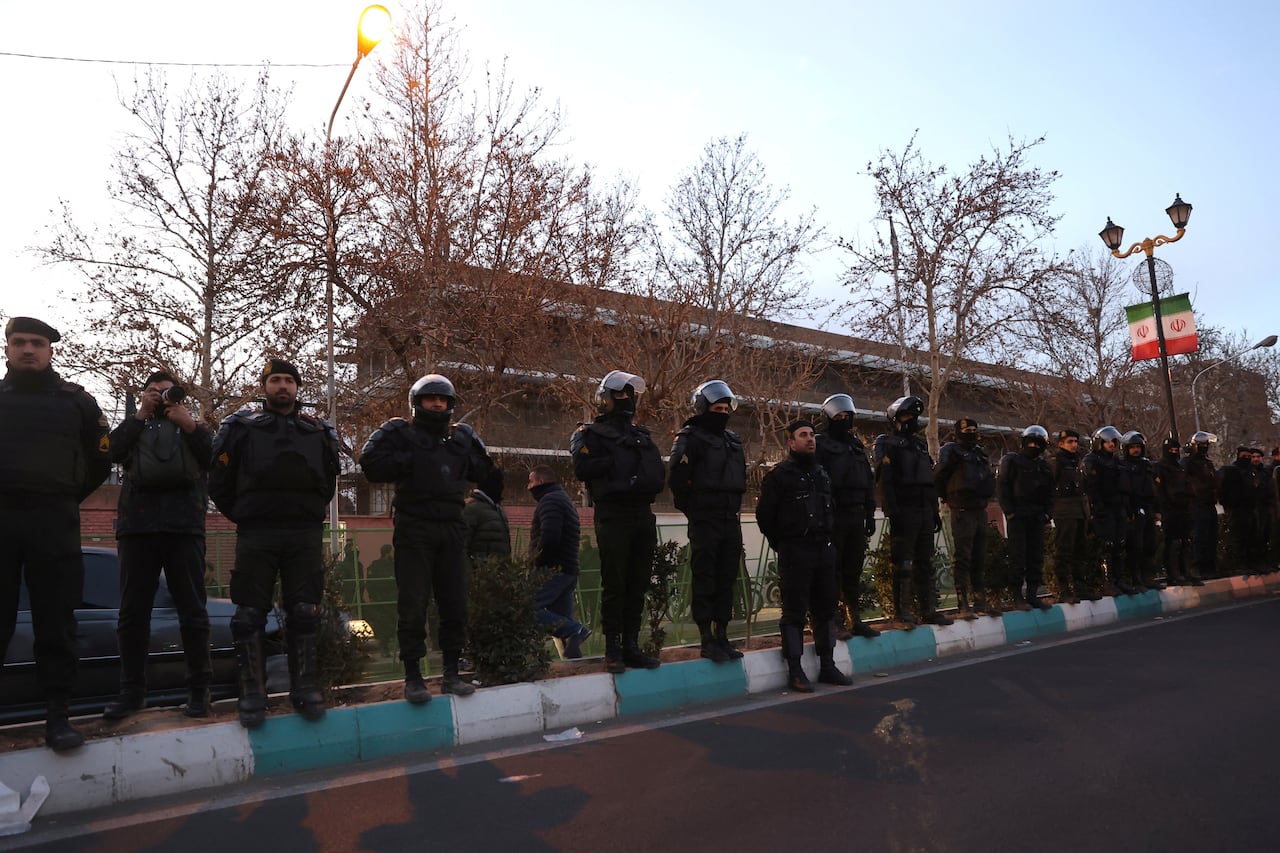 Members of the Iranian police stand guard in front of the British embassy following anti-government protests in Tehran on Jan. 14. (Majid Asgaripour/West Asia News Agency/Reuters)
That’s because several “different segments of society” have taken to the streets and banks and government facilities were burned. A CCTV video verified by Reuters and posted on social media last week showed footage of a mosque in Tehran being vandalized.
In the central Iranian city of Isfahan, a man told CBC the situation was so tense, even grocery stores didn’t “dare to open.”
He said after an office belonging to a subsidiary of Iran’s state broadcaster was set on fire on Jan. 9, pickup trucks arrived mounted with heavy machine guns. The guns were fired into the air to disperse the crowd.
“There were fatalities, but the numbers are very unclear,” he said of that particular incident.
Starlink banned
Iranians told CBC that it has been impossible to talk to people outside of the country unless you have access to a Starlink satellite internet system, which was formally banned in June, after the 12-day war between Israel and Iran.
Earlier this week, President Trump mused about sending Iran more of the systems. On Wednesday, Iran’s intelligence services said they confiscated a large shipment of Starlink kits in one of the country’s border areas.
WATCH | The role of the son of Iran’s last shah in the protests: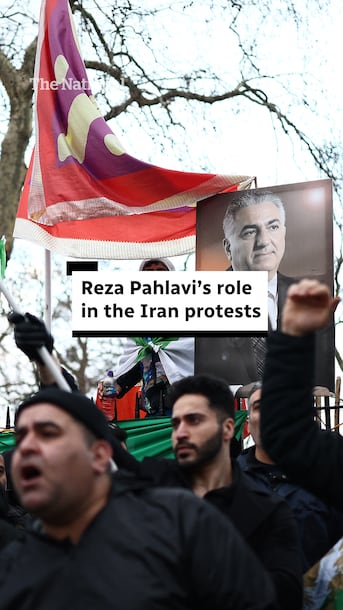
Reza Pahlavi’s role in the Iran protests
Reza Pahlavi is the son of the last shah of Iran. For The National, CBC’s Ashley Fraser breaks down the exiled crown prince’s role in the current anti-government protest in the country and why he remains a divisive figure.
Human rights groups reported that security forces had started seizing satellite dishes, in what is seen as an attempt to restrict access to foreign TV channels.
Awyar Shekhi, who is with the Norway-based Iranian Kurdish rights group Hengaw, said over the past two days, some people inside Iran were able to call out, but that calls into the country wouldn’t connect.
When she spoke with CBC by Zoom around 8 a.m. ET on Wednesday, she said Hengaw had not yet been able to connect with any of his sources on the ground that day.
Trump threats
In a defiant address delivered on Jan. 9, Iran’s Supreme Leader Ayatollah Ali Khamenei called the protesters troublemakers who were trying to please the U.S. president.
Trump has threatened to punish the long-ruling regime for using violence against demonstrators. He told Iranians to keep protesting, saying that “help is on the way,” without specifying what kind of response he is considering.
“Some think Trump won’t do anything. Some are upset with him, asking why he spoke if he didn’t intend to act,” wrote the 22-year-old from Bandar Abbas.
“People hope that the repressors, commanders and key figures of the Islamic regime will be targeted by drones and missiles.”
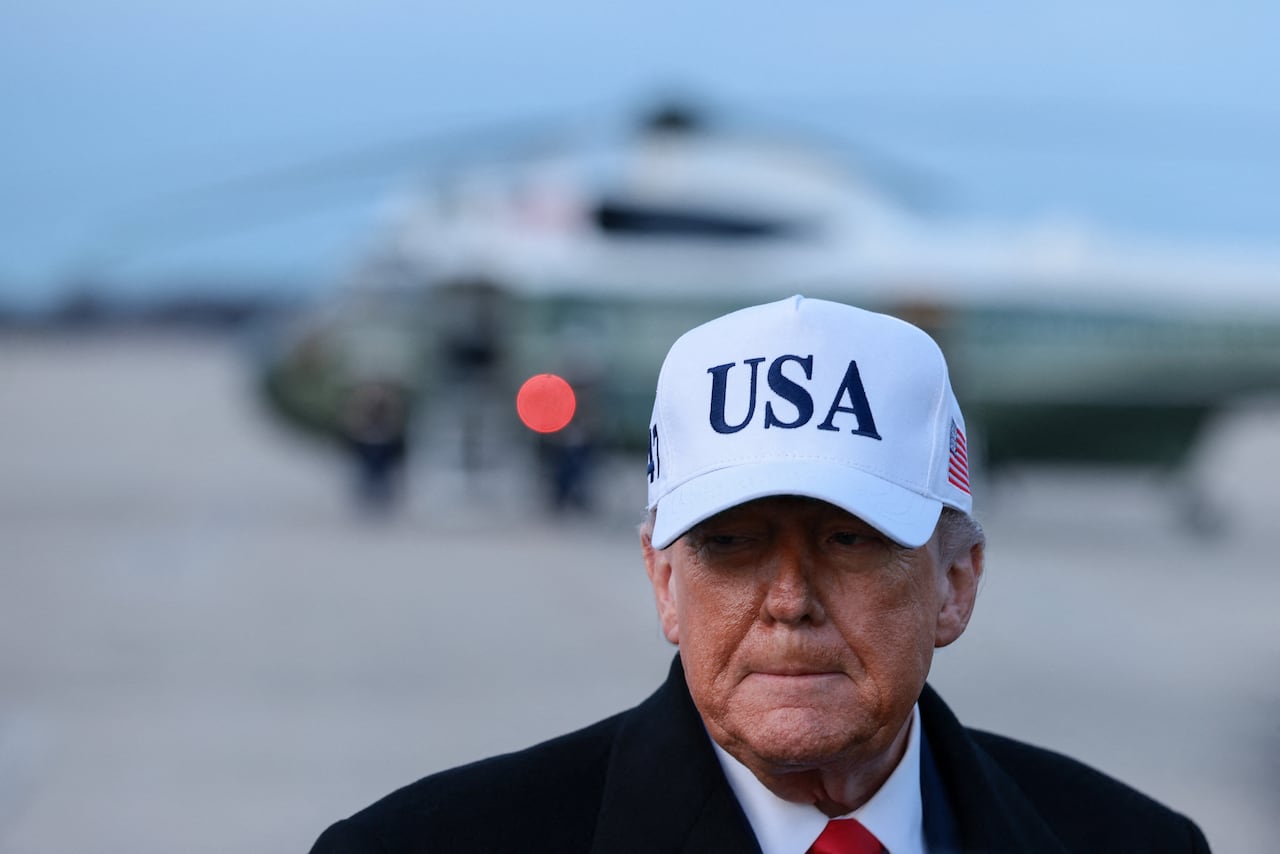 U.S. President Donald Trump is seen at Joint Base Andrews, Maryland, on Jan. 13, 2026. (Evelyn Hockstein/Reuters)
He hopes mounting international pressure leads to the regime’s demise, but others feel it is nowhere close to collapsing.
“These people are not going to disappear so easily,” said a 47-year-old living in Tehran in a voice message sent through Telegram. “This system is far more brutal, more complex and far more professional.”
He said security forces, including those in plain clothes, are on the streets, and public fear is pervasive. He notes that when he and others talk on the phone within Iran, they choose to temper their language, in case someone is listening.
There is widespread anxiety and anticipation about what could come next. He said people are hoping an outside power, potentially Trump, can help force a revolution.
“It is as if people are waiting for a saviour,” the man said.
In the northern part of the capital where he lives, he said people are still taking to the streets nightly, but are now mostly chanting broader slogans about change.
“I think people have pulled back for now because of the killings,” he said. “They are absorbing the shock, regrouping and then they will strike again.”